Florida B.E.S.T. MA.912.FL.3.4
The Standard
Explain the relationship between simple interest and linear growth. Explain the relationship between compound interest and exponential growth and the relationship between continuously compounded interest and exponential growth.
Florida B.E.S.T. Standards for Mathematics
Teacher's field guide
What This Standard Means
What Students Need to Do
- Students use tables, graphs, and formulas to connect simple interest with linear growth. They connect compound and continuously compounded interest with exponential growth. They explain how rate, compounding frequency, and time change a balance or total cost.
What Mastery Looks Like
- A student can identify an interest model as linear or exponential from a formula, table, graph, or situation. They can calculate balances and explain why compounding produces accelerating growth while simple interest adds a fixed amount. They can compare how each model affects long-term costs or savings.
Common Misconceptions
- Students often treat compound interest as adding the same dollar amount each period. They may enter a percent as a whole number or mix annual and monthly periods. Some think continuous compounding means unlimited growth rather than growth modeled with e.
How to Assess It
- Exit ticket: A $1,000 account earns 6% for five years. Find the balance with simple, annual compound, and continuous compound interest, then label each model linear or exponential.
Lesson moves
Ways to Teach It
Give groups 20 counters, then have them model five periods of adding 5 counters versus increasing the pile by 25%.
Ask students to explain why the same principal, rate, and time produce different balances under simple, annual compound, and continuous compound interest.
Run a card sort matching interest formulas, tables, graphs, and account stories, then have pairs defend one disputed match.
Compare two bank offers with stated annual rates and compounding schedules, then calculate which gives a $2,000 deposit more after five years.
Free download
Printable MA.912.FL.3.4 Worksheet
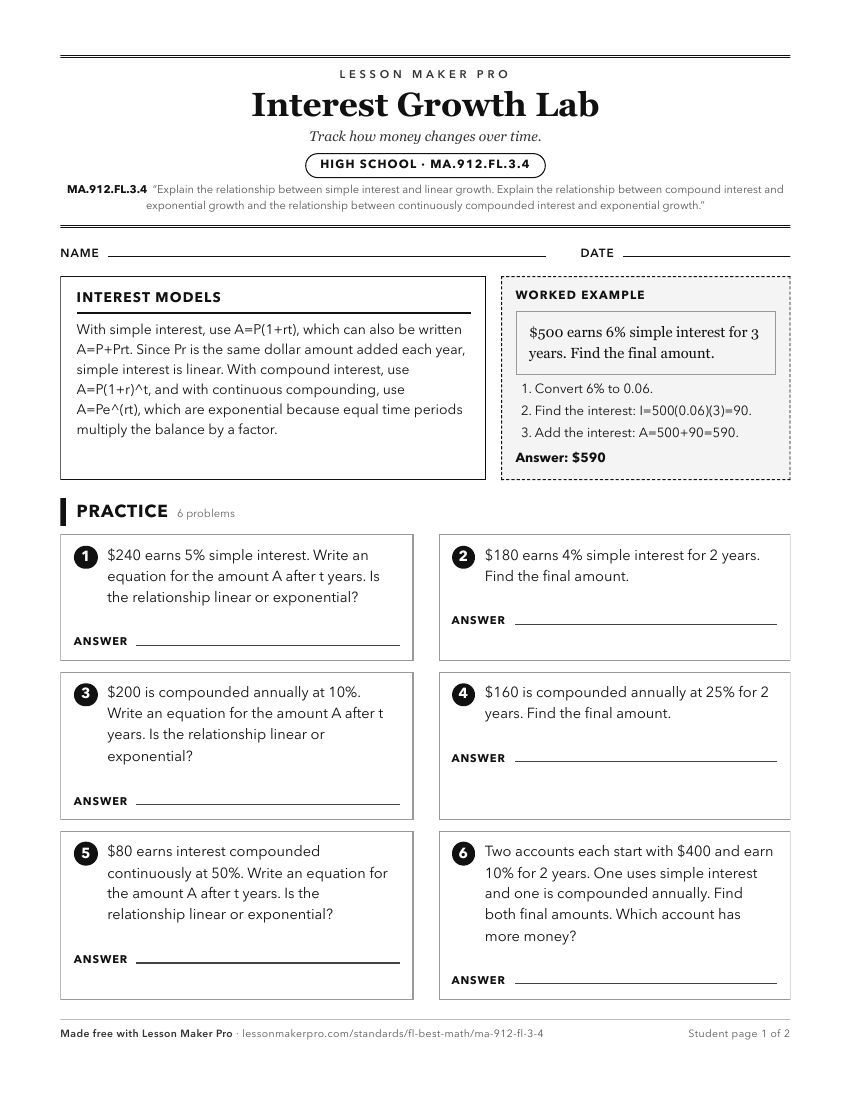
A ready-to-print activity worksheet aligned to MA.912.FL.3.4, with an answer key for the teacher on its own page. No account needed.
PDF, US Letter, prints cleanly in black and white.
Download the worksheetKeep exploring
Related Standards
- MA.912.AR.5.4
Write an exponential function to represent a relationship between two quantities from a graph, a written description or a table of values within a mathematical ...
- MA.912.FL.3.2
Solve real-world problems involving simple, compound and continuously compounded interest.
- MA.912.AR.5.3
Given a mathematical or real-world context, classify an exponential function as representing growth or decay.
- MA.912.FL.3.1
Compare simple, compound and continuously compounded interest over time.
Turn this exact standard into a lesson
Grade, subject, topic, and the complete standard are prefilled. Create one free, no account needed.
Also for this standard:Make a WorksheetMake a QuizMake a Sub Lesson