Florida B.E.S.T. MA.912.FL.3.3
The Standard
Solve real-world problems involving present value and future value of money
Florida B.E.S.T. Standards for Mathematics
Teacher's field guide
What This Standard Means
What Students Need to Do
- Students calculate how money grows over time and how much money must be invested now to reach a future amount. They use interest rates, time, and compounding frequency in real financial situations.
What Mastery Looks Like
- Students correctly identify the principal, rate, time, and number of compounding periods. They calculate present or future value, round money correctly, and explain what the result means.
Common Misconceptions
- Students may treat the annual rate as the rate for every compounding period. They may confuse present value with future value or use years instead of total compounding periods.
How to Assess It
- Exit ticket: An account earns 4.8% compounded monthly. Find the future value of $3,000 after four years and the deposit needed today for $5,000 in four years.
Lesson moves
Ways to Teach It
Give pairs rate, time, and deposit cards to match, then have them calculate each investment’s future value with a calculator.
Ask students to write which is better: receiving $8,000 now or $10,000 in five years, using a given investment rate.
Run a calculator relay where teams solve present-value and future-value cards, then check answers at a posted answer station.
Compare two real savings account offers and calculate how much a $2,000 deposit would be worth after three years.
Free download
Printable MA.912.FL.3.3 Worksheet
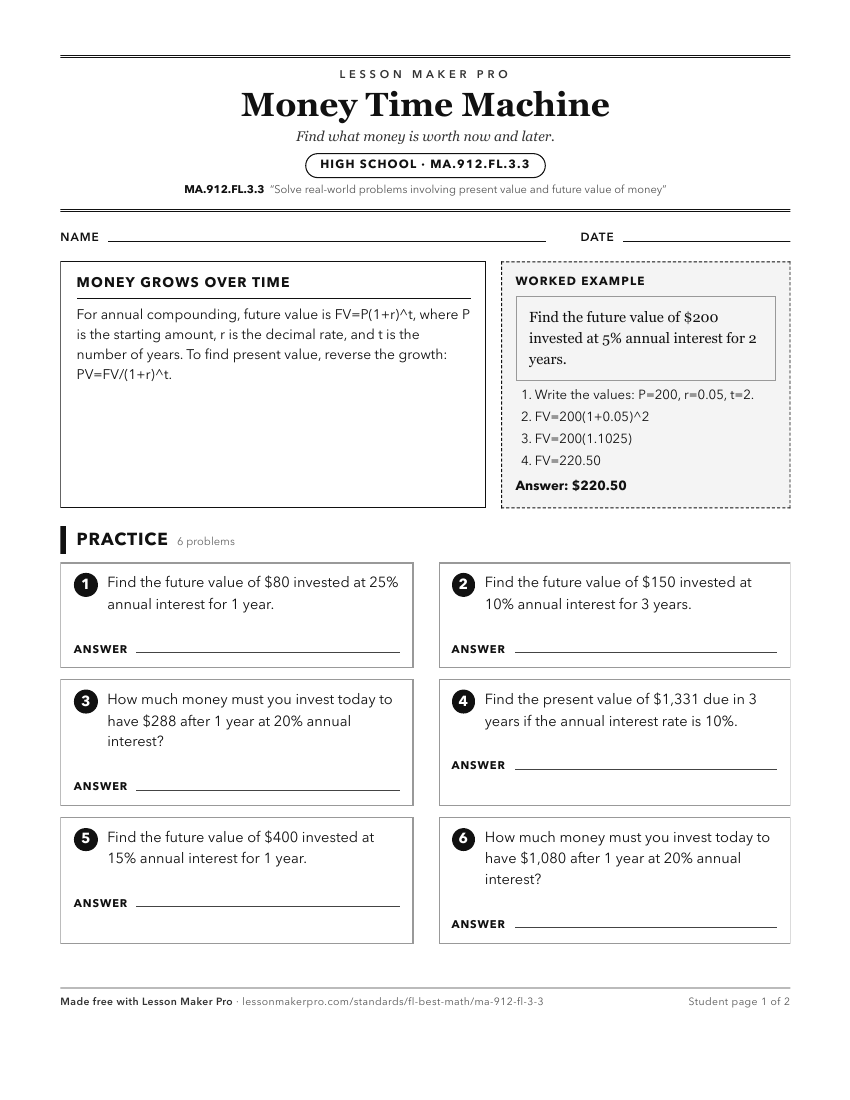
A ready-to-print activity worksheet aligned to MA.912.FL.3.3, with an answer key for the teacher on its own page. No account needed.
PDF, US Letter, prints cleanly in black and white.
Download the worksheetKeep exploring
Related Standards
Turn this exact standard into a lesson
Grade, subject, topic, and the complete standard are prefilled. Create one free, no account needed.
Also for this standard:Make a WorksheetMake a QuizMake a Sub Lesson