Florida B.E.S.T. MA.912.AR.10
B.E.S.T. Standard (Benchmark Cluster)
Solve problems involving sequences and series.
Florida B.E.S.T. Standards for Mathematics
Cluster contents
Benchmarks in This Standard
MA.912.AR.10 is a B.E.S.T. standard. These are the benchmarks under it.
- MA.912.AR.10.1
Given a mathematical or real-world context, write and solve problems involving arithmetic sequences.
- MA.912.AR.10.2
Given a mathematical or real-world context, write and solve problems involving geometric sequences.
- MA.912.AR.10.3
Recognize and apply the formula for the sum of a finite arithmetic series to solve mathematical and real-world problems.
- MA.912.AR.10.4
Recognize and apply the formula for the sum of a finite or an infinite geometric series to solve mathematical and real-world problems.
- MA.912.AR.10.5
Given a mathematical or real-world context, write a sequence using function notation, defined explicitly or recursively, to represent relationships between quan...
- MA.912.AR.10.6
Given a mathematical or real-world context, find the domain of a given sequence defined recursively or explicitly.
Teacher's field guide
What This Cluster Means
What Students Need to Do
- Students identify arithmetic and geometric patterns from lists, tables, formulas, or situations. They write recursive and explicit rules, then find requested terms and finite sums. For infinite geometric series, they decide whether a sum exists and calculate it when it does.
What Mastery Looks Like
- A student can classify a pattern and write an explicit or recursive rule. They accurately find requested terms, finite sums, and infinite geometric sums when the ratio allows one. Their answers fit the given context and include units when needed.
Common Misconceptions
- Students may mix up a sequence, which lists terms, with a series, which adds them. They may use a common difference for a geometric pattern or choose the wrong sum formula. They may also miscount term positions or assume every infinite geometric series has a finite sum.
How to Assess It
- Give this exit ticket: “For 5, 9, 13, ... and 81, 27, 9, ..., classify each, write an explicit rule, and find each six-term sum. Which related infinite series has a finite sum?”
Lesson moves
Ways to Teach It
Build growing figures with square tiles, record each stage, write a term rule, and find the total tiles used through stage ten.
Ask, “Why can an infinite geometric series have a finite sum?” Students explain using 1/2 + 1/4 + 1/8 + ....
Use a card sort matching term lists, tables, recursive rules, explicit rules, and sums for arithmetic and geometric patterns.
Model a ball dropped from 2 meters with a 70 percent rebound, then calculate its total vertical distance over infinitely many bounces.
Free download
Printable MA.912.AR.10 Worksheet
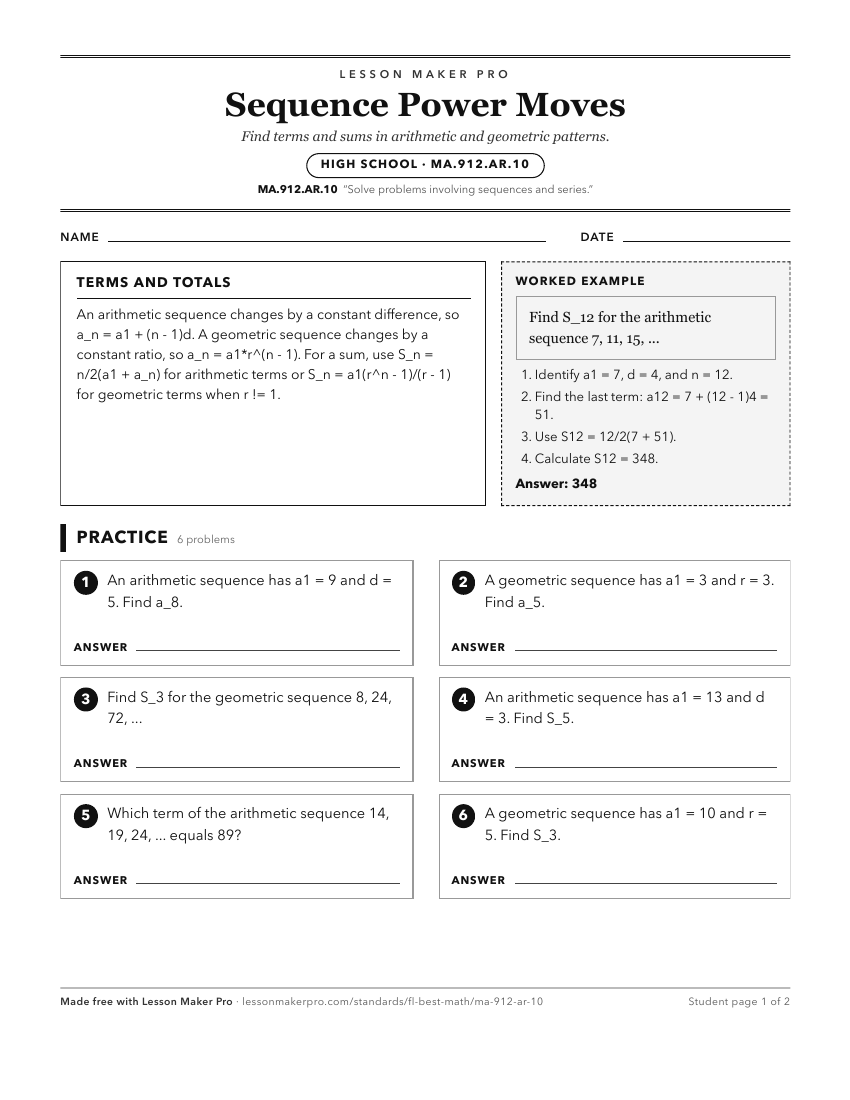
A ready-to-print activity worksheet aligned to MA.912.AR.10, with an answer key for the teacher on its own page. No account needed.
PDF, US Letter, prints cleanly in black and white.
Download the worksheetKeep exploring
Related Standards
Turn this cluster into a lesson
Grade, subject, topic, and the complete cluster are prefilled. Create one free, no account needed.
Also for this cluster:Make a WorksheetMake a QuizMake a Sub Lesson