Florida B.E.S.T. MA.6.AR.3
B.E.S.T. Standard (Benchmark Cluster)
Understand ratio and unit rate concepts and use them to solve problems.
Florida B.E.S.T. Standards for Mathematics
Cluster contents
Benchmarks in This Standard
MA.6.AR.3 is a B.E.S.T. standard. These are the benchmarks under it.
- MA.6.AR.3.1
Given a real-world context, write and interpret ratios to show the relative sizes of two quantities using appropriate notation: a/b, a to b, or a:b where b ≠ 0.
- MA.6.AR.3.2
Given a real-world context, determine a rate for a ratio of quantities with different units. Calculate and interpret the corresponding unit rate.
- MA.6.AR.3.3
Extend previous understanding of fractions and numerical patterns to generate or complete a two- or three-column table to display equivalent part-to-part ratios...
- MA.6.AR.3.4
Apply ratio relationships to solve mathematical and real-world problems involving percentages using the relationship between two quantities.
- MA.6.AR.3.5
Solve mathematical and real-world problems involving ratios, rates and unit rates, including comparisons, mixtures, ratios of lengths and conversions within the...
Teacher's field guide
What This Cluster Means
What Students Need to Do
- Students compare two quantities, write equivalent ratios, and find the amount for one unit. They use tables, diagrams, and equations to solve missing-value and comparison problems.
What Mastery Looks Like
- Students label both quantities and units, then choose a table, diagram, or equation that fits the problem. They find equivalent ratios and unit rates accurately and explain what each number means.
Common Misconceptions
- Students may reverse the order of a ratio or compare quantities by subtraction instead of division. They may divide in the wrong order when finding a unit rate. Some use an additive pattern instead of scaling both quantities by the same factor.
How to Assess It
- Give this exit ticket: “Three notebooks cost $7.50. Find the cost per notebook and the cost of eight notebooks. Show your reasoning.”
Lesson moves
Ways to Teach It
Build bags with two red and three blue counters, then make equivalent batches and record each ratio in a table.
Ask, “Which is a better buy: six yogurts for $4.50 or ten for $7.00?” Students defend their choice with unit rates.
Play Ratio Match with cards showing equivalent tables, tape diagrams, equations, and unit rates; students collect matching sets.
Compare grocery shelf labels by calculating price per ounce for three cereal boxes and naming the best value.
Free download
Printable MA.6.AR.3 Worksheet
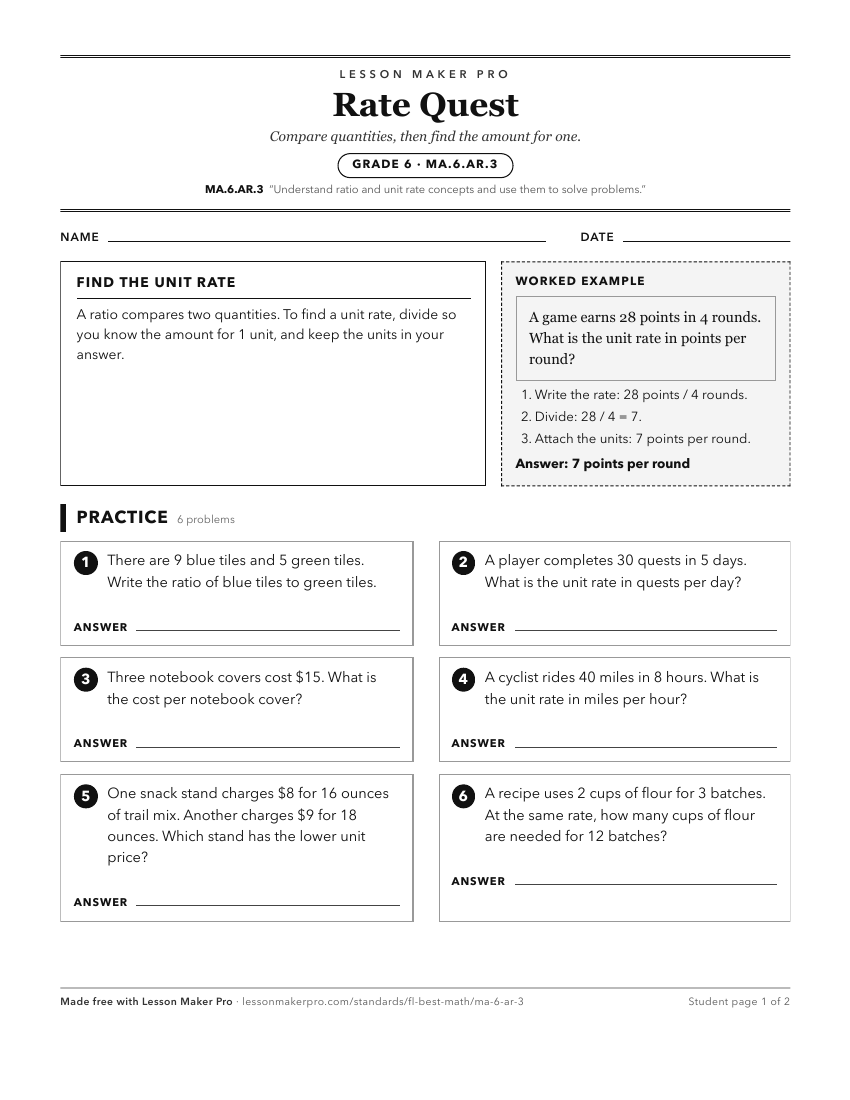
A ready-to-print activity worksheet aligned to MA.6.AR.3, with an answer key for the teacher on its own page. No account needed.
PDF, US Letter, prints cleanly in black and white.
Download the worksheetKeep exploring
Related Standards
Turn this cluster into a lesson
Grade, subject, topic, and the complete cluster are prefilled. Create one free, no account needed.
Also for this cluster:Make a WorksheetMake a QuizMake a Sub Lesson