Florida B.E.S.T. MA.6.AR.3.2
The Standard
Given a real-world context, determine a rate for a ratio of quantities with different units. Calculate and interpret the corresponding unit rate.
Florida B.E.S.T. Standards for Mathematics
Teacher's field guide
What This Standard Means
What Students Need to Do
- Students compare two quantities measured in different units, such as miles and hours or dollars and pounds. They divide to find the amount for one unit and explain its meaning in context.
What Mastery Looks Like
- Students correctly divide the quantities in the order required by the context. They label the unit rate, such as 30 miles per gallon, and explain what the number means.
Common Misconceptions
- Students may divide in the wrong order, such as finding gallons per mile when the question asks for miles per gallon. They may omit units or stop before making the second quantity equal to one. Some treat a rate and its unit rate as identical values.
How to Assess It
- Give this exit ticket: A car travels 180 miles on 6 gallons of gas. Write the rate, find the unit rate, and explain what it means.
Lesson moves
Ways to Teach It
Set out grocery packages with prices and amounts, then have pairs calculate unit prices and label each answer with dollars per item.
Ask students to compare 12 miles in 2 hours with 15 miles in 3 hours and defend which traveler is faster.
Use matching cards showing a situation, a rate, a unit rate, and its meaning; teams build correct sets.
Have students use a takeout menu to calculate cost per taco, slice, or ounce and choose the better buy.
Free download
Printable MA.6.AR.3.2 Worksheet
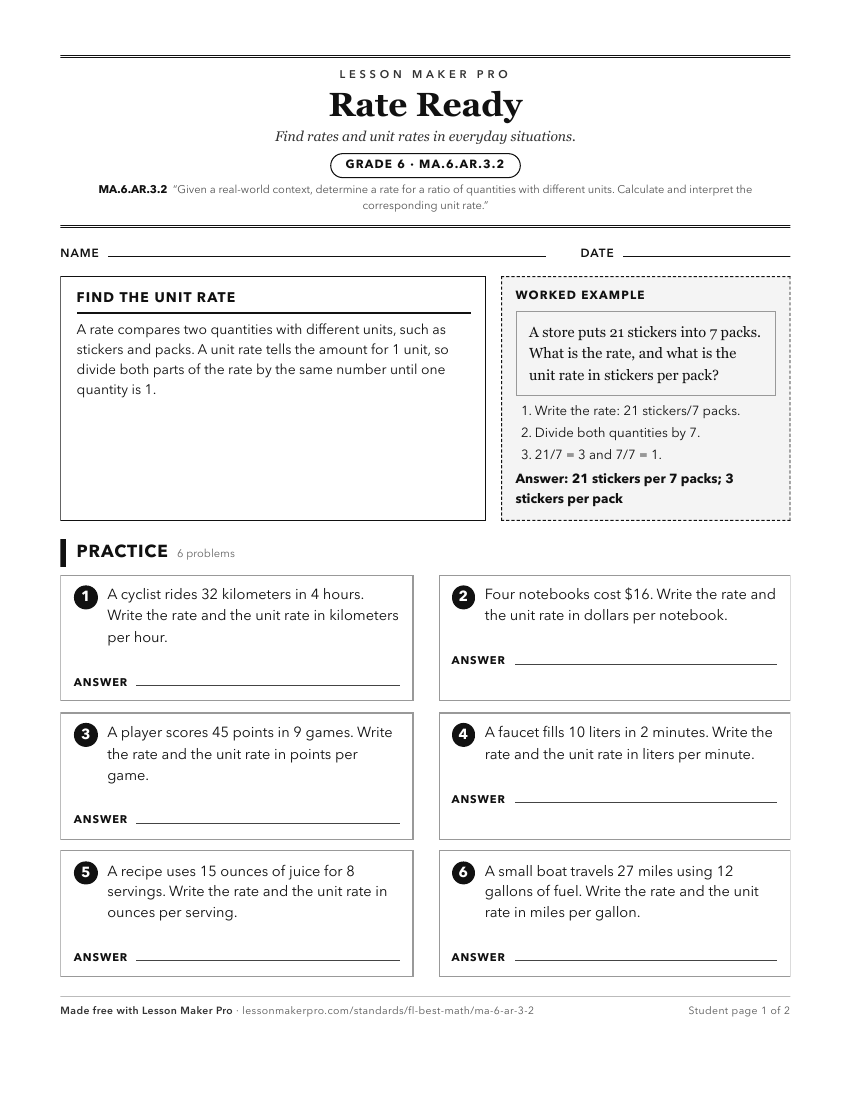
A ready-to-print activity worksheet aligned to MA.6.AR.3.2, with an answer key for the teacher on its own page. No account needed.
PDF, US Letter, prints cleanly in black and white.
Download the worksheetKeep exploring
Related Standards
- MA.7.AR.3.2
Apply previous understanding of ratios to solve real-world problems involving proportions.
- MA.6.AR.3.1
Given a real-world context, write and interpret ratios to show the relative sizes of two quantities using appropriate notation: a/b, a to b, or a:b where b ≠ 0.
- MA.6.AR.3.5
Solve mathematical and real-world problems involving ratios, rates and unit rates, including comparisons, mixtures, ratios of lengths and conversions within the...
- MA.6.AR.3
Understand ratio and unit rate concepts and use them to solve problems.
Turn this exact standard into a lesson
Grade, subject, topic, and the complete standard are prefilled. Create one free, no account needed.
Also for this standard:Make a WorksheetMake a QuizMake a Sub Lesson