Alabama Social Studies SS24.WH.18
Standard Cluster
Describe the interrelationship between people and the environment in the late twentieth and early twenty-first centuries. 18a Research major natural disasters and evaluate the effects of changes in weather, climate, and natural resource usage on regional identity. 18b Compare and contrast the current consumption of natural resources in various countries across the world. 18c Explain problems and opportunities involving science, technology, and worldwide communication, including the Internet, in the late twentieth and early twenty-first centuries.
2024 Alabama Course of Study: Social Studies
Cluster contents
Standards in This Cluster
SS24.WH.18 is a cluster heading. These are the individual standards under it.
- SS24.WH.18a
Research major natural disasters and evaluate the effects of changes in weather, climate, and natural resource usage on regional identity.
- SS24.WH.18b
Compare and contrast the current consumption of natural resources in various countries across the world.
- SS24.WH.18c
Explain problems and opportunities involving science, technology, and worldwide communication, including the Internet, in the late twentieth and early twenty-fi...
Teacher's field guide
What This Cluster Means
What Students Need to Do
- Students investigate natural disasters and explain how weather, climate, and resource use can change a region's jobs and identity. They compare countries' total and per-person resource use. They describe benefits and problems that come with scientific tools and worldwide online communication.
What Mastery Looks Like
- Using a Katrina flood map, a student can explain how displacement disrupted New Orleans neighborhoods and local traditions. They can rank countries by total and per-person energy use and explain why the rankings differ. They can explain how satellite forecasts and online alerts help during storms, while outages and false posts can block help.
Common Misconceptions
- Students may treat one hurricane as proof of a climate trend. They may confuse a country's total energy use with its use per person. They may assume everyone can get online alerts during a disaster, even when power or cell service fails.
How to Assess It
- Show a Katrina flood map and ask: "How could flooding change a New Orleans neighborhood's identity, and how might online alerts help or fail its residents?"
Lesson moves
Ways to Teach It
Use paper maps of New Orleans flood zones and Katrina evacuation routes; students mark flooded neighborhoods and write how displacement might affect local culture.
Ask: How could the Internet help people after a hurricane, and who might be left out without power or access?
Print two Our World in Data energy charts; teams rank three countries by total and per-person use, then explain the different rankings.
Read a city water conservation notice; students explain how shortages might change a local job or outdoor tradition.
Free download
Printable SS24.WH.18 Worksheet
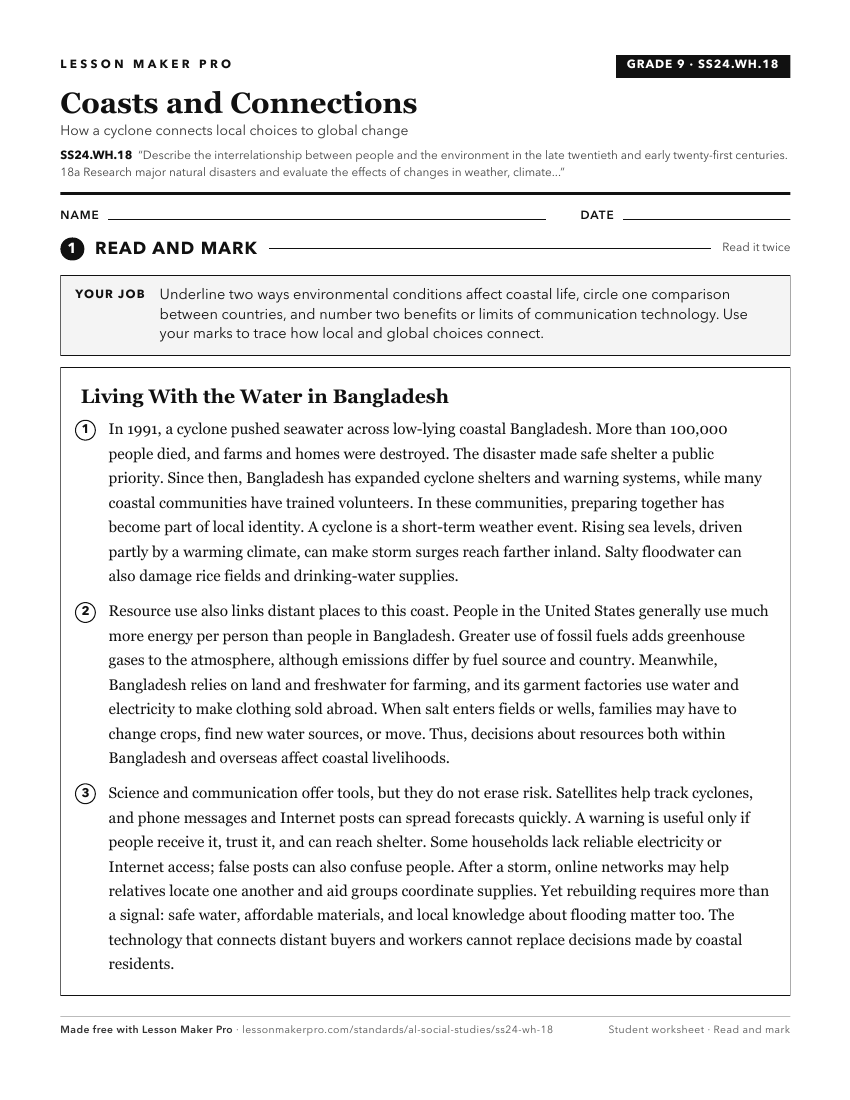
A ready-to-print activity worksheet aligned to SS24.WH.18, with an answer key for the teacher on its own page. No account needed.
PDF, US Letter, prints cleanly in black and white.
Download the worksheetKeep exploring
Related Standards
- SS24.US1.16
Describe the transformation of American society and politics during the late nineteenth and early twentieth centuries.
- SS24.US2.19a
Trace the evolution of the environmental movement and political debate over climate change from the 1980s to the present, including how environmental and natura...
- SS24.HG.12
Explain how interaction between people and the environment affects culture in today's society.
Turn this cluster into a lesson
Grade, subject, topic, and the complete cluster are prefilled. Create one free, no account needed.
Also for this cluster:Make a WorksheetMake a QuizMake a Sub Lesson