Alabama Social Studies SS24.USG.11
Standard Cluster
Analyze the electoral process, focusing on election laws and systems at the national, state, and local levels, and explain their constitutional underpinnings, practical implementation, and effects on voter participation and representation in democratic governance. 11b Outline how the Electoral College functions and explain how candidates must appeal to a wide variety of states and develop coalitions in order to secure the electoral votes required to win the presidency. 11b Evaluate the effects of reapportionment, redistricting, and gerrymandering on congressional elections.
2024 Alabama Course of Study: Social Studies
Cluster contents
Standards in This Cluster
SS24.USG.11 is a cluster heading. These are the individual standards under it.
Teacher's field guide
What This Cluster Means
What Students Need to Do
- Students explain how constitutional rules, state laws, and local election offices shape voting and turnout. They build a path to 270 electoral votes using states with different populations. They use census counts and district maps to explain changes in House seats and representation.
What Mastery Looks Like
- Given a state vote map, a student can total electoral votes and explain why a candidate needs support from several states. Given census counts and two district maps, they can tell whether a change is reapportionment or redistricting and explain who benefits. They can distinguish constitutional rules from rules set by states and carried out by local officials.
Common Misconceptions
- Students may think the national popular vote alone decides the presidency, or that every state awards electors the same way. They often confuse reapportionment, which moves House seats among states, with redistricting, which redraws lines within a state. They may call any oddly shaped district a gerrymander without checking how its lines affect voters.
How to Assess It
- Exit ticket: A state gains one House seat after the census, then redraws its districts. Name each process, state how many more electoral votes it gets, and explain one way the new district lines could affect representation.
Lesson moves
Ways to Teach It
Give pairs a 4-by-4 grid of red and blue voters; have them draw four equal-population districts and compare seat totals across maps.
Ask: Which three states should a presidential candidate visit next? Use an electoral vote map to explain how those visits build a coalition.
Play a 270-vote card game: teams draw state cards, total electoral votes, and trade cards to build different winning coalitions.
Open your county election office's sample ballot and registration page; find one local race and the next registration deadline.
Free download
Printable SS24.USG.11 Worksheet
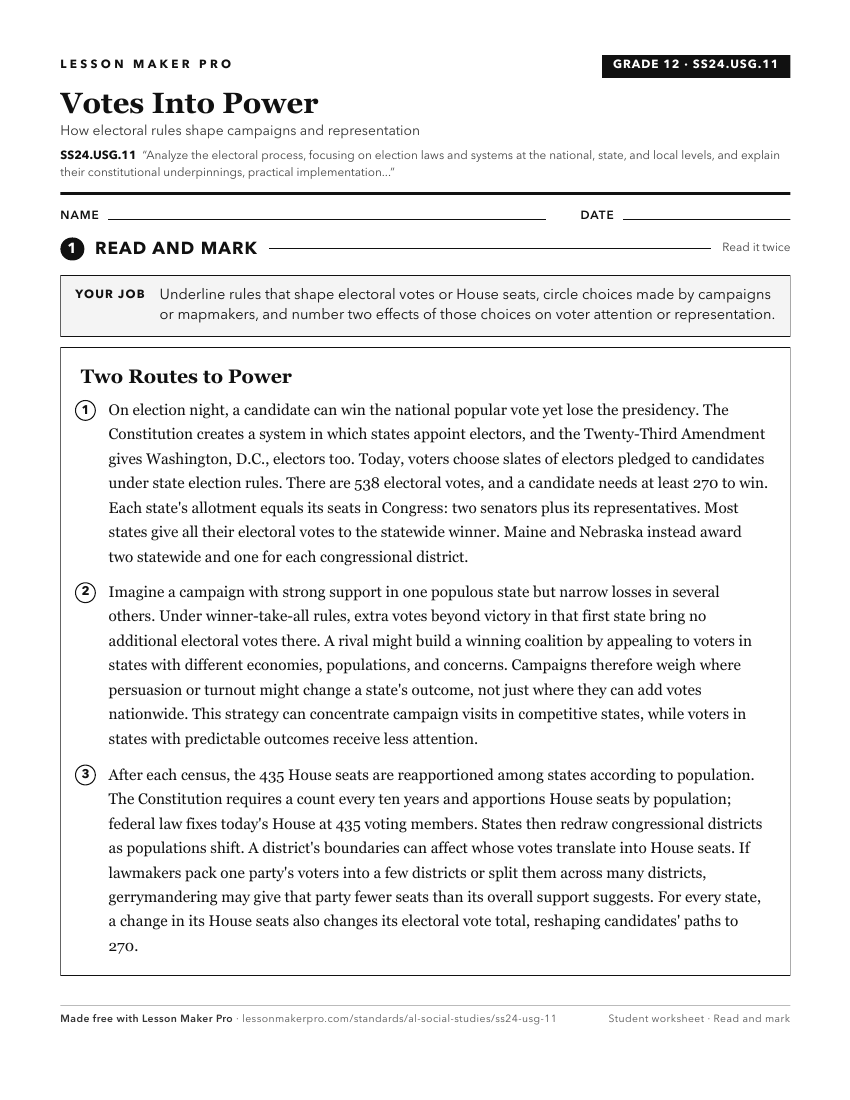
A ready-to-print activity worksheet aligned to SS24.USG.11, with an answer key for the teacher on its own page. No account needed.
PDF, US Letter, prints cleanly in black and white.
Download the worksheetKeep exploring
Related Standards
- SS24.6.13c
Analyze key elements of the Constitution that deal with citizenship and civic participation, including the path to citizenship and the process for amending the ...
- SS24.6.18
Analyze how an individual’s civic participation can influence government, politics, and society.
- SS24.USG.7c
Analyze historic and current barriers to voting access and voter turnout, and weigh the benefits and consequences of possible solutions.
Turn this cluster into a lesson
Grade, subject, topic, and the complete cluster are prefilled. Create one free, no account needed.
Also for this cluster:Make a WorksheetMake a QuizMake a Sub Lesson