Alabama Social Studies SS24.USG.11b
The Standard
- SS24.USG.11
- Analyze the electoral process, focusing on election laws and systems at the national, state, and local levels, and explain their constitutional underpinnings, practical implementation, and effects on voter participation and representation in democratic governance.
Evaluate the effects of reapportionment, redistricting, and gerrymandering on congressional elections.
2024 Alabama Course of Study: Social Studies
Teacher's field guide
What This Standard Means
What Students Need to Do
- Students explain how census counts can change a state's number of House seats. They compare district maps and identify how new boundaries can change election results. They explain how drawing lines to favor a party can affect representation.
What Mastery Looks Like
- A student can tell the difference between giving a state another seat and drawing its district lines. Given two maps of the same voters, they can show how packing one party's voters into a district could change the seats each party wins.
Common Misconceptions
- Students may think reapportionment redraws district lines, rather than changing how many seats states receive. They may assume equal-size districts are always fair, or that an oddly shaped district proves a map was drawn to favor a party.
How to Assess It
- Exit ticket: After a census, a state gains one House seat. A new map puts most Party A voters into one district. What did reapportionment change, what did redistricting change, and how might that district affect Party A's seat total?
Lesson moves
Ways to Teach It
Give pairs a 4-by-5 grid with 12 blue and 8 red voters; have them draw four connected, equal-size districts and count winners.
Show two maps of the same voter grid; ask, 'Which voters got packed together, and who benefits from that choice?'
Hand out cards labeled 'state gains a seat,' 'district line moves,' and 'party voters clustered'; have students sort and explain them.
Compare Texas's 2012 and 2022 House maps and seat totals; circle a changed boundary and predict who might benefit.
Free download
Printable SS24.USG.11b Worksheet
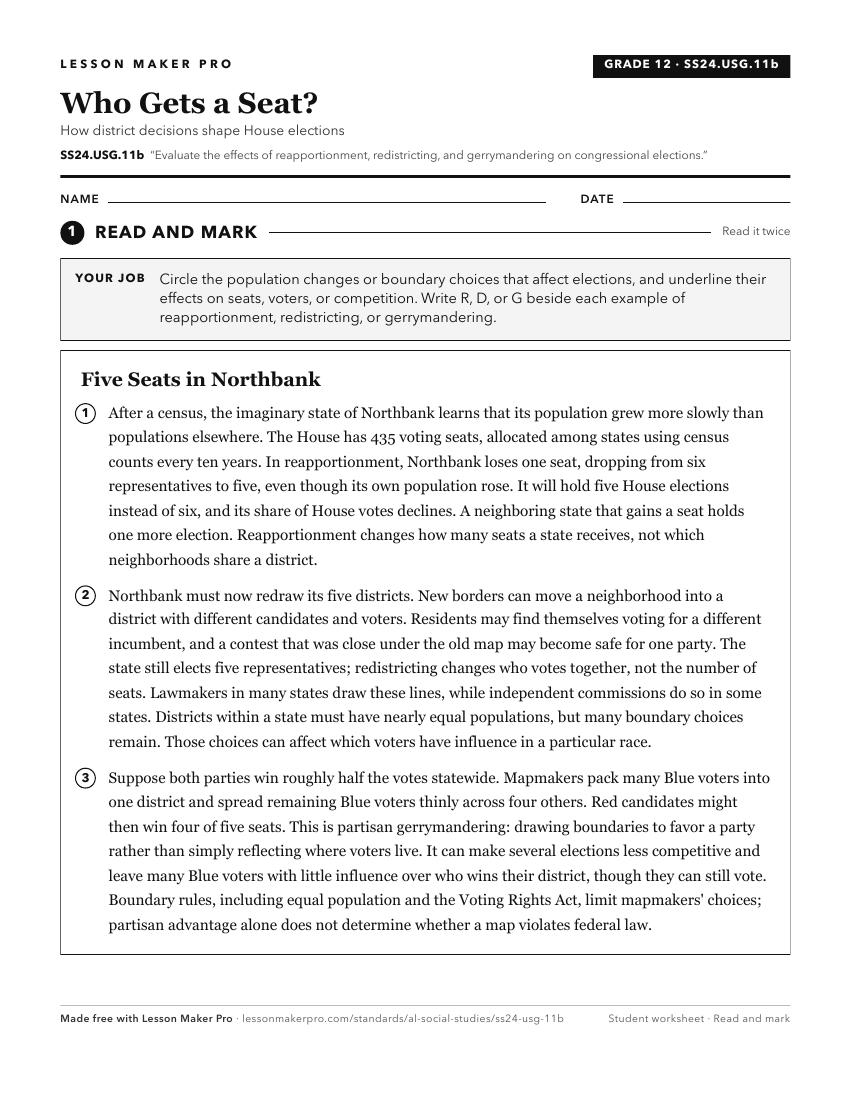
A ready-to-print activity worksheet aligned to SS24.USG.11b, with an answer key for the teacher on its own page. No account needed.
PDF, US Letter, prints cleanly in black and white.
Download the worksheetKeep exploring
Related Standards
- SS24.USG.7c
Analyze historic and current barriers to voting access and voter turnout, and weigh the benefits and consequences of possible solutions.
- SS24.USG.11
Analyze the electoral process, focusing on election laws and systems at the national, state, and local levels, and explain their constitutional underpinnings, p...
- SS24.US1.13b
Compare congressional and presidential Reconstruction plans, including the legislation and constitutional amendments each plan proposed and passed.
- SS24.USG.10b
Assess the impact of political parties on citizens and elected officials, including the increase of political polarization, rise of independent voters, and disi...
Turn this exact standard into a lesson
Grade, subject, topic, and the complete standard are prefilled. Create one free, no account needed.
Also for this standard:Make a WorksheetMake a QuizMake a Sub Lesson