Alabama Social Studies SS24.USG.10b
The Standard
- SS24.USG.10
- Outline major characteristics and functions of contemporary political parties in the United States, including the role of state and national conventions as well as party leadership.
Assess the impact of political parties on citizens and elected officials, including the increase of political polarization, rise of independent voters, and disillusionment with party systems.
2024 Alabama Course of Study: Social Studies
Teacher's field guide
What This Standard Means
What Students Need to Do
- Students examine polls on party identification and trust, along with lawmakers’ voting records. They explain how party ties can shape voters’ choices and elected officials’ decisions.
What Mastery Looks Like
- Students use numbers to describe changes in independent identification, party trust, and party-line voting. They explain a possible effect on voters and lawmakers without claiming the numbers prove what caused those changes.
Common Misconceptions
- Students may think independent voters never favor a party or cannot vote in any primary. They may assume every party-line vote proves polarization, or that people who distrust parties stop voting.
How to Assess It
- Give this exit ticket with mock data: independent identification rises from 30% to 40%, party trust falls from 50% to 35%, and party-line votes rise from 60% to 80%. Ask, “What might change for voters and lawmakers, and what can these numbers not prove?”
Lesson moves
Ways to Teach It
Give pairs six fictional lawmaker cards listing party, district views, and roll-call votes; have them sort party-line votes and flag votes against district views.
Ask: “Why might an independent voter favor one party’s candidates yet distrust both parties?”
Show teams three mini polls on party trust and independent identification; award points for accurate claims backed by a number.
Use your county’s sample ballot; have students mark partisan and nonpartisan races and discuss how labels might guide voters without revealing candidate positions.
Free download
Printable SS24.USG.10b Worksheet
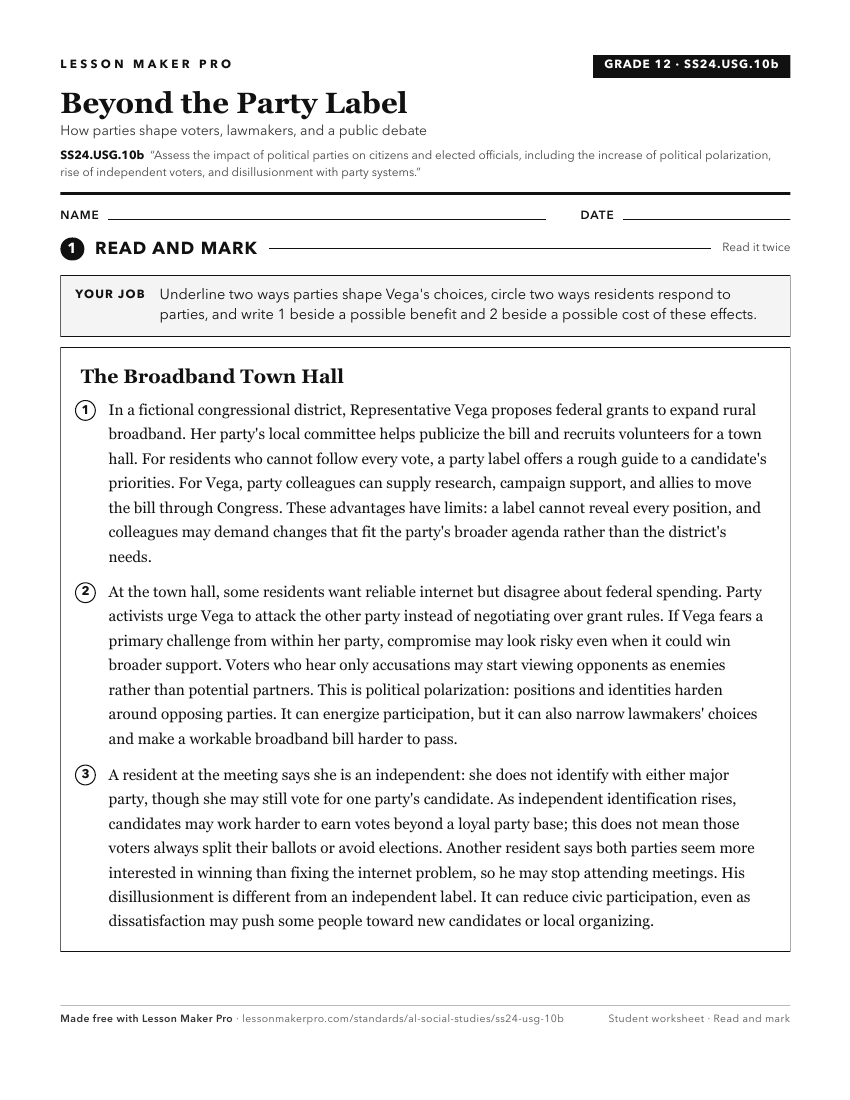
A ready-to-print activity worksheet aligned to SS24.USG.10b, with an answer key for the teacher on its own page. No account needed.
PDF, US Letter, prints cleanly in black and white.
Download the worksheetKeep exploring
Related Standards
- SS24.USG.7c
Analyze historic and current barriers to voting access and voter turnout, and weigh the benefits and consequences of possible solutions.
- SS24.US2.20a
Assess how political events beginning with the Clinton presidency and into the early 2000s contributed to growing political polarization.
- SS24.USG.7a
Explain how increases and shifts in political participation by minorities and other voting blocs shape political party coalitions, campaigns, and voter turnout.
- SS24.USG.10
Outline major characteristics and functions of contemporary political parties in the United States, including the role of state and national conventions as well...
Turn this exact standard into a lesson
Grade, subject, topic, and the complete standard are prefilled. Create one free, no account needed.
Also for this standard:Make a WorksheetMake a QuizMake a Sub Lesson