Alabama Social Studies SS24.USG.10
Standard Cluster
Outline major characteristics and functions of contemporary political parties in the United States, including the role of state and national conventions as well as party leadership. 10a Describe how third-party candidates have historically affected elections in the United States, and evaluate the arguments for and against their inclusion in contemporary elections. 10b Assess the impact of political parties on citizens and elected officials, including the increase of political polarization, rise of independent voters, and disillusionment with party systems.
2024 Alabama Course of Study: Social Studies
Cluster contents
Standards in This Cluster
SS24.USG.10 is a cluster heading. These are the individual standards under it.
- SS24.USG.10a
Describe how third-party candidates have historically affected elections in the United States, and evaluate the arguments for and against their inclusion in con...
- SS24.USG.10b
Assess the impact of political parties on citizens and elected officials, including the increase of political polarization, rise of independent voters, and disi...
Teacher's field guide
What This Cluster Means
What Students Need to Do
- Students explain what state and national conventions do and how party leaders support candidates. They use past elections to explain how third-party candidates can affect results and weigh arguments for including them. They examine how party loyalty and polarization affect voters and elected officials.
What Mastery Looks Like
- A student can match delegate selection, presidential nomination, and fundraising to the party groups responsible. They can use the 1912 election to explain both the choice Roosevelt offered voters and the risk of splitting votes, without claiming his run alone decided the result. They can explain why a voter might identify as independent and how party pressure can shape a lawmaker's vote.
Common Misconceptions
- Students may think a state convention formally nominates the presidential candidate, rather than the national convention. They may assume every third-party voter would otherwise choose the same major-party candidate. They may mistake independent identification for political apathy or think party leaders can order lawmakers' votes.
How to Assess It
- Exit ticket: Wilson won 42% of the vote in 1912, Roosevelt 27%, and Taft 23%; name one job each for a state convention, national convention, and party chair, then give one benefit and one risk of Roosevelt's run.
Lesson moves
Ways to Teach It
Sort cards for selecting delegates, nominating a president, and raising funds under state convention, national convention, or party chair.
Show 1912 vote totals and ask students to argue whether Roosevelt's run increased voter choice or risked splitting votes.
Give pairs six mock voter cards with party labels and ballots; they tally party-line voting and test whether independents vote alike.
Open a recent Senate roll-call vote, sort senators by party label, and check how often members voted with their party.
Free download
Printable SS24.USG.10 Worksheet
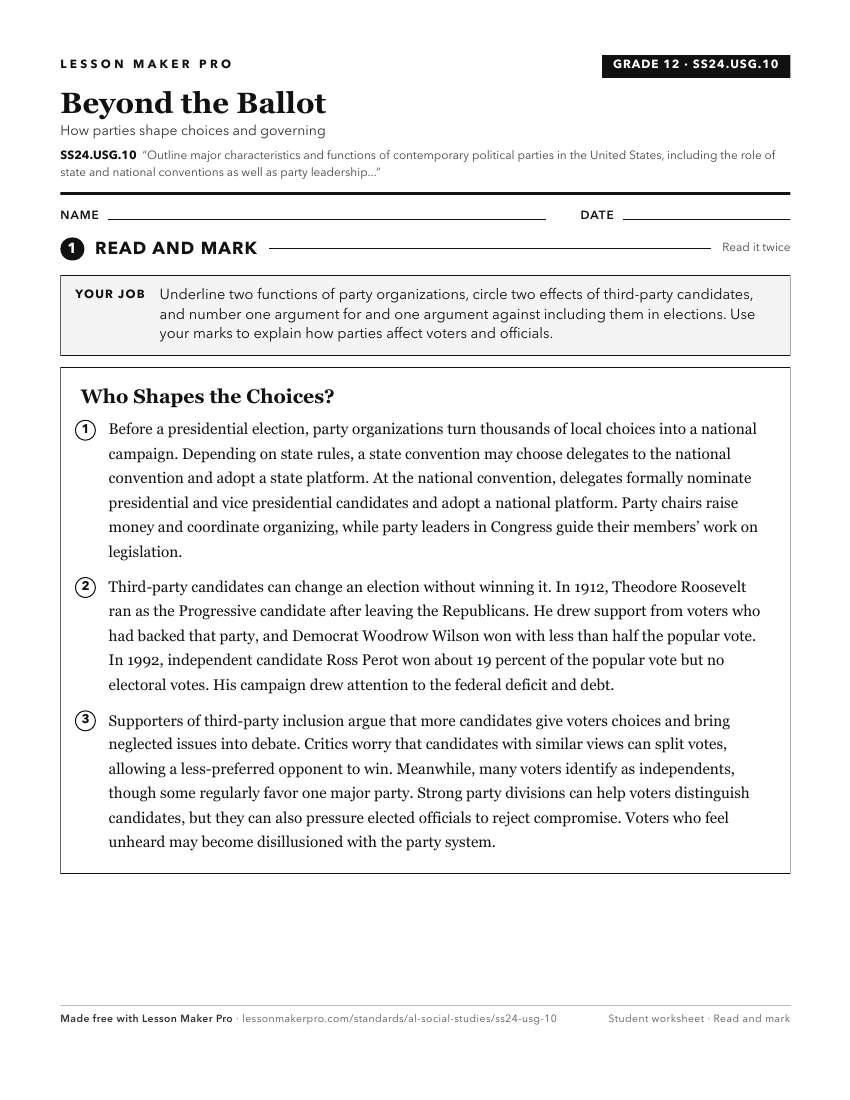
A ready-to-print activity worksheet aligned to SS24.USG.10, with an answer key for the teacher on its own page. No account needed.
PDF, US Letter, prints cleanly in black and white.
Download the worksheetKeep exploring
Related Standards
- SS24.6.20
Trace the development of the Federalist and Democratic-Republican political parties in the 1790s, and describe the role of political parties in the American pol...
- SS24.6.13
Describe major ideas, concepts, and limitations of the Constitution of the United States.
- SS24.US1.3a
Identify and explain factors leading to the development of political parties, including the conflicting views of Thomas Jefferson and Alexander Hamilton, George...
Turn this cluster into a lesson
Grade, subject, topic, and the complete cluster are prefilled. Create one free, no account needed.
Also for this cluster:Make a WorksheetMake a QuizMake a Sub Lesson