Alabama Social Studies SS24.6.20
Standard Cluster
Trace the development of the Federalist and Democratic-Republican political parties in the 1790s, and describe the role of political parties in the American political system. 20a Describe Alexander Hamilton’s economic plan for the new United States and explain how this became the foundation of capitalism in the country. 20b Compare the arguments for and against the establishment of the National Bank as represented by differing interpretations of the Constitution. 20c Compare Alexander Hamilton’s vision for an industrial United States to Thomas Jefferson’s agricultural vision. 20d Describe the significance of the Election of 1800 as setting the precedent for a peaceful transition of power and the electoral reform the election produced.
2024 Alabama Course of Study: Social Studies
Cluster contents
Standards in This Cluster
SS24.6.20 is a cluster heading. These are the individual standards under it.
- SS24.6.20a
Describe Alexander Hamilton’s economic plan for the new United States and explain how this became the foundation of capitalism in the country.
- SS24.6.20b
Compare the arguments for and against the establishment of the National Bank as represented by differing interpretations of the Constitution.
- SS24.6.20c
Compare Alexander Hamilton’s vision for an industrial United States to Thomas Jefferson’s agricultural vision.
- SS24.6.20d
Describe the significance of the Election of 1800 as setting the precedent for a peaceful transition of power and the electoral reform the election produced.
Teacher's field guide
What This Cluster Means
What Students Need to Do
- Students trace how disagreements over federal power and economic policy formed the Federalist and Democratic-Republican parties. They explain Hamilton’s debt and bank plans, then compare his support for industry with Jefferson’s farm-based vision. They explain how the 1800 election transferred power peacefully and led to new voting rules.
What Mastery Looks Like
- A student connects paying state debts and creating a national bank to credit for privately owned businesses. They explain why Hamilton believed Congress could create a bank and Jefferson believed it could not. They describe how parties organized opposing views and how the 1800 tie led to separate electoral votes for president and vice president.
Common Misconceptions
- Students may confuse the Democratic-Republicans with today’s Republican Party. They may think the Constitution explicitly created a national bank. They may miss that Jefferson and Burr tied, forcing a House vote.
How to Assess It
- Exit ticket: “How did Hamilton and Jefferson use the Constitution to disagree about the bank, and what changed after the 1800 election?”
Lesson moves
Ways to Teach It
Give pairs debt, bank, factory, and farm cards; have them sort each under Hamilton or Jefferson and explain two choices.
Ask: “Could Congress create a bank if the Constitution does not name one?” Have students write Hamilton’s answer and Jefferson’s answer.
Play party match: read “support a national bank” and “protect state powers”; teams hold up Federalist or Democratic-Republican cards.
Show a sample modern presidential ballot listing a running mate; ask why electors cast separate votes for president and vice president after 1800.
Free download
Printable SS24.6.20 Worksheet
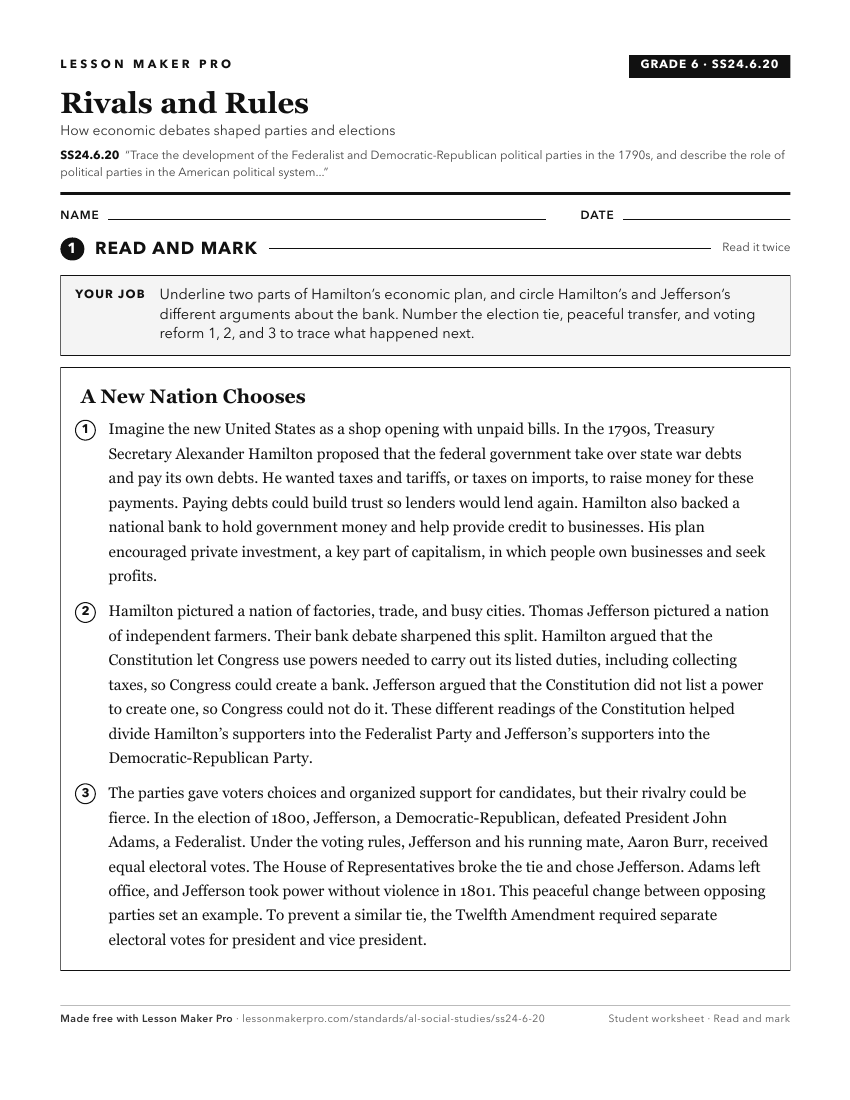
A ready-to-print activity worksheet aligned to SS24.6.20, with an answer key for the teacher on its own page. No account needed.
PDF, US Letter, prints cleanly in black and white.
Download the worksheetKeep exploring
Related Standards
- SS24.7.14b
Trace the development of Greek city-states' political systems, including democracy, that influenced the governments of modern nations.
- SS24.US1.2
Evaluate how events and issues from the signing of the Treaty of Paris (1783) to the ratification of the Constitution of the United States affected the developm...
- SS24.USG.10
Outline major characteristics and functions of contemporary political parties in the United States, including the role of state and national conventions as well...
- SS24.US1.3a
Identify and explain factors leading to the development of political parties, including the conflicting views of Thomas Jefferson and Alexander Hamilton, George...
Turn this cluster into a lesson
Grade, subject, topic, and the complete cluster are prefilled. Create one free, no account needed.
Also for this cluster:Make a WorksheetMake a QuizMake a Sub Lesson