Alabama Social Studies SS24.US1.2
Standard Cluster
Evaluate how events and issues from the signing of the Treaty of Paris (1783) to the ratification of the Constitution of the United States affected the development of the political system of the United States. 2a Identify the strengths and weaknesses of the Articles of Confederation, and describe how Shays’ Rebellion generated sentiment favoring a strong central government. 2b Describe the major issues debated at the Constitutional Convention and analyze the solutions produced, including: the distribution of political power among states and within the federal government; the conduct of foreign affairs, commerce, and trade; the election of the executive; and slavery as a regional and federal issue. 2c Compare the arguments of Federalists and Anti-Federalists regarding ratification of the United States Constitution, and explain how the Bill of Rights represented a compromise between fundamental liberties and the powers of government.
2024 Alabama Course of Study: Social Studies
Cluster contents
Standards in This Cluster
SS24.US1.2 is a cluster heading. These are the individual standards under it.
- SS24.US1.2a
Identify the strengths and weaknesses of the Articles of Confederation, and describe how Shays’ Rebellion generated sentiment favoring a strong central governme...
- SS24.US1.2b
Describe the major issues debated at the Constitutional Convention and analyze the solutions produced, including: the distribution of political power among stat...
- SS24.US1.2c
Compare the arguments of Federalists and Anti-Federalists regarding ratification of the United States Constitution, and explain how the Bill of Rights represent...
Teacher's field guide
What This Cluster Means
What Students Need to Do
- Students explain how independence left the states with war debts, and how the Articles helped them cooperate but left Congress unable to tax or regulate trade. They link Shays’ Rebellion to calls for stronger national power and explain convention decisions about representation, divided powers, trade, foreign affairs, presidential elections, and slavery. They compare ratification arguments and explain why a promised Bill of Rights helped win support.
What Mastery Looks Like
- A student can name western land policy as an Articles success and connect Congress’s lack of tax power to its difficulty raising funds. They can explain equal Senate seats, population-based House seats, checks among branches, federal control of trade and treaties, the Electoral College, and compromises over slavery. They can compare Federalist and Anti-Federalist arguments and explain why promising a Bill of Rights changed votes.
Common Misconceptions
- Students may think Congress could tax under the Articles or that both houses of Congress give states equal seats. Some say the convention ended slavery or gave voters a direct national vote for president. Others mix up Federalists and Anti-Federalists or assume the Bill of Rights was in the original Constitution.
How to Assess It
- Exit ticket: How did Congress’s lack of tax power limit its response to Shays’ Rebellion? Name one change made at the convention, then explain why an Anti-Federalist might still demand a Bill of Rights.
Lesson moves
Ways to Teach It
Hand pairs cards labeled war debts, Congress cannot tax, Massachusetts taxes, and Shays’ Rebellion; have them build a cause-and-effect chain.
Ask students whether small and large states should have equal votes in Congress, then have them defend answers using the Great Compromise.
Run a card match: pair representation, trade, presidential elections, and slavery with two-house Congress, federal trade power, Electoral College, and Three-Fifths Compromise.
Have students read their school’s student council election rules and compare who chooses the leader with the Electoral College.
Free download
Printable SS24.US1.2 Worksheet
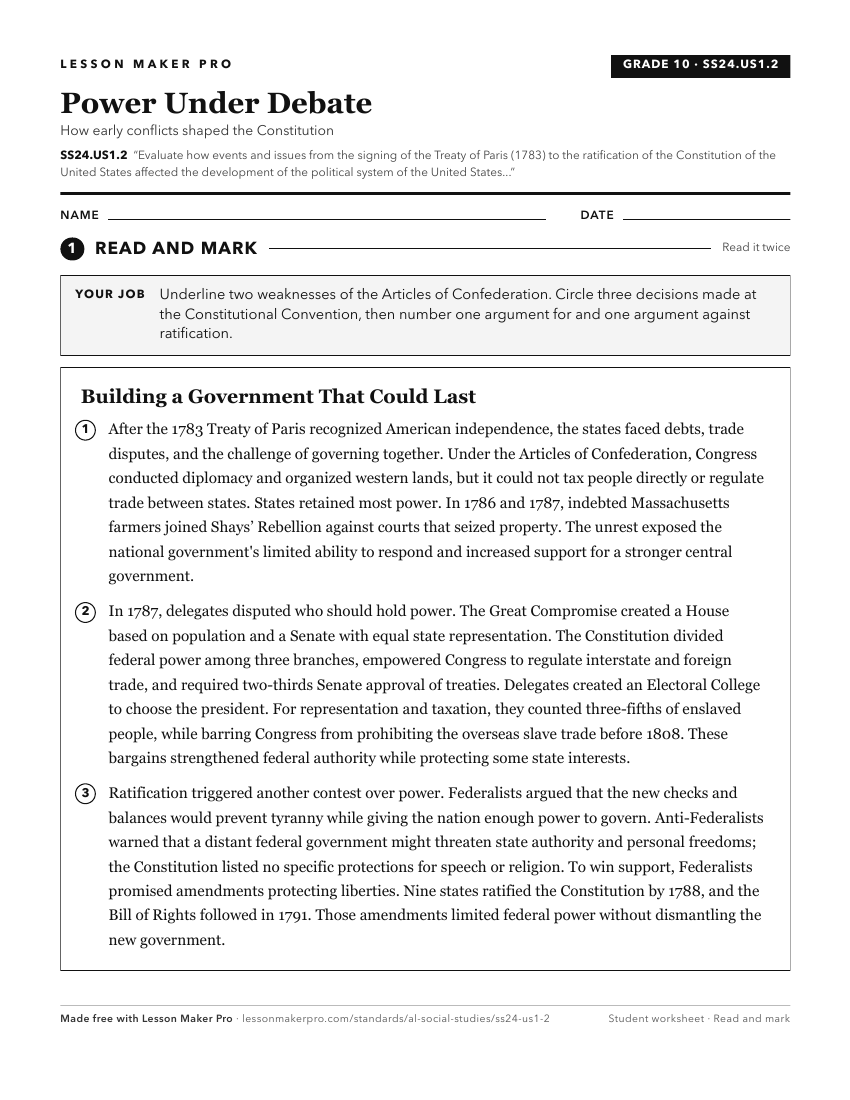
A ready-to-print activity worksheet aligned to SS24.US1.2, with an answer key for the teacher on its own page. No account needed.
PDF, US Letter, prints cleanly in black and white.
Download the worksheetKeep exploring
Related Standards
- SS24.4.7
Summarize the key factors leading to the ratification of the Constitution, including the weaknesses of the Articles of Confederation, Shays’ Rebellion, and the ...
- SS24.USG.2
Describe how the Declaration of Independence, the Articles of Confederation, and events of the American Revolution influenced the drafting and ratification of t...
- SS24.6.9b
Analyze how the Treaty of Paris of 1783 affected the development of the United States, including the establishment of its boundaries.
- SS24.US1.1
Trace the events from 1754 to 1783 that led to the independence of the United States of America.
Turn this cluster into a lesson
Grade, subject, topic, and the complete cluster are prefilled. Create one free, no account needed.
Also for this cluster:Make a WorksheetMake a QuizMake a Sub Lesson