Alabama Social Studies SS24.US1.1
Standard Cluster
Trace the events from 1754 to 1783 that led to the independence of the United States of America. 1a Explain how British policies and actions from 1754 to 1775 created political and economic disagreements with American colonists. 1b Analyze the means by which colonists protested British policies and the ideas communicated through colonists’ speeches and written pamphlets. 1c Summarize the main arguments within the Declaration of Independence, its rationale for separation from Great Britain, and its ideas of equality, liberty, natural rights, and the rule of law. 1d Evaluate the contributions of colonial leaders, including George Washington; military strategy; and the support of foreign nations to significant victories in the War for Independence. 1e Compare and contrast the contributions of different groups in colonial America to the War for Independence and the effects of the war on members of these groups, including free and enslaved Black Americans, Loyalists, Native Americans, and women.
2024 Alabama Course of Study: Social Studies
Cluster contents
Standards in This Cluster
SS24.US1.1 is a cluster heading. These are the individual standards under it.
- SS24.US1.1a
Explain how British policies and actions from 1754 to 1775 created political and economic disagreements with American colonists.
- SS24.US1.1b
Analyze the means by which colonists protested British policies and the ideas communicated through colonists’ speeches and written pamphlets.
- SS24.US1.1c
Summarize the main arguments within the Declaration of Independence, its rationale for separation from Great Britain, and its ideas of equality, liberty, natura...
- SS24.US1.1d
Evaluate the contributions of colonial leaders, including George Washington; military strategy; and the support of foreign nations to significant victories in t...
- SS24.US1.1e
Compare and contrast the contributions of different groups in colonial America to the War for Independence and the effects of the war on members of these groups...
Teacher's field guide
What This Cluster Means
What Students Need to Do
- Students put events from 1754 to 1783 in order and explain why British policies drew protests. They explain arguments in pamphlets and the Declaration about rights, equality, and government. They connect leaders, strategy, and foreign aid to victories, then compare the roles and outcomes of free and enslaved Black Americans, Loyalists, Native Americans, and women.
What Mastery Looks Like
- A student can use a timeline and source excerpts to link British policies, colonial protests, and the decision to separate. They can explain why the Declaration says people may reject a government. They can explain a victory using Washington's strategy and French support, then compare how the war affected two different groups.
Common Misconceptions
- Some students think every colonist backed independence or that taxes were the only cause of protest. Others assume the Declaration gave equal rights to everyone or that Washington won without French support.
How to Assess It
- Show students a Stamp Act notice, a Declaration excerpt, a Yorktown map showing French ships, and a 1783 Book of Negroes entry. Ask for four linked sentences explaining a dispute, the case for separation, a factor in victory, and one Black Loyalist's wartime outcome.
Lesson moves
Ways to Teach It
Have pairs sort dated cards from the French and Indian War through the 1783 treaty, then link taxes, boycotts, battles, and French aid.
Read excerpts from Common Sense and the Declaration, then write which claims about rights and government might persuade a hesitant colonist.
Play a Yorktown planning game with Washington, French fleet, and British supply cards; explain how each shaped the outcome.
Open a National Park Service Revolutionary War exhibit; tally mentions of women, free and enslaved Black Americans, Loyalists, and Native nations.
Free download
Printable SS24.US1.1 Worksheet
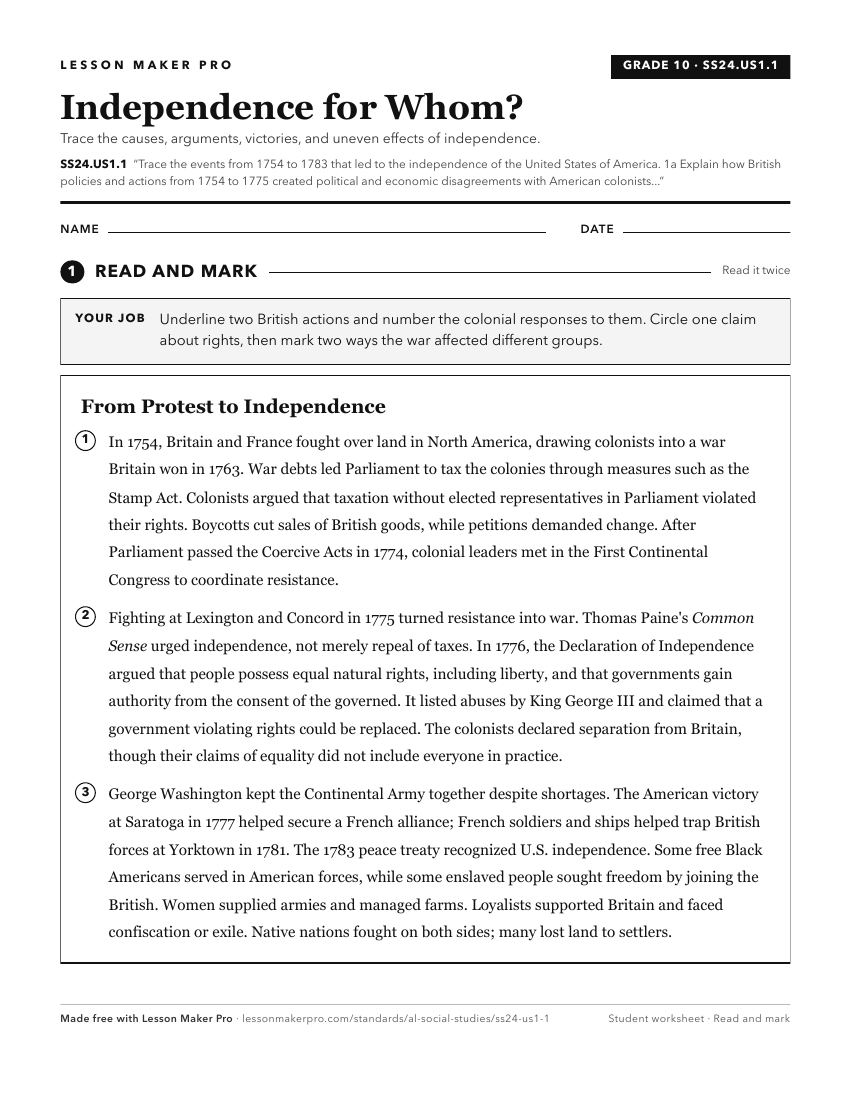
A ready-to-print activity worksheet aligned to SS24.US1.1, with an answer key for the teacher on its own page. No account needed.
PDF, US Letter, prints cleanly in black and white.
Download the worksheetKeep exploring
Related Standards
- SS24.USG.2
Describe how the Declaration of Independence, the Articles of Confederation, and events of the American Revolution influenced the drafting and ratification of t...
- SS24.US1.3d
Describe relations of the United States with Britain, France, and Native American nations from 1789 to 1812.
- SS24.6.7
Identify causes and events leading to the War for Independence, including salutary neglect, the Stamp Act, the Boston Massacre, the Boston Tea Party, the Intole...
- SS24.US1.2
Evaluate how events and issues from the signing of the Treaty of Paris (1783) to the ratification of the Constitution of the United States affected the developm...
Turn this cluster into a lesson
Grade, subject, topic, and the complete cluster are prefilled. Create one free, no account needed.
Also for this cluster:Make a WorksheetMake a QuizMake a Sub Lesson