Alabama Social Studies SS24.6.7
Standard Cluster
Identify causes and events leading to the War for Independence, including salutary neglect, the Stamp Act, the Boston Massacre, the Boston Tea Party, the Intolerable Acts, Virginia Convention (1775), and the Declaration of Independence, and describe how these events escalated tension between the colonies and Great Britain. 7a Develop an argument defending the belief that the French and Indian War served as a defining event in the relationship between the American colonies and British government. 7b Compare and contrast methods of colonial activism and protest against British policies, including boycotts, craftwork, letters, petitions, poems, public oration, and speeches. 7c Describe the positive and negative effects of taxation and trade on the economic livelihood of American colonies in the 1760s and 1770s and explain how this issue violated colonists’ expectations of representative government. 7d Summarize the arguments put forth by Patriots and Loyalists regarding the question of independence from Great Britain, and describe efforts to compromise. 7e Define the key principles contained in the Declaration of Independence, including inalienable rights, equality, and social contract, and explain how they have been presented in significant statements of belief throughout United States history to the present.
2024 Alabama Course of Study: Social Studies
Cluster contents
Standards in This Cluster
SS24.6.7 is a cluster heading. These are the individual standards under it.
- SS24.6.7a
Develop an argument defending the belief that the French and Indian War served as a defining event in the relationship between the American colonies and British...
- SS24.6.7b
Compare and contrast methods of colonial activism and protest against British policies, including boycotts, craftwork, letters, petitions, poems, public oration...
- SS24.6.7c
Describe the positive and negative effects of taxation and trade on the economic livelihood of American colonies in the 1760s and 1770s and explain how this iss...
- SS24.6.7d
Summarize the arguments put forth by Patriots and Loyalists regarding the question of independence from Great Britain, and describe efforts to compromise.
- SS24.6.7e
Define the key principles contained in the Declaration of Independence, including inalienable rights, equality, and social contract, and explain how they have b...
Teacher's field guide
What This Cluster Means
What Students Need to Do
- Students explain how the French and Indian War changed British policy, then trace the taxes, protests, and crackdowns that led to independence. They compare ways colonists protested and weigh Patriot and Loyalist arguments, including efforts to compromise. They explain how trade and taxes affected colonists, why representation mattered, and how later Americans used ideas from the Declaration.
What Mastery Looks Like
- Students put events from salutary neglect to the Declaration in order and explain how tensions rose. They use war debt and a colonial protest to argue why the French and Indian War changed relations with Britain. They describe gains and losses from trade and taxes, explain the dispute over representation, and find a Declaration principle in a later U.S. statement.
Common Misconceptions
- Some students think the French and Indian War was fought only against Native peoples, not France and its allies. Others assume all colonists wanted independence or that a boycott and a petition worked the same way. They may mistake the Declaration’s claim of equality for equality in practice in 1776.
How to Assess It
- On an exit ticket, ask: “How did the French and Indian War lead to one named colonial protest, and why did that protest raise tensions with Britain?”
Lesson moves
Ways to Teach It
Have pairs sort cards for salutary neglect, the Stamp Act, Boston Massacre, Boston Tea Party, Intolerable Acts, Virginia Convention, and Declaration; draw cause arrows.
Have students write a Patriot or Loyalist reply to a proposed petition to the king, giving one reason for accepting or rejecting it.
Run a card match: pair boycotts, homespun cloth, letters, petitions, poems, and speeches with their intended audience and likely effect.
Compare a current sales tax receipt and a town council agenda; ask who approves the tax and how residents can object.
Free download
Printable SS24.6.7 Worksheet
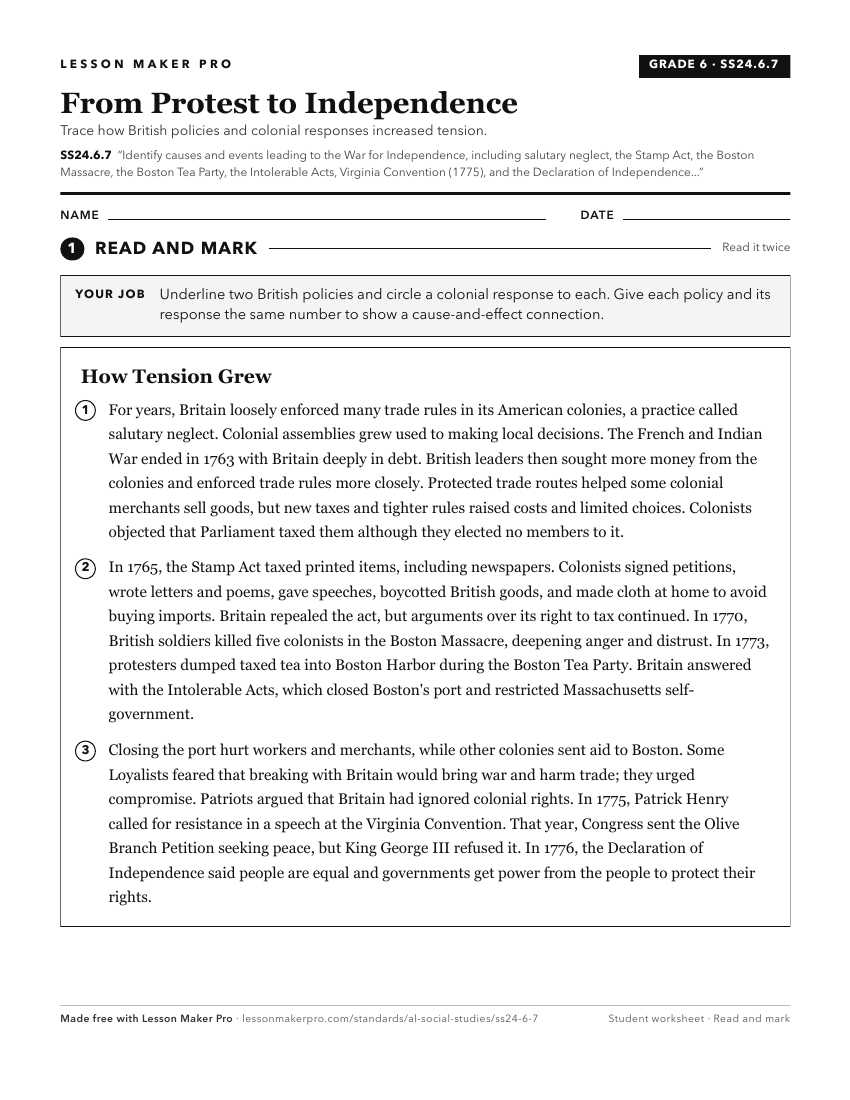
A ready-to-print activity worksheet aligned to SS24.6.7, with an answer key for the teacher on its own page. No account needed.
PDF, US Letter, prints cleanly in black and white.
Download the worksheetKeep exploring
Related Standards
- SS24.4.6
Identify and describe key events of the American Revolution, including the Battles of Lexington and Concord, Saratoga, and Yorktown.
- SS24.4.5
Summarize the causes of the French and Indian War and describe how its outcomes increased tensions that led to the American Revolution.
- SS24.4.5b
Describe key events that caused tension and led American colonists to protest against Great Britain, including the Sugar Act, Stamp Act, Townshend Acts, Boston ...
- SS24.US1.1
Trace the events from 1754 to 1783 that led to the independence of the United States of America.
Turn this cluster into a lesson
Grade, subject, topic, and the complete cluster are prefilled. Create one free, no account needed.
Also for this cluster:Make a WorksheetMake a QuizMake a Sub Lesson