Alabama Social Studies SS24.4.6
Standard Cluster
Identify and describe key events of the American Revolution, including the Battles of Lexington and Concord, Saratoga, and Yorktown. 6a Summarize the contributions of different groups and individuals to the American Revolution. 6b Describe events that took place in Alabama during the Revolution, including the Spanish seizure of Mobile and the Battle of Fort Charlotte, and explain the involvement of Native Americans. 6c Summarize the principles of the Declaration of Independence. 6d Explain how the Treaty of Paris (1783) and Pinckney’s Treaty helped set the boundaries of the United States, including the area that would become Alabama.
2024 Alabama Course of Study: Social Studies
Cluster contents
Standards in This Cluster
SS24.4.6 is a cluster heading. These are the individual standards under it.
- SS24.4.6a
Summarize the contributions of different groups and individuals to the American Revolution.
- SS24.4.6b
Describe events that took place in Alabama during the Revolution, including the Spanish seizure of Mobile and the Battle of Fort Charlotte, and explain the invo...
- SS24.4.6c
Summarize the principles of the Declaration of Independence.
- SS24.4.6d
Explain how the Treaty of Paris (1783) and Pinckney’s Treaty helped set the boundaries of the United States, including the area that would become Alabama.
Teacher's field guide
What This Cluster Means
What Students Need to Do
- Put Lexington and Concord, Saratoga, and Yorktown in order and tell why each mattered. Describe how different groups shaped the war, including Native nations and the Spanish force that took Fort Charlotte at Mobile. Explain the Declaration's ideas about rights and government, then find early U.S. borders near Alabama on a map.
What Mastery Looks Like
- Students explain that Lexington and Concord began the fighting, Saratoga helped win French support, and Yorktown brought a British surrender. They describe Spain's capture of Fort Charlotte, explain that Native nations chose different alliances, and name a contribution by women or enslaved people. They explain rights and consent of the governed, then show how the two treaties set boundaries at the Mississippi River and 31st parallel.
Common Misconceptions
- Students may call Saratoga the final battle or say the war ended the day Yorktown fell. They may assume all Native nations fought on one side or that Mobile was already part of the United States. Some confuse the Declaration with a treaty that set borders.
How to Assess It
- Give students a map with the Mississippi River, 31st parallel, and Mobile marked. Ask: "Which treaty recognized the western boundary, which confirmed the southern boundary, and why was Mobile outside the United States?"
Lesson moves
Ways to Teach It
Give pairs dated cards for Lexington and Concord, Saratoga, Yorktown, and Fort Charlotte; have them build a timeline and mark battles on a map.
Ask students to write: "Who lacked the rights named in the Declaration?" Require an example involving enslaved people or Native nations.
Play timeline match: students pair each battle with its result, then match Bernardo de Gálvez, French troops, and Creek groups with their wartime roles.
On a current Alabama map, mark Mobile and the 31st parallel; compare a 1795 map to see why Mobile stayed Spanish.
Free download
Printable SS24.4.6 Worksheet
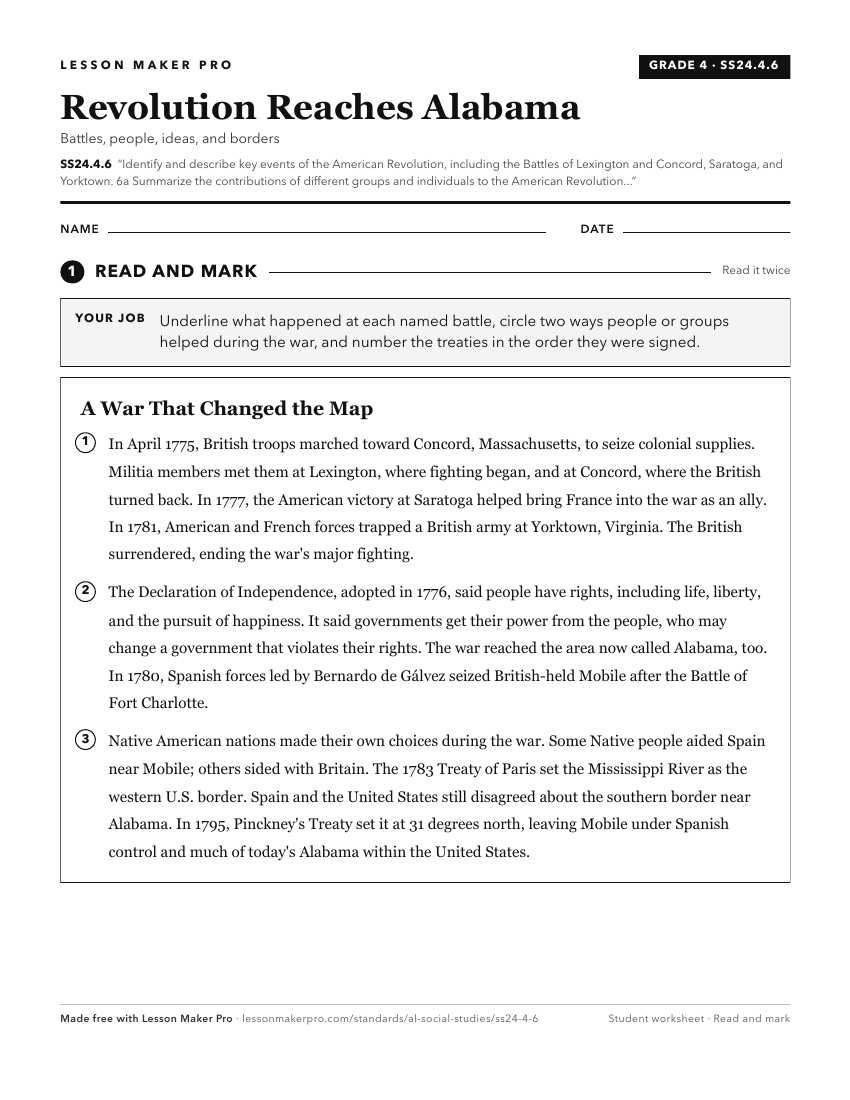
A ready-to-print activity worksheet aligned to SS24.4.6, with an answer key for the teacher on its own page. No account needed.
PDF, US Letter, prints cleanly in black and white.
Download the worksheetKeep exploring
Related Standards
- SS24.6.7
Identify causes and events leading to the War for Independence, including salutary neglect, the Stamp Act, the Boston Massacre, the Boston Tea Party, the Intole...
- SS24.6.8
Differentiate among the outcomes of major events and campaigns of the War for Independence, including the northern, middle, southern, and western theaters.
- SS24.4.5b
Describe key events that caused tension and led American colonists to protest against Great Britain, including the Sugar Act, Stamp Act, Townshend Acts, Boston ...
Turn this cluster into a lesson
Grade, subject, topic, and the complete cluster are prefilled. Create one free, no account needed.
Also for this cluster:Make a WorksheetMake a QuizMake a Sub Lesson