Alabama Social Studies SS24.4.7
Standard Cluster
Summarize the key factors leading to the ratification of the Constitution, including the weaknesses of the Articles of Confederation, Shays’ Rebellion, and the Constitutional Convention with its compromises. 7a Describe the system of government established by the Constitution, including the three branches of government and their functions. 7b Explain why the Bill of Rights was added to the Constitution and how the amendment process allows changes to protect or expand rights.
2024 Alabama Course of Study: Social Studies
Cluster contents
Standards in This Cluster
SS24.4.7 is a cluster heading. These are the individual standards under it.
Teacher's field guide
What This Cluster Means
What Students Need to Do
- Students explain how weak tax powers under the Articles and Shays’ Rebellion led to calls for a new government. They describe convention deals and why a promised Bill of Rights helped win ratification. They name each branch’s job and explain how amendments can protect or expand rights.
What Mastery Looks Like
- A student can explain why leaders wanted change and describe the House and Senate deal. They can explain that the three-fifths deal counted enslaved people for representation while denying them political rights. They match Congress, the president, and courts to their jobs, and explain that amendments need broad approval from Congress and the states.
Common Misconceptions
- Students may think the national government could collect taxes under the Articles or that Shays’ Rebellion was a fight against Britain. They may think the president makes laws alone or that the Bill of Rights was in the first draft. Some think a president can add an amendment alone.
How to Assess It
- Exit ticket: Name one problem under the Articles, one convention deal, and one job for each branch. Then explain why people wanted a Bill of Rights and who must approve an amendment.
Lesson moves
Ways to Teach It
Give groups tax, debt, and Shays’ Rebellion cards; have them build a cause-and-effect chain from the Articles to the convention.
Ask: How did the House and Senate deal settle representation, and what was unjust about counting enslaved people as three-fifths?
Play branch sort: read 'passes a law,' 'carries it out,' and 'decides what it means'; students hold up branch cards.
Read a petition to change voting rules; ask why signatures alone cannot amend the Constitution and whose approval is needed.
Free download
Printable SS24.4.7 Worksheet
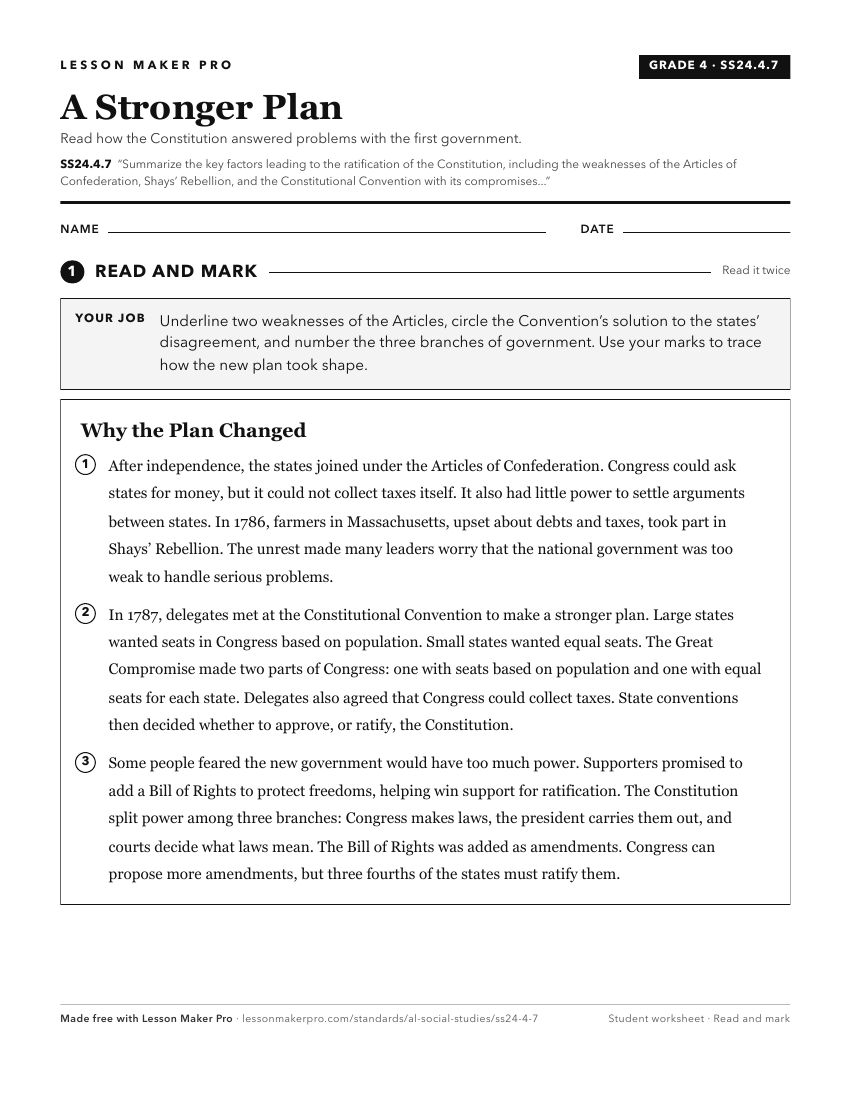
A ready-to-print activity worksheet aligned to SS24.4.7, with an answer key for the teacher on its own page. No account needed.
PDF, US Letter, prints cleanly in black and white.
Download the worksheetKeep exploring
Related Standards
- SS24.USG.2
Describe how the Declaration of Independence, the Articles of Confederation, and events of the American Revolution influenced the drafting and ratification of t...
- SS24.6.11
Analyze how collaboration and compromise were employed to address key issues during the Constitutional Convention, including representation in Congress (Great C...
- SS24.US1.2a
Identify the strengths and weaknesses of the Articles of Confederation, and describe how Shays’ Rebellion generated sentiment favoring a strong central governme...
- SS24.6.11b
Summarize the arguments favoring and opposing ratification of the Constitution of the United States.
Turn this cluster into a lesson
Grade, subject, topic, and the complete cluster are prefilled. Create one free, no account needed.
Also for this cluster:Make a WorksheetMake a QuizMake a Sub Lesson