Alabama Social Studies SS24.6.11
Standard Cluster
Analyze how collaboration and compromise were employed to address key issues during the Constitutional Convention, including representation in Congress (Great Compromise and bicameral legislature), balance of power between national and state governments (establishment of the system of federalism), limiting government power (establishment of the three branches), and slavery (Three-Fifths Compromise). 11a Describe the role of Founding Fathers at the Constitutional Convention and explain how they contributed to the development of the Constitution. 11b Summarize the arguments favoring and opposing ratification of the Constitution of the United States. 11c Assess the arguments made by groups and individuals seeking greater inclusion and advancement of fundamental values in the late 1700s, including women and Black Americans, who were excluded from early American political participation.
2024 Alabama Course of Study: Social Studies
Cluster contents
Standards in This Cluster
SS24.6.11 is a cluster heading. These are the individual standards under it.
- SS24.6.11a
Describe the role of Founding Fathers at the Constitutional Convention and explain how they contributed to the development of the Constitution.
- SS24.6.11b
Summarize the arguments favoring and opposing ratification of the Constitution of the United States.
- SS24.6.11c
Assess the arguments made by groups and individuals seeking greater inclusion and advancement of fundamental values in the late 1700s, including women and Black...
Teacher's field guide
What This Cluster Means
What Students Need to Do
- Students explain why delegates disagreed over representation, slavery, and the division of power. They describe what key delegates proposed and compare arguments for and against ratification. They examine demands for rights from women and Black Americans who were excluded from political participation.
What Mastery Looks Like
- A student can explain how Sherman's two-house plan addressed representation and how federalism and three branches divide power. They can explain that counting enslaved people for representation did not give them votes. They can compare ratification arguments and use Abigail Adams's letter or Prince Hall's petition to show whose rights remained unprotected.
Common Misconceptions
- Students may think both houses of Congress give states seats based on population, or that the first draft included a bill of rights. Some confuse the division of power between governments with the division among branches. Others think counting enslaved people gave them votes.
How to Assess It
- Ask students to explain how Sherman's two-house plan addressed the representation dispute. Then have them name one group denied political rights and state what that group demanded.
Lesson moves
Ways to Teach It
Give pairs state population cards and counters; have them model equal Senate seats and population-based House seats, then explain Sherman's deal.
Hand out short excerpts from Abigail Adams's letter and Prince Hall's petition; ask, "Whose freedom and voice were missing?"
Run a card match pairing Madison, Sherman, and Washington with their convention roles, then Federalist and Anti-Federalist claims with their reasons.
Give students a state driver's license rule and a federal passport rule; have them identify which government handles each and why.
Free download
Printable SS24.6.11 Worksheet
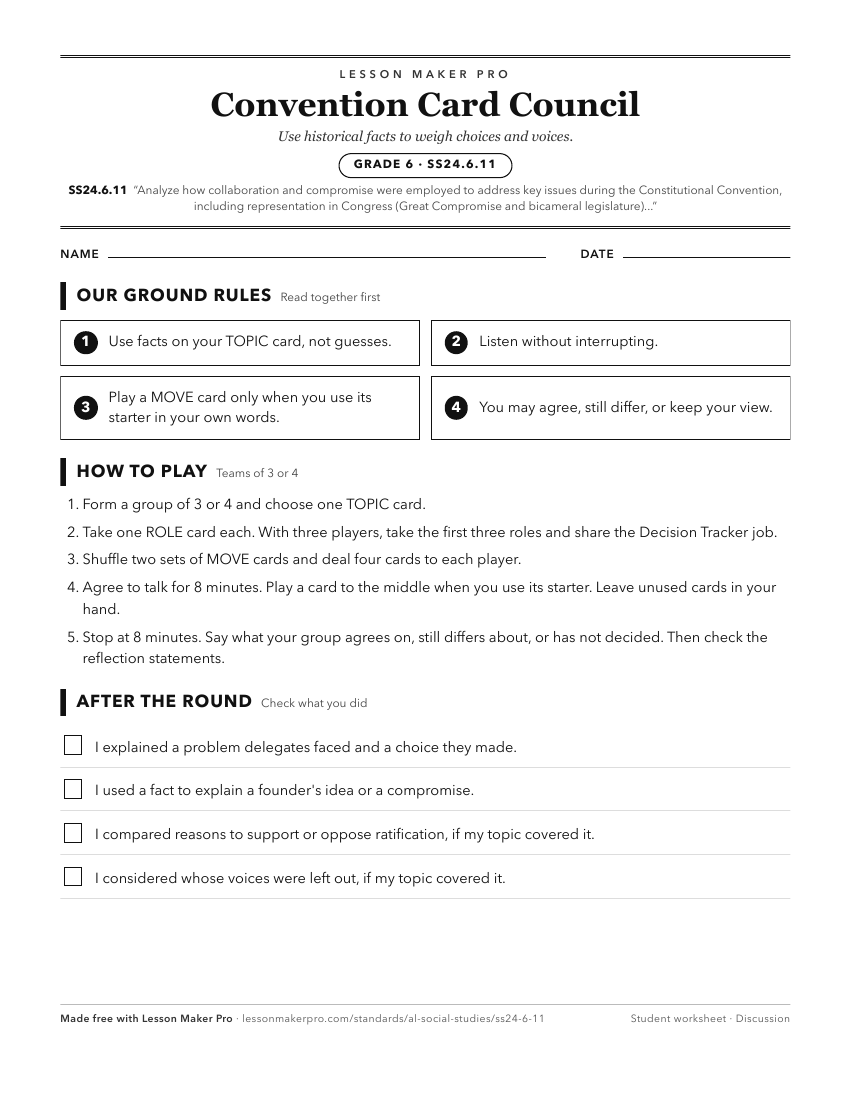
A ready-to-print activity worksheet aligned to SS24.6.11, with an answer key for the teacher on its own page. No account needed.
PDF, US Letter, prints cleanly in black and white.
Download the worksheetKeep exploring
Related Standards
- SS24.4.7
Summarize the key factors leading to the ratification of the Constitution, including the weaknesses of the Articles of Confederation, Shays’ Rebellion, and the ...
- SS24.USG.3a
Summarize and explain the underlying principles of the Constitution, including checks and balances, federalism, limited government, popular sovereignty, republi...
- SS24.US1.2c
Compare the arguments of Federalists and Anti-Federalists regarding ratification of the United States Constitution, and explain how the Bill of Rights represent...
- SS24.US1.2b
Describe the major issues debated at the Constitutional Convention and analyze the solutions produced, including: the distribution of political power among stat...
Turn this cluster into a lesson
Grade, subject, topic, and the complete cluster are prefilled. Create one free, no account needed.
Also for this cluster:Make a WorksheetMake a QuizMake a Sub Lesson