Alabama Social Studies SS24.USG.10a
The Standard
- SS24.USG.10
- Outline major characteristics and functions of contemporary political parties in the United States, including the role of state and national conventions as well as party leadership.
Describe how third-party candidates have historically affected elections in the United States, and evaluate the arguments for and against their inclusion in contemporary elections.
2024 Alabama Course of Study: Social Studies
Teacher's field guide
What This Standard Means
What Students Need to Do
- Students use past election results to explain how third-party candidates affected votes and campaigns. They weigh wider voter choice against concerns about vote splitting when considering ballot and debate access today.
What Mastery Looks Like
- A student can use the 1912 results to explain how Theodore Roosevelt divided Republican support with William Howard Taft. They can make a fair argument on each side of third-party access without assuming all Roosevelt voters would have chosen Taft.
Common Misconceptions
- Students may assume every third-party vote would have gone to one major-party candidate. They may also think a large popular-vote share guarantees electoral votes, or confuse ballot access with debate invitations.
How to Assess It
- Exit ticket: In 1912, Wilson won 42% of the popular vote, Roosevelt 27%, and Taft 23%. Name one effect of Roosevelt’s run and give one argument for or against third-party ballot access today.
Lesson moves
Ways to Teach It
Give groups a 1992 election map and a card showing Perot’s 19% popular-vote share; have them mark his state wins.
Ask: Should a candidate polling at 5% get a debate spot? Defend your answer with one benefit and one concern.
Vote on pizza, tacos, or sandwiches for a mock lunch, then hold a two-option runoff and compare the totals.
Look up Alabama’s ballot-access rules for minor parties, then list two steps a party must complete to appear on the ballot.
Free download
Printable SS24.USG.10a Worksheet
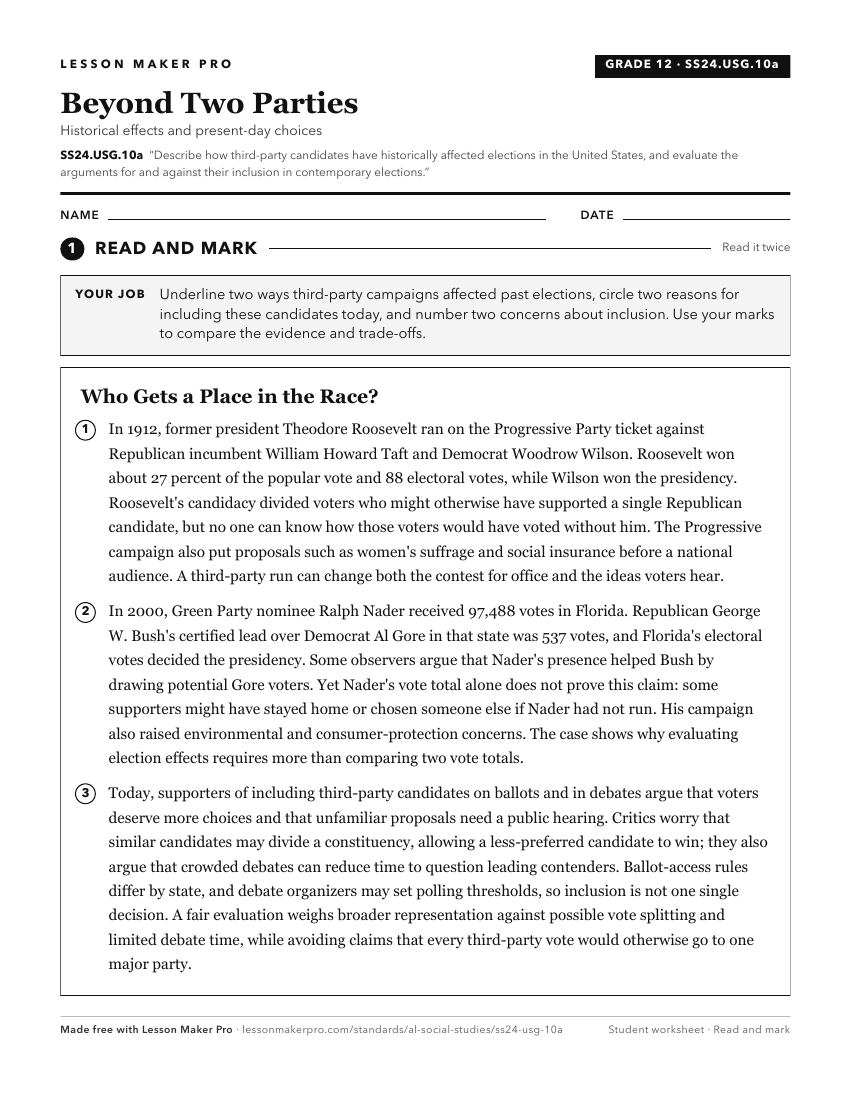
A ready-to-print activity worksheet aligned to SS24.USG.10a, with an answer key for the teacher on its own page. No account needed.
PDF, US Letter, prints cleanly in black and white.
Download the worksheetKeep exploring
Related Standards
- SS24.USG.9b
Analyze the influence of television and digital media on elections and campaign spending.
- SS24.USG.7c
Analyze historic and current barriers to voting access and voter turnout, and weigh the benefits and consequences of possible solutions.
- SS24.USG.10b
Assess the impact of political parties on citizens and elected officials, including the increase of political polarization, rise of independent voters, and disi...
- SS24.USG.10
Outline major characteristics and functions of contemporary political parties in the United States, including the role of state and national conventions as well...
Turn this exact standard into a lesson
Grade, subject, topic, and the complete standard are prefilled. Create one free, no account needed.
Also for this standard:Make a WorksheetMake a QuizMake a Sub Lesson