Alabama Social Studies SS24.USG.7a
The Standard
- SS24.USG.7
- Analyze how the expansion of suffrage affected the political system of the United States, including the enfranchisement of non-property owners, women, Black Americans, and persons 18 to 20 years of age.
Explain how increases and shifts in political participation by minorities and other voting blocs shape political party coalitions, campaigns, and voter turnout.
2024 Alabama Course of Study: Social Studies
Teacher's field guide
What This Standard Means
What Students Need to Do
- Students compare who votes and which parties they support across elections. They explain how changes in participation can alter a party’s supporters, campaign plans, and turnout.
What Mastery Looks Like
- Given election data, students calculate turnout rates and identify which groups became a larger part of a party’s coalition. They suggest a campaign response based on the numbers without assuming everyone in a group votes alike.
Common Misconceptions
- Students may think a group’s growing population means its turnout rate rose. They may assume everyone in a racial or age group votes for the same party, or that campaign outreach alone caused turnout to change.
How to Assess It
- Exit ticket: Group A has 100 eligible voters, with 40 ballots and 20 Party X votes in year 1, then 70 ballots and 50 Party X votes in year 2. Group B gives Party X 50 votes in both years. Ask students to find Group A’s turnout rates and explain how Party X’s supporter mix and outreach might change.
Lesson moves
Ways to Teach It
Sort 30 fictional ballot cards by voter group and party, then add 10 voters from one group and retally each party’s supporters.
Show two election tables with ballots and party votes by group; ask, “Which group changed the coalition most, and what numbers show it?”
Give pairs three fictional districts and outreach cards; have them match each outreach plan to a turnout shift and defend it with numbers.
Use Census voting-rate tables for 2020 and 2024; have students compare youth turnout and propose one campaign outreach move.
Free download
Printable SS24.USG.7a Worksheet
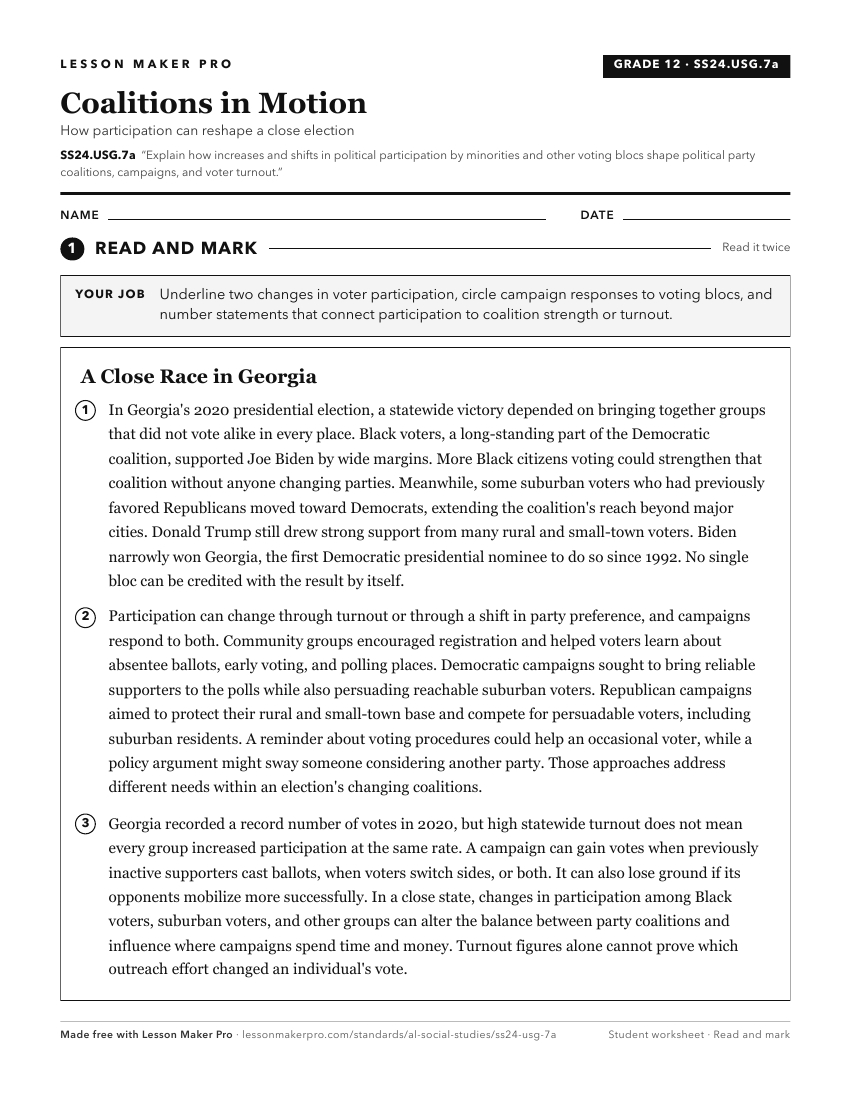
A ready-to-print activity worksheet aligned to SS24.USG.7a, with an answer key for the teacher on its own page. No account needed.
PDF, US Letter, prints cleanly in black and white.
Download the worksheetKeep exploring
Related Standards
- SS24.6.18
Analyze how an individual’s civic participation can influence government, politics, and society.
- SS24.USG.7c
Analyze historic and current barriers to voting access and voter turnout, and weigh the benefits and consequences of possible solutions.
- SS24.1.1b
Explain how voting enables communities to make choices and decisions.
- SS24.USG.10b
Assess the impact of political parties on citizens and elected officials, including the increase of political polarization, rise of independent voters, and disi...
Turn this exact standard into a lesson
Grade, subject, topic, and the complete standard are prefilled. Create one free, no account needed.
Also for this standard:Make a WorksheetMake a QuizMake a Sub Lesson