Alabama Social Studies SS24.US1.19c
The Standard
- SS24.US1.19
- Describe the emergence of the New South economy and Jim Crow era, and explain the corresponding efforts to secure civil rights by Black Americans after Reconstruction.
Analyze the ideologies, efforts, and impacts of civil rights reformers, groups, and civic organizations that challenged Jim Crow laws and violence at the turn of the twentieth century.
2024 Alabama Course of Study: Social Studies
Teacher's field guide
What This Standard Means
What Students Need to Do
- Students explain how Ida B. Wells, W. E. B. Du Bois, and civic groups challenged segregation and lynching. They compare reporting, organizing, and public demands for equal rights. They explain what these efforts changed and why Jim Crow persisted.
What Mastery Looks Like
- A student can link Wells's anti-lynching reporting to public pressure and the Niagara Movement's demands to organized opposition to segregation. They can explain that these efforts built support but did not end Jim Crow or racial violence.
Common Misconceptions
- Students may think all reformers agreed on a strategy. Booker T. Washington stressed economic progress, while Du Bois demanded full political rights. Students may also confuse these early efforts with the sit-ins and marches of the 1950s and 1960s.
How to Assess It
- Exit ticket: How did Ida B. Wells and the Niagara Movement challenge Jim Crow or racial violence? Give one effect and one limit of their efforts.
Lesson moves
Ways to Teach It
Build a dated timeline with cards for Wells's pamphlet, the National Association of Colored Women, the Niagara Movement, and the NAACP.
Read short excerpts from Wells's anti-lynching pamphlet and Washington's Atlanta speech; write how their strategies differed and whom each hoped to persuade.
Match cards naming reformers, groups, tactics, and outcomes; explain why Wells matches anti-lynching reporting rather than court challenges.
Compare the NAACP's 1909 founding call with its current voting rights page; note one shared goal and one difference in tactics.
Free download
Printable SS24.US1.19c Worksheet
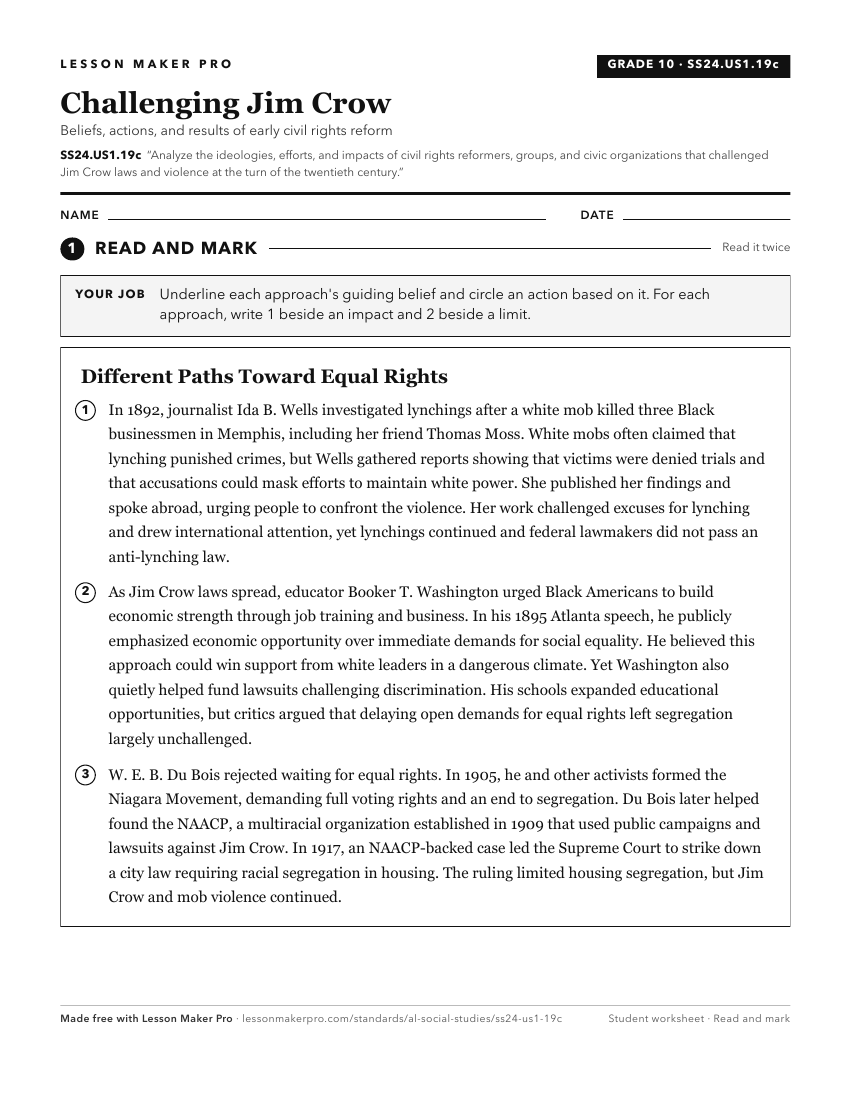
A ready-to-print activity worksheet aligned to SS24.US1.19c, with an answer key for the teacher on its own page. No account needed.
PDF, US Letter, prints cleanly in black and white.
Download the worksheetKeep exploring
Related Standards
- SS24.4.16
Describe how political and social changes of the late 1870s to 1900 affected Black and white Alabamians, including the introduction of Jim Crow laws, sharecropp...
- SS24.US2.10
Evaluate the influence of events, organizations, and individual actions on the expansion of the Civil Rights Movement nationally.
- SS24.US2.10b
Analyze the extent to which the actions and campaigns of civil rights activists and organizations from 1954 to 1965 prompted federal measures to advance civil a...
- SS24.AS.15
Evaluate the extent to which civil rights reformers in Alabama at the turn of the twentieth century successfully challenged the emergence of the Jim Crow South.
Turn this exact standard into a lesson
Grade, subject, topic, and the complete standard are prefilled. Create one free, no account needed.
Also for this standard:Make a WorksheetMake a QuizMake a Sub Lesson