Alabama Social Studies SS24.AS.15
Standard Cluster
Evaluate the extent to which civil rights reformers in Alabama at the turn of the twentieth century successfully challenged the emergence of the Jim Crow South. 15a Describe the role of women reformers in promoting reform, including Margaret Murray Washington and Julia Tutwiler. 15b Explain the role of individuals and communities in helping to expand educational and entrepreneurial opportunities for Black Alabamians at the turn of the twentieth century.
2024 Alabama Course of Study: Social Studies
Cluster contents
Standards in This Cluster
SS24.AS.15 is a cluster heading. These are the individual standards under it.
Teacher's field guide
What This Cluster Means
What Students Need to Do
- Students compare reforms led by Margaret Murray Washington, Julia Tutwiler, and Black Alabama communities with the barriers imposed by Jim Crow. They use examples from schools, work, and voting to judge what changed and what did not.
What Mastery Looks Like
- A student can explain how Washington's women's clubs and Tuskegee training expanded opportunities for Black Alabamians. They can distinguish those gains from Tutwiler's school reforms, which mainly served white women, and explain why segregation and voting barriers remained.
Common Misconceptions
- Students may assume reforms for women benefited Black and white women equally. They may also mistake better access to training for an end to segregation, or confuse Margaret Murray Washington with Booker T. Washington.
How to Assess It
- Exit ticket: Name one opportunity created by a reformer or Black community, then use one Jim Crow barrier to explain why that gain had limits.
Lesson moves
Ways to Teach It
Sort four source cards, Tuskegee courses, Washington's women's club, Tutwiler's school, and a 1901 voting rule, into opportunities and barriers.
Ask: Did Alabama Girls' Industrial School challenge Jim Crow when Black girls could not attend? Cite one source.
Play a card match pairing Washington's club, Tutwiler's school, Tuskegee trades, and Black community fundraising with their beneficiaries and limits.
Check a nearby community college's admissions page and compare who can enroll today with who could attend Tutwiler's school or Tuskegee.
Free download
Printable SS24.AS.15 Worksheet
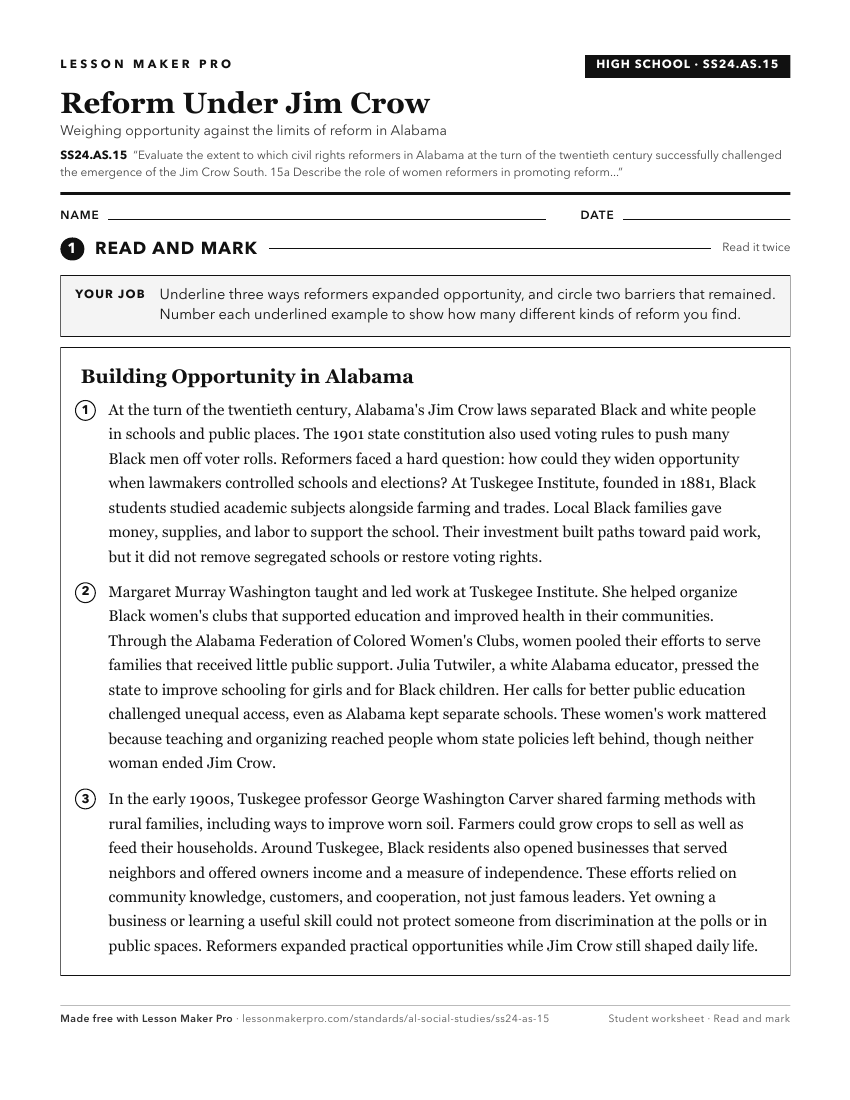
A ready-to-print activity worksheet aligned to SS24.AS.15, with an answer key for the teacher on its own page. No account needed.
PDF, US Letter, prints cleanly in black and white.
Download the worksheetKeep exploring
Related Standards
- SS24.AS.16c
Identify civil rights leaders and foot soldiers in Alabama, and explain their contributions to fostering change in the state.
- SS24.AS.14b
Evaluate the role of new labor systems, Black Codes, and violence in stemming civil rights progress following Reconstruction in Alabama.
- SS24.4.16
Describe how political and social changes of the late 1870s to 1900 affected Black and white Alabamians, including the introduction of Jim Crow laws, sharecropp...
- SS24.US1.19c
Analyze the ideologies, efforts, and impacts of civil rights reformers, groups, and civic organizations that challenged Jim Crow laws and violence at the turn o...
Turn this cluster into a lesson
Grade, subject, topic, and the complete cluster are prefilled. Create one free, no account needed.
Also for this cluster:Make a WorksheetMake a QuizMake a Sub Lesson