Alabama Social Studies SS24.US1.15b
The Standard
- SS24.US1.15
- Evaluate the United States’ efforts to increase engagement with Asia and the Pacific Islands in the late nineteenth century.
Summarize why the United States sought to acquire the Hawaiian Islands and describe native Hawaiians’ efforts to resist annexation.
2024 Alabama Course of Study: Social Studies
Teacher's field guide
What This Standard Means
What Students Need to Do
- Explain how sugar sales, Pacific trade, and the need for a naval base shaped U.S. interest in Hawaii. Describe how Native Hawaiians used petitions and public organizing to oppose annexation.
What Mastery Looks Like
- Students can explain why sugar growers favored annexation and why Pearl Harbor mattered to the U.S. Navy. They can identify the 1897 anti-annexation petition as evidence of organized Native Hawaiian resistance.
Common Misconceptions
- Students may think the U.S. bought Hawaii from its people or that Hawaiians agreed to annexation. They may also confuse the 1893 overthrow of the monarchy with the 1898 annexation.
How to Assess It
- Exit ticket: Give two reasons U.S. leaders wanted Hawaii. Then explain how the 1897 petition challenged annexation.
Lesson moves
Ways to Teach It
Give pairs a Pacific map and yarn; have them link California, Hawaii, and Japan, then label trade and naval interests.
Ask students: How does a petition signed by thousands of Hawaiians challenge the claim that Hawaiians wanted annexation?
Have students sort cards labeled sugar tariffs, Pearl Harbor, the queen's protest, and the 1897 petition into motives and resistance.
Show a current map of Pacific naval bases; students find Pearl Harbor and write how its location could help ships reach Asia.
Free download
Printable SS24.US1.15b Worksheet
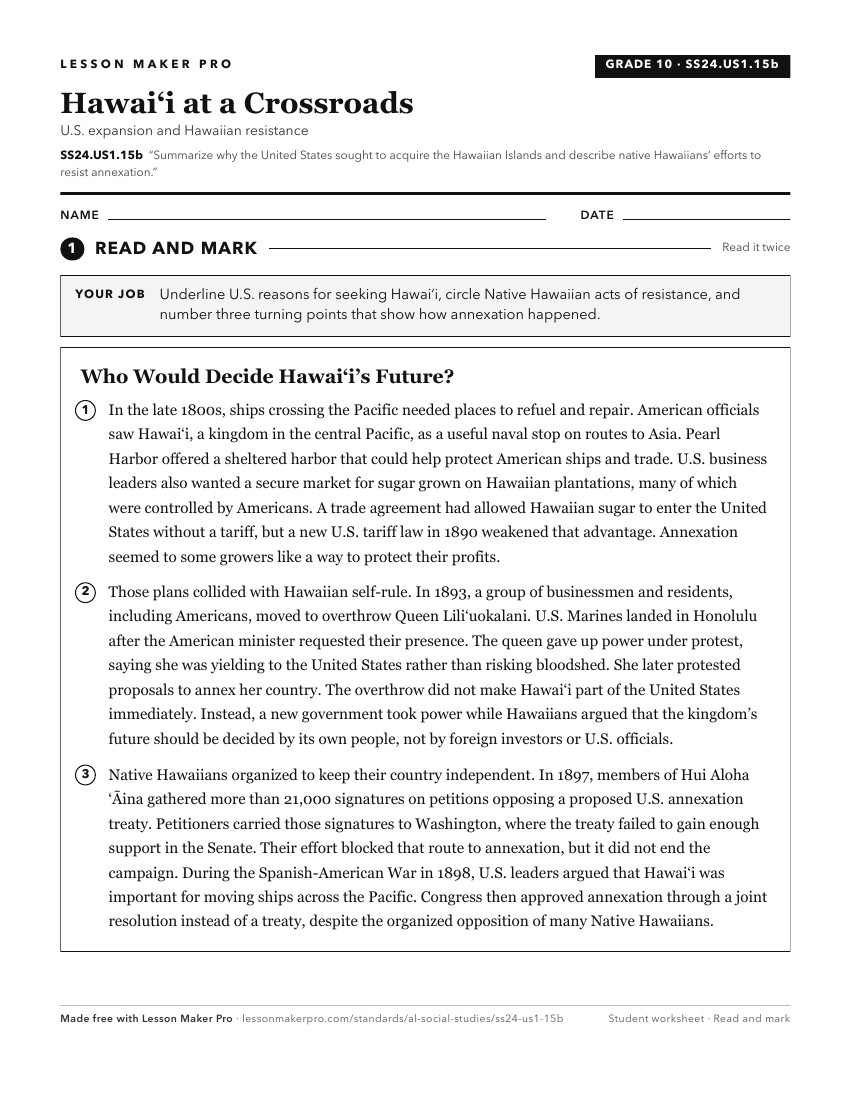
A ready-to-print activity worksheet aligned to SS24.US1.15b, with an answer key for the teacher on its own page. No account needed.
PDF, US Letter, prints cleanly in black and white.
Download the worksheetKeep exploring
Related Standards
- SS24.US2.1
Summarize conflicting viewpoints over the United States’ role in the world from the Spanish-American War to its entry into World War I.
- SS24.US2.6a
Summarize the United States’ foreign policies of isolationism and internationalism as World War II began and explain how the bombing of Pearl Harbor affected th...
- SS24.WH.6b
Summarize how the actions of imperialist nations affected cultures and peoples of Africa and Asia, and explain how these peoples resisted imperialization.
- SS24.US1.15
Evaluate the United States’ efforts to increase engagement with Asia and the Pacific Islands in the late nineteenth century.
Turn this exact standard into a lesson
Grade, subject, topic, and the complete standard are prefilled. Create one free, no account needed.
Also for this standard:Make a WorksheetMake a QuizMake a Sub Lesson