Alabama Social Studies SS24.US1.15
Standard Cluster
Evaluate the United States’ efforts to increase engagement with Asia and the Pacific Islands in the late nineteenth century. 15a Describe the economic contributions of Asian immigrants in the second half of the nineteenth century and the hostility they faced in the United States. 15b Summarize why the United States sought to acquire the Hawaiian Islands and describe native Hawaiians’ efforts to resist annexation.
2024 Alabama Course of Study: Social Studies
Cluster contents
Standards in This Cluster
SS24.US1.15 is a cluster heading. These are the individual standards under it.
- SS24.US1.15a
Describe the economic contributions of Asian immigrants in the second half of the nineteenth century and the hostility they faced in the United States.
- SS24.US1.15b
Summarize why the United States sought to acquire the Hawaiian Islands and describe native Hawaiians’ efforts to resist annexation.
Teacher's field guide
What This Cluster Means
What Students Need to Do
- Students explain why U.S. leaders wanted trade routes and ports across the Pacific. They describe Asian immigrants’ work on railroads, farms, and in businesses, along with the exclusion and violence they faced. They explain why U.S. leaders wanted Hawaii and how Native Hawaiians opposed annexation.
What Mastery Looks Like
- A student can explain how Chinese railroad workers helped the economy while the Chinese Exclusion Act barred new Chinese laborers. They can connect Hawaiian sugar and naval plans to annexation, then use the 1897 Kūʻē petitions as evidence of resistance. They can weigh U.S. gains against the loss of Native Hawaiian self-rule.
Common Misconceptions
- Students may think Asian immigrants only worked on railroads, overlooking farming and small businesses. They may assume Native Hawaiians welcomed annexation or willingly gave up their monarchy. Some confuse the monarchy’s overthrow in 1893 with annexation in 1898.
How to Assess It
- Exit ticket: Did U.S. expansion benefit everyone? Explain using Chinese railroad workers, the Chinese Exclusion Act, U.S. interest in Hawaiian sugar, and the 1897 Kūʻē petitions.
Lesson moves
Ways to Teach It
On a printed Pacific map, use yarn to connect San Francisco, Honolulu, and Yokohama; place sugar and naval-base cards at Honolulu.
Read an excerpt from the 1897 Kūʻē petitions and write a two-sentence reply to a U.S. senator favoring annexation.
Sort cards labeled Chinese railroad work, Chinese Exclusion Act, Hawaiian sugar tariffs, and Kūʻē petitions into contribution, hostility, motive, and resistance.
Compare a modern Pacific shipping map with an 1898 map; mark Honolulu and explain its value as a stop on routes to Asia.
Free download
Printable SS24.US1.15 Worksheet
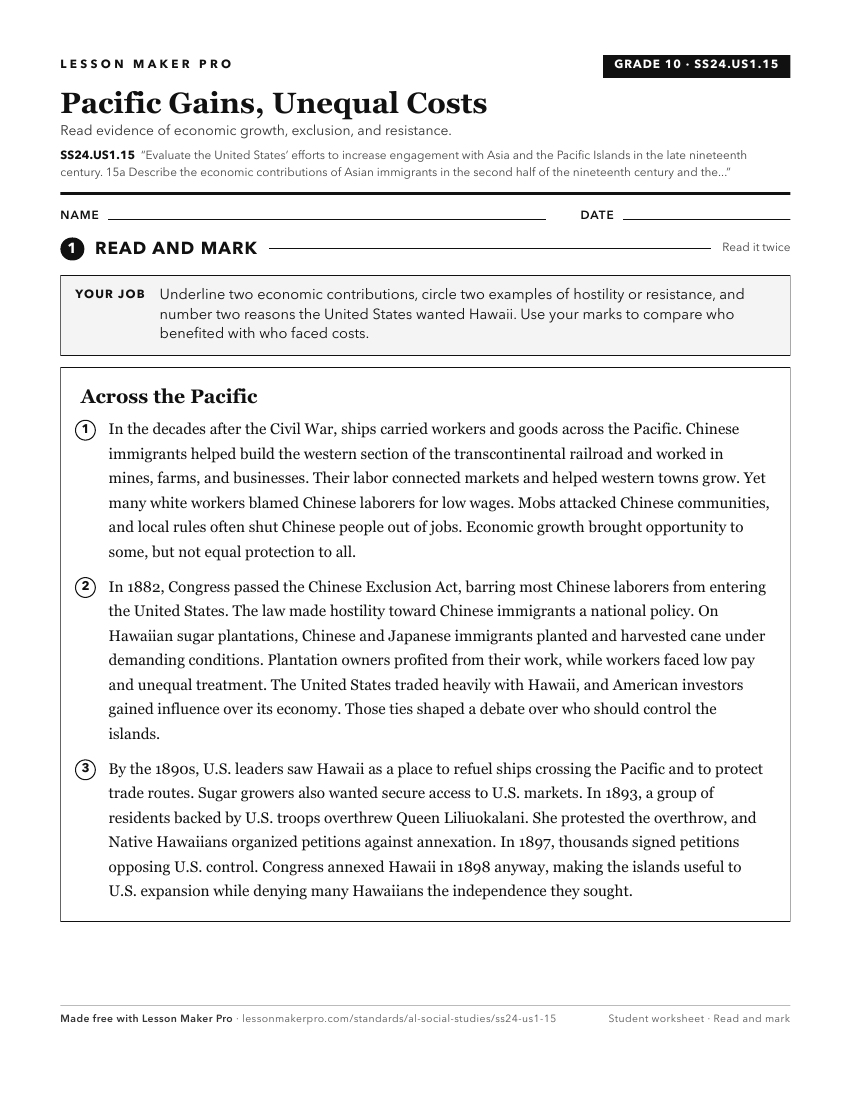
A ready-to-print activity worksheet aligned to SS24.US1.15, with an answer key for the teacher on its own page. No account needed.
PDF, US Letter, prints cleanly in black and white.
Download the worksheetKeep exploring
Related Standards
- SS24.WH.6c
Identify Western nations’ spheres of influence in Africa, Asia, and Latin America that resulted from nineteenth and twentieth century imperialism.
- SS24.US2.7c
Evaluate the effectiveness of United States strategies in the war, including the decision to utilize atomic weapons on Japan.
- SS24.WH.5c
Analyze the rise of Japan’s power in East Asia beginning with the Meiji Restoration.
- SS24.US1.6
Evaluate the influence of American social and political reform on the emergence of a national identity from the early to mid-nineteenth century.
Turn this cluster into a lesson
Grade, subject, topic, and the complete cluster are prefilled. Create one free, no account needed.
Also for this cluster:Make a WorksheetMake a QuizMake a Sub Lesson