Alabama Social Studies SS24.S.8b
The Standard
- SS24.S.8
- Explain the purpose of social systems and institutions, including governments, houses of worship, schools, and voluntary associations.
Differentiate among Weber’s three types of authority (charismatic, rational-legal, and traditional) in respect to source of power and leadership style.*
2024 Alabama Course of Study: Social Studies · Groups and Socialization
Teacher's field guide
What This Standard Means
What Students Need to Do
- Students identify whether a leader's authority comes from personal appeal, custom, or formal rules and an office. They explain how each source affects the way the leader gets people to follow.
What Mastery Looks Like
- A student can classify a movement founder, a hereditary chief, and an elected mayor. They can explain why followers respond to speeches, inherited customs, or decisions made under written rules.
Common Misconceptions
- Students may mistake a popular mayor's personality for the source of the mayor's legal authority. They may call a long-serving principal a traditional leader, though that position comes from district rules, not inherited custom.
How to Assess It
- Exit ticket: Label each leader's type of authority and name a clue about both their source of power and how they lead: a chief follows inherited customs, a mayor applies city rules, and a founder rallies followers through speeches.
Lesson moves
Ways to Teach It
Give pairs three leader profile cards, three power-source cards, and three leadership-style cards to match and explain.
Ask students to write two sentences comparing why people follow a mayor and a movement founder, then predict what happens when each leaves.
Play a quick card sort: teams match six leader scenarios to an authority type and point to the clue in each.
Compare a principal's job description, a royal family tree, and a neighborhood organizer's speech to identify each source of authority.
Free download
Printable SS24.S.8b Worksheet
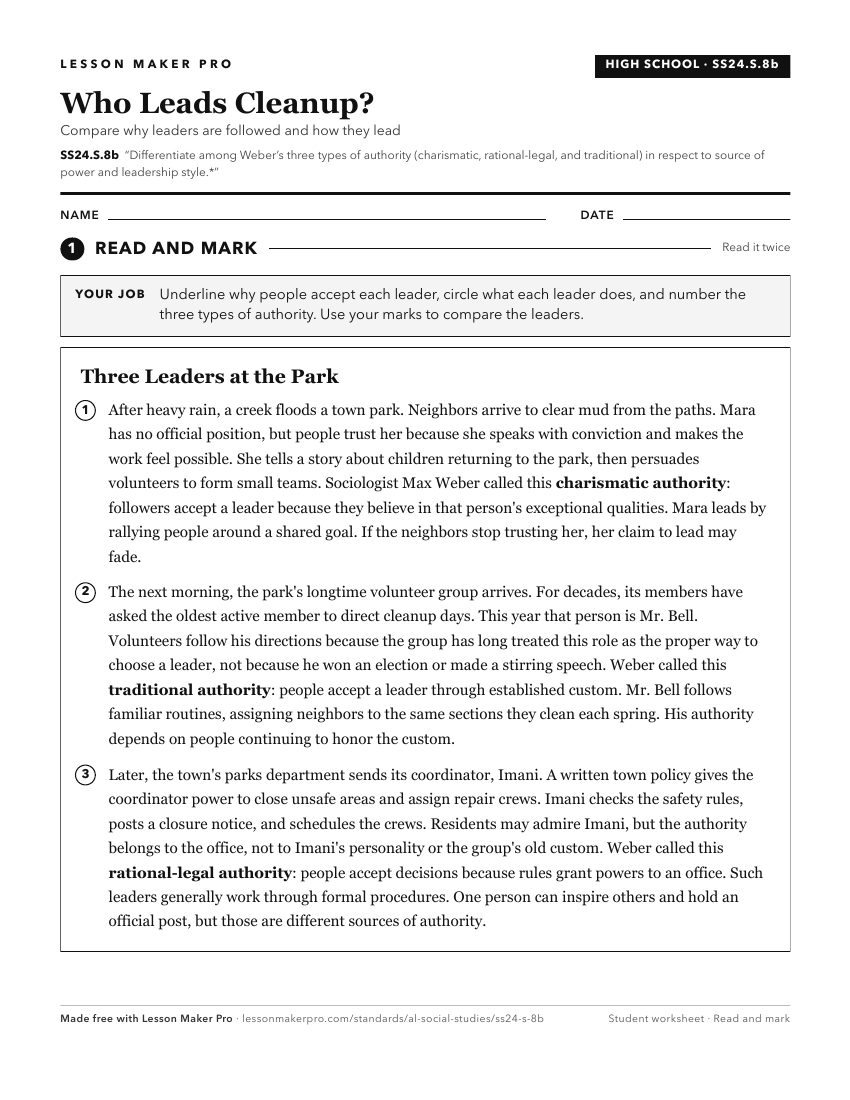
A ready-to-print activity worksheet aligned to SS24.S.8b, with an answer key for the teacher on its own page. No account needed.
PDF, US Letter, prints cleanly in black and white.
Download the worksheetKeep exploring
Related Standards
- SS24.S.8a
Compare how authority is perceived in legitimate power and coercive power leadership styles.*
- SS24.S.7
Analyze how different types of social groups can influence individual and group behavior.*
- SS24.6.10a
Compare and contrast the division of power among levels of government in unitary, federal, and confederate styles of governance.
- SS24.S.3
Compare and contrast the three major sociological theories: functionalism, conflict theory, and symbolic interaction.*
Turn this exact standard into a lesson
Grade, subject, topic, and the complete standard are prefilled. Create one free, no account needed.
Also for this standard:Make a WorksheetMake a QuizMake a Sub Lesson