Alabama Social Studies SS24.S.8a
The Standard
- SS24.S.8
- Explain the purpose of social systems and institutions, including governments, houses of worship, schools, and voluntary associations.
Compare how authority is perceived in legitimate power and coercive power leadership styles. *
2024 Alabama Course of Study: Social Studies · Groups and Socialization
Teacher's field guide
What This Standard Means
What Students Need to Do
- Students compare why people follow a leader with a recognized right to give directions and one who relies on threatened penalties. They use details from a situation to explain whether followers accept the leader's authority, fear the consequences, or both.
What Mastery Looks Like
- Given an elected club president and a peer who threatens exclusion, a student can explain why members might obey each one. They can also explain that an elected leader may use threats.
Common Misconceptions
- Students may assume that anyone with a title has authority the group accepts. They may think coercion only comes from people without an official role. They may also mistake obedience for agreement.
How to Assess It
- Exit ticket: An elected club president assigns jobs under club rules, then threatens to exclude anyone who refuses. What gives the president accepted authority, and what part relies on coercion?
Lesson moves
Ways to Teach It
Have pairs arrange paper slips labeled elected president, club rule, penalty threat, and member response into two chains showing why members comply.
Ask: If a principal threatens detention for breaking a rule, does their authority come from their position, the threatened penalty, or both?
Play a three-card sort: elected captain assigns drills, peer threatens gossip, and principal warns of detention; label each role, threat, or both.
Read the school handbook's attendance rule and consequence, then ask whether students comply because of school authority, the penalty, or both.
Free download
Printable SS24.S.8a Worksheet
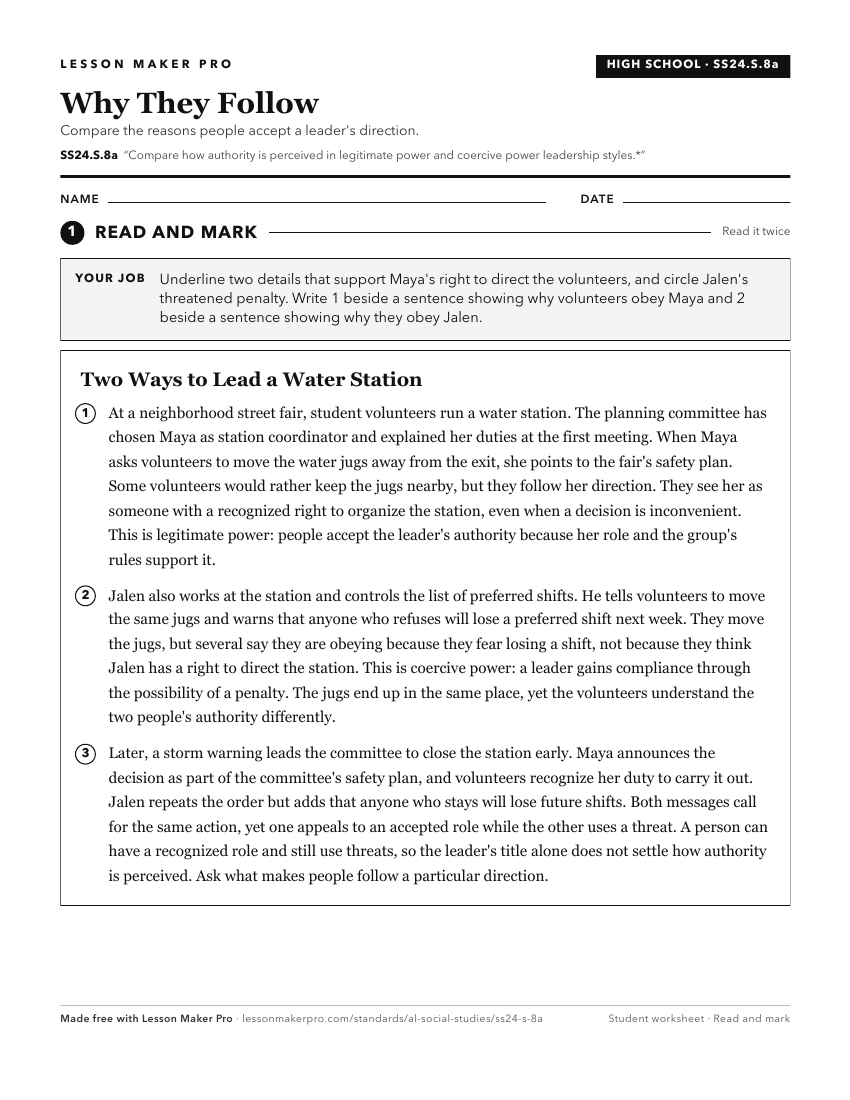
A ready-to-print activity worksheet aligned to SS24.S.8a, with an answer key for the teacher on its own page. No account needed.
PDF, US Letter, prints cleanly in black and white.
Download the worksheetKeep exploring
Related Standards
- SS24.2.2a
Compare the state and national governments in respect to their powers, roles, and leaders.
- SS24.S.8b
Differentiate among Weber’s three types of authority (charismatic, rational-legal, and traditional) in respect to source of power and leadership style.*
- SS24.P.17a
Critique the ethical issues found in Stanley Milgram's work with obedience and S. E. Asch's work with conformity.
- SS24.6.10a
Compare and contrast the division of power among levels of government in unitary, federal, and confederate styles of governance.
Turn this exact standard into a lesson
Grade, subject, topic, and the complete standard are prefilled. Create one free, no account needed.
Also for this standard:Make a WorksheetMake a QuizMake a Sub Lesson