Alabama Social Studies SS24.S.8
Standard Cluster
Explain the purpose of social systems and institutions, including governments, houses of worship, schools, and voluntary associations. 8a Compare how authority is perceived in legitimate power and coercive power leadership styles. * 8b Differentiate among Weber’s three types of authority (charismatic, rational-legal, and traditional) in respect to source of power and leadership style.*
2024 Alabama Course of Study: Social Studies
Cluster contents
Standards in This Cluster
SS24.S.8 is a cluster heading. These are the individual standards under it.
Teacher's field guide
What This Cluster Means
What Students Need to Do
- Students explain how governments, houses of worship, schools, and volunteer groups meet community needs. They tell whether people follow a leader because they accept the leader's right to lead or fear punishment. They identify authority based on custom, personal appeal, or formal rules.
What Mastery Looks Like
- Given a hereditary ruler, an appointed principal, and an admired organizer, students name the source of each leader's authority and point to a clue. They can explain that a principal's office gives them authority, while a threat of detention uses coercion. They can name a need each institution meets.
Common Misconceptions
- Students may think houses of worship only hold services or that volunteer groups have no rules. They may treat a principal's accepted authority and a threat of detention as the same kind of power. They may confuse authority based on family custom, personal appeal, and written rules.
How to Assess It
- Exit ticket: Match a government, house of worship, school, and volunteer food pantry to one need each. Then label the authority behind a hereditary ruler, an appointed principal, and an admired organizer, and explain why a threat of detention is coercive.
Lesson moves
Ways to Teach It
Give pairs cards labeled city council, mosque, high school, and volunteer food pantry; have them match each card to a community need.
Ask: When a principal announces a phone rule, do students comply because they accept school rules or fear detention? Discuss both possibilities.
Play a three-corner game: read profiles of a hereditary ruler, an appointed judge, and an admired organizer; students choose the matching authority corner.
Use a local food bank flyer and a school handbook to compare how each group sets rules and organizes people.
Free download
Printable SS24.S.8 Worksheet
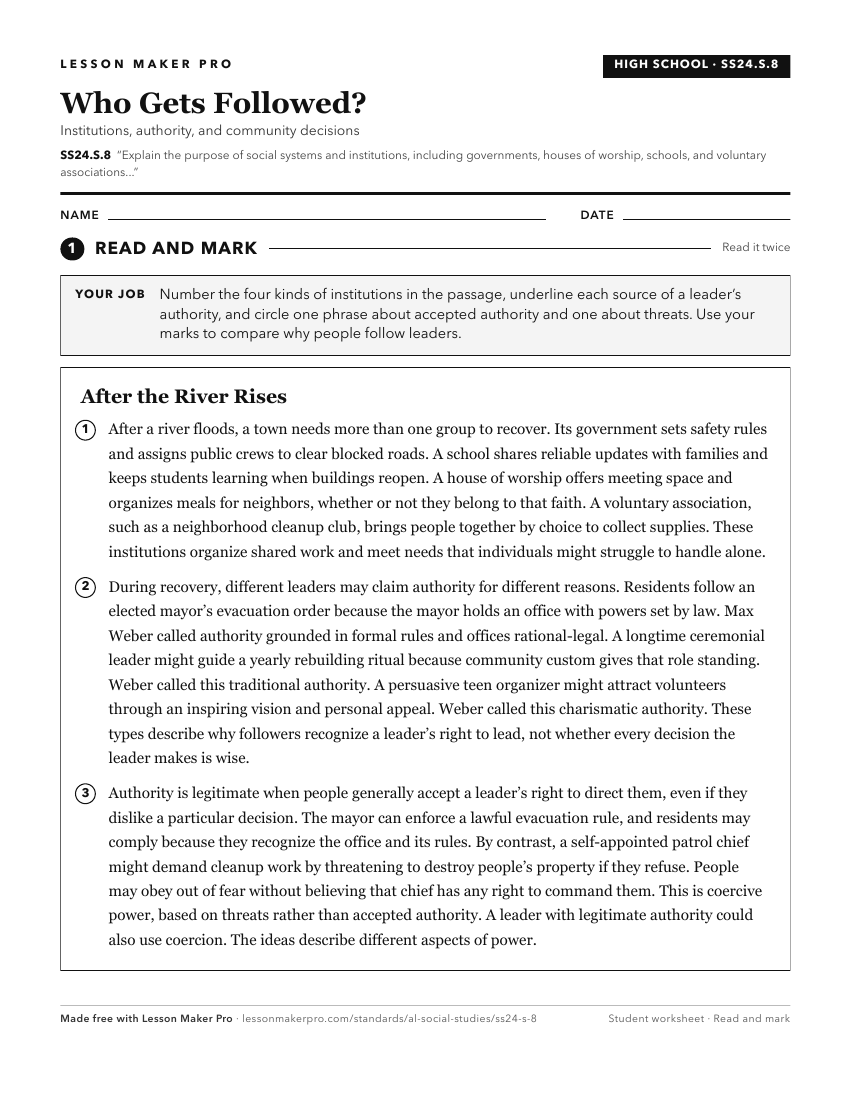
A ready-to-print activity worksheet aligned to SS24.S.8, with an answer key for the teacher on its own page. No account needed.
PDF, US Letter, prints cleanly in black and white.
Download the worksheetKeep exploring
Related Standards
- SS24.S.11c
Explain the role of social institutions in fostering change and reinforcing stratification.*
- SS24.S.1b
Identify and explain tenets of sociology, including functional integration, power, social action, social structure, and culture.
- SS24.1.3
Explain the role of commercial institutions within the local community, including banks, grocery stores, and other businesses.
- SS24.K.1b
Explain how rules meet needs and provide order, security, and safety in the home, school, and community.
Turn this cluster into a lesson
Grade, subject, topic, and the complete cluster are prefilled. Create one free, no account needed.
Also for this cluster:Make a WorksheetMake a QuizMake a Sub Lesson