Alabama Social Studies SS24.S.1
Standard Cluster
Describe the development of sociology as a social science field of study.* 1a Explain the contributions of important figures in the field of sociology, including Émile Durkheim, George Herbert Mead, Karl Marx, Max Weber, and W.E.B. Du Bois.* 1b Identify and explain tenets of sociology, including functional integration, power, social action, social structure, and culture.
2024 Alabama Course of Study: Social Studies
Cluster contents
Standards in This Cluster
SS24.S.1 is a cluster heading. These are the individual standards under it.
- SS24.S.1a
Explain the contributions of important figures in the field of sociology, including Émile Durkheim, George Herbert Mead, Karl Marx, Max Weber, and W.E.B. Du Boi...
- SS24.S.1b
Identify and explain tenets of sociology, including functional integration, power, social action, social structure, and culture.
Teacher's field guide
What This Cluster Means
What Students Need to Do
- Explain how factory growth and crowded cities led scholars to study social life. Connect five early thinkers to the questions they asked. Use familiar settings to explain group ties, power, personal motives, routines, and shared customs.
What Mastery Looks Like
- Students link Durkheim to social bonds, Mead to the self formed through interaction, Marx to class conflict, Weber to meaningful action, and Du Bois to research on racial inequality. They explain why rapid social change prompted these questions. In a cafeteria, they can point to group ties, who makes rules, why students act, daily routines, and unwritten customs.
Common Misconceptions
- Students may confuse Marx’s focus on class conflict with Weber’s focus on what actions mean to people. They may think culture means only holidays, not everyday customs like where people choose to sit. They may assume strong group ties mean everyone has equal power.
How to Assess It
- Give students this exit ticket: “A factory brings many families to a growing city, and workers organize for safer jobs. Why might scholars study this change? Connect two named thinkers to the scene and identify one example of power or group ties.”
Lesson moves
Ways to Teach It
Give pairs cards labeled class conflict, social bonds, meaningful action, racial inequality, and self through interaction; have them match each card to a thinker.
Ask students to write: “In our cafeteria, what shapes who sits together?” Require one observed example and an explanation.
Sort five cards by group ties, power, motives, structure, or culture: club jobs, principal’s rules, joining for friends, class schedules, shared slang.
Print a school board agenda; students mark public comment times, who votes, and which policies may change their daily routines.
Free download
Printable SS24.S.1 Worksheet
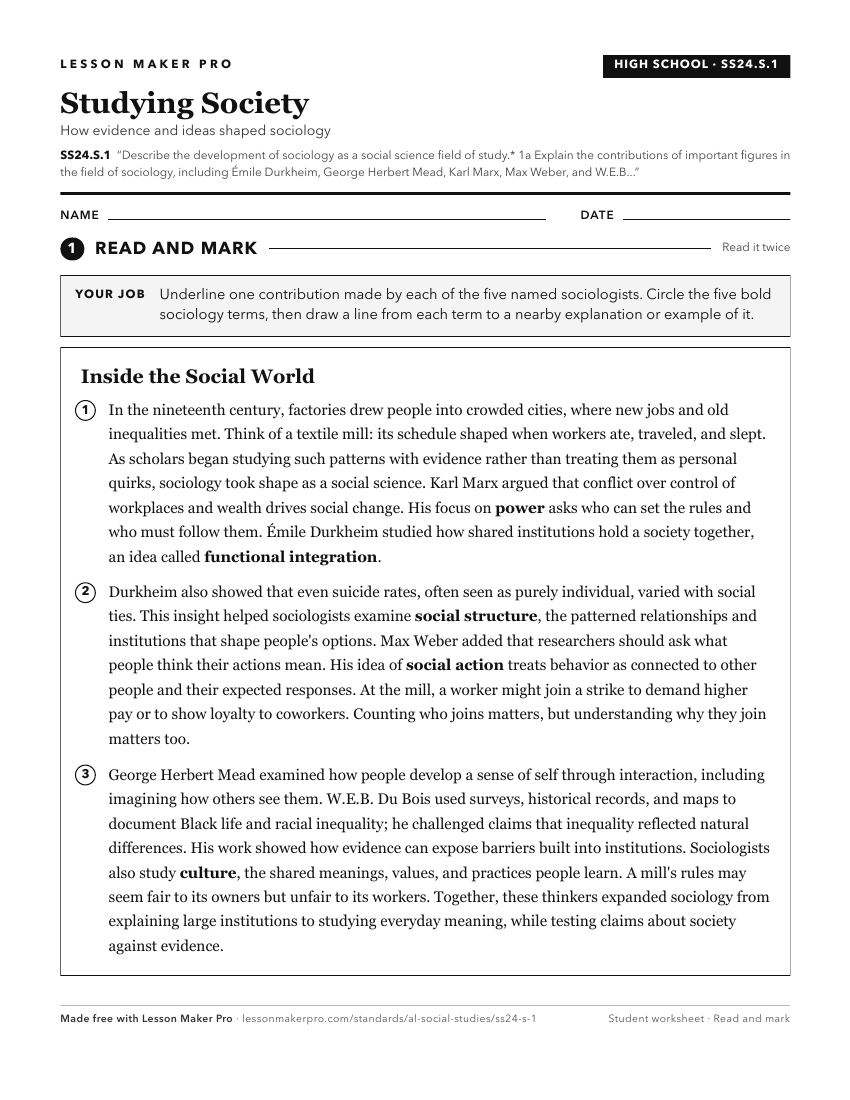
A ready-to-print activity worksheet aligned to SS24.S.1, with an answer key for the teacher on its own page. No account needed.
PDF, US Letter, prints cleanly in black and white.
Download the worksheetKeep exploring
Related Standards
- SS24.S.2
Explain methods and tools of research used by sociologists.*
- SS24.S.5c
Investigate and explain the impact of psychological theories that influence sociology, including Erikson’s Psychosocial Development, Kohlberg’s Stages of Moral ...
- SS24.P.1
Trace the development of psychology as a scientific discipline, including its evolution from other fields of study.*
Turn this cluster into a lesson
Grade, subject, topic, and the complete cluster are prefilled. Create one free, no account needed.
Also for this cluster:Make a WorksheetMake a QuizMake a Sub Lesson