Alabama Social Studies SS24.P.16
Standard Cluster
Describe major psychological disorders and their treatments and explain how examples of abnormal behavior differ from normal behavior.* 16a Describe various approaches for explaining mental illness, including biological and medical, cognitive, and sociocultural models. 16b Differentiate among types of mental illness, including mood, anxiety, somatoform, schizophrenic, dissociative, and personality disorders.
2024 Alabama Course of Study: Social Studies
Cluster contents
Standards in This Cluster
SS24.P.16 is a cluster heading. These are the individual standards under it.
Teacher's field guide
What This Cluster Means
What Students Need to Do
- Students look at context, duration, distress, and daily functioning to tell when behavior may need clinical attention. They distinguish mood, anxiety, somatic symptom, schizophrenia spectrum, dissociative, and personality disorders. They explain how biology, thought patterns, and social context can shape mental health, and describe possible treatments.
What Mastery Looks Like
- Given fictional cases, a student identifies the likely disorder family and cites a clue. They separate a brief bad day from sustained low mood that disrupts life. They name a plausible treatment without claiming to diagnose the person.
Common Misconceptions
- Students may call any unusual behavior a disorder, even when it causes no lasting distress or disruption. They may confuse schizophrenia with multiple identities or assume physical symptoms in somatic symptom disorders are faked. Some think medication is the only treatment.
How to Assess It
- Exit ticket: “A student misses school for weeks after repeated panic attacks. Name the likely disorder family, one sign this is more than ordinary nerves, one cognitive explanation, and one possible treatment.”
Lesson moves
Ways to Teach It
Sort six fictional case cards by disorder family, then attach a treatment card and point to the clue that supports each match.
Give pairs two worry vignettes and ask which shows sustained distress or disrupted daily life, and what else they need to know.
Play a card-match using a fictional anxiety case: connect biological, cognitive, and sociocultural explanations to medication, cognitive behavioral therapy, and family check-ins.
Read a printed community clinic intake page and write two questions someone could ask about evaluation and treatment options.
Free download
Printable SS24.P.16 Worksheet
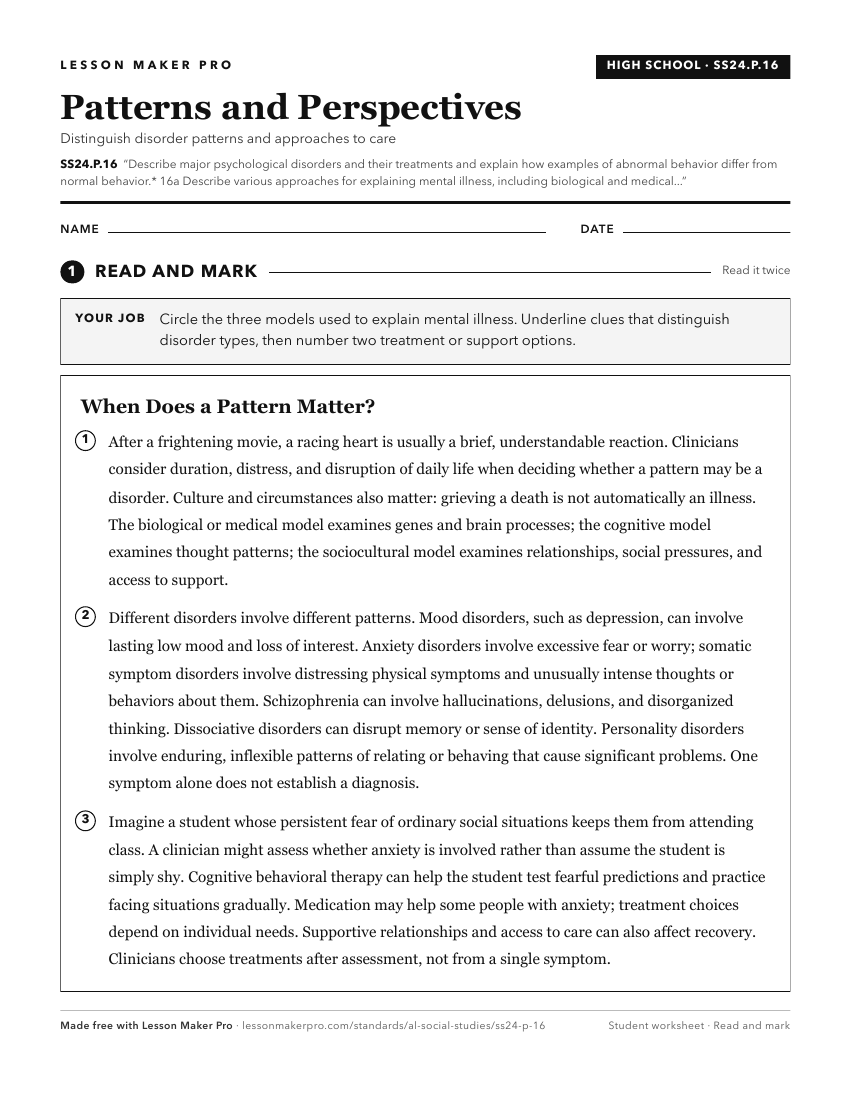
A ready-to-print activity worksheet aligned to SS24.P.16, with an answer key for the teacher on its own page. No account needed.
PDF, US Letter, prints cleanly in black and white.
Download the worksheetKeep exploring
Related Standards
Turn this cluster into a lesson
Grade, subject, topic, and the complete cluster are prefilled. Create one free, no account needed.
Also for this cluster:Make a WorksheetMake a QuizMake a Sub Lesson