Alabama Social Studies SS24.HOS.21a
The Standard
- SS24.HOS.21
- Evaluate the extent to which the legal responses, including the Nuremberg Trials, held Nazi officials to account for war crimes and crimes against humanity.*
Assess the contributions of Supreme Court Justice Robert Jackson and the arguments he made as Chief Prosecutor for the United States at the Nuremberg Trials.
2024 Alabama Course of Study: Social Studies · Post-War
Teacher's field guide
What This Standard Means
What Students Need to Do
- Students explain how Robert Jackson helped set up the Nuremberg prosecutions and presented the U.S. case against Nazi leaders. They use his opening statement to explain why leaders should face individual charges in a fair trial.
What Mastery Looks Like
- A student can match invasion planning, prisoner abuse, and persecution of civilians to the charges brought at Nuremberg. They can use Jackson's words to explain why high office did not excuse a defendant and why the prosecution presented evidence in court.
Common Misconceptions
- Some students think Jackson was the judge who handed down the verdict, rather than the U.S. prosecutor. Others think holding high office or following orders automatically excused defendants, or that the trials punished people simply for losing the war.
How to Assess It
- Hand out a short excerpt from Jackson's opening statement and Article 7 of the Nuremberg Charter. Ask: Why could a Nazi leader face trial despite holding high office? Name one charge the prosecution could bring.
Lesson moves
Ways to Teach It
Give pairs printed excerpts from Jackson's opening statement and the Nuremberg Charter; have them sort claims under charges, leader accountability, or trial fairness.
Ask: Why did Jackson argue for a public trial rather than punishment without trial? Have students cite one line from his opening statement.
Post three case cards, planning an invasion, killing prisoners of war, and persecuting civilians; teams match each to a Nuremberg charge.
Compare the Nuremberg Charter's charge list with the International Criminal Court's four crime types; students circle shared categories and name the added one.
Free download
Printable SS24.HOS.21a Worksheet
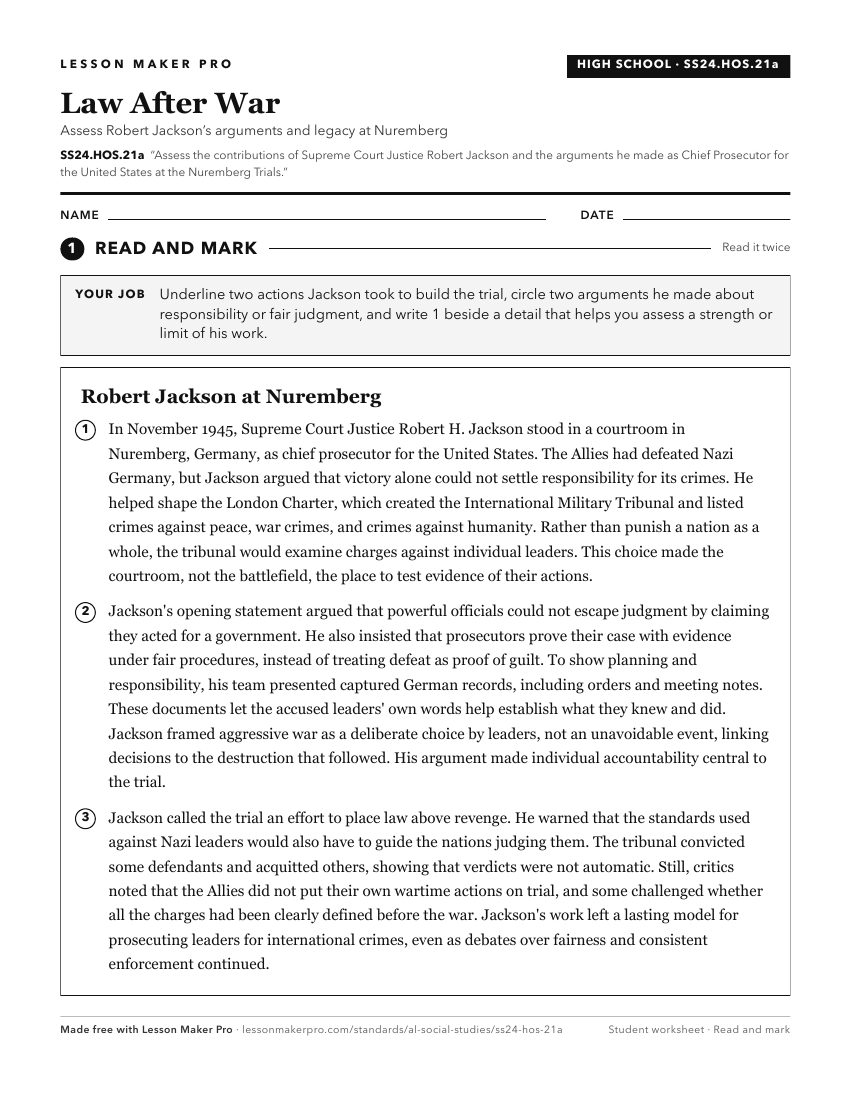
A ready-to-print activity worksheet aligned to SS24.HOS.21a, with an answer key for the teacher on its own page. No account needed.
PDF, US Letter, prints cleanly in black and white.
Download the worksheetKeep exploring
Related Standards
- SS24.HOS.7b
Evaluate the effects of the Nuremberg Laws on Jewish life in Germany.*
- SS24.HOS.21c
Explain the effects of the Adolf Eichmann trial in 1961 on policy concerning crimes against humanity, capital punishment, accountability, and the testimony of s...
- SS24.WH.12a
Explain the origins, conduct, and outcomes of the Nuremberg Trials and Tokyo War Crimes Tribunal.
- SS24.HOS.21
Evaluate the extent to which the legal responses, including the Nuremberg Trials, held Nazi officials to account for war crimes and crimes against humanity.*
Turn this exact standard into a lesson
Grade, subject, topic, and the complete standard are prefilled. Create one free, no account needed.
Also for this standard:Make a WorksheetMake a QuizMake a Sub Lesson