Alabama Social Studies SS24.HOS.21c
The Standard
- SS24.HOS.21
- Evaluate the extent to which the legal responses, including the Nuremberg Trials, held Nazi officials to account for war crimes and crimes against humanity.*
Explain the effects of the Adolf Eichmann trial in 1961 on policy concerning crimes against humanity, capital punishment, accountability, and the testimony of survivors.
2024 Alabama Course of Study: Social Studies · Post-War
Teacher's field guide
What This Standard Means
What Students Need to Do
- Students explain how Israel tried Eichmann for crimes against humanity committed during World War II. They connect the trial to debates about prosecuting crimes across borders and using the death penalty. They explain how survivor testimony brought firsthand accounts to a wide public audience.
What Mastery Looks Like
- A student can use a trial excerpt to explain why following orders did not excuse Eichmann's actions. They can distinguish his 1961 trial from his 1962 execution and explain why the death sentence drew debate. They can describe how survivors' accounts shaped public understanding of the Holocaust.
Common Misconceptions
- Students may think the trial created the charge of crimes against humanity or made the death penalty standard worldwide. Some assume that following orders removed Eichmann's responsibility. Others treat survivor testimony as background rather than evidence heard in court.
How to Assess It
- Exit ticket: In four sentences, explain one point the trial made about accountability, one debate about Eichmann's death sentence, and one effect of survivor testimony. Support one point with a detail from a trial excerpt.
Lesson moves
Ways to Teach It
Give pairs printed judgment, sentencing, and survivor testimony excerpts; have them sort each under accountability, capital punishment, or public memory.
Ask students to write three sentences: Should following orders reduce responsibility for crimes against humanity? Use one detail from Eichmann's judgment.
Run a claim-check game with cards saying 'the trial created crimes against humanity' or 'Israel executed Eichmann'; students mark each true or false and correct errors.
Post a headline about a modern war crimes prosecution beside a 1961 Eichmann headline; students identify who claims authority to prosecute each case.
Free download
Printable SS24.HOS.21c Worksheet
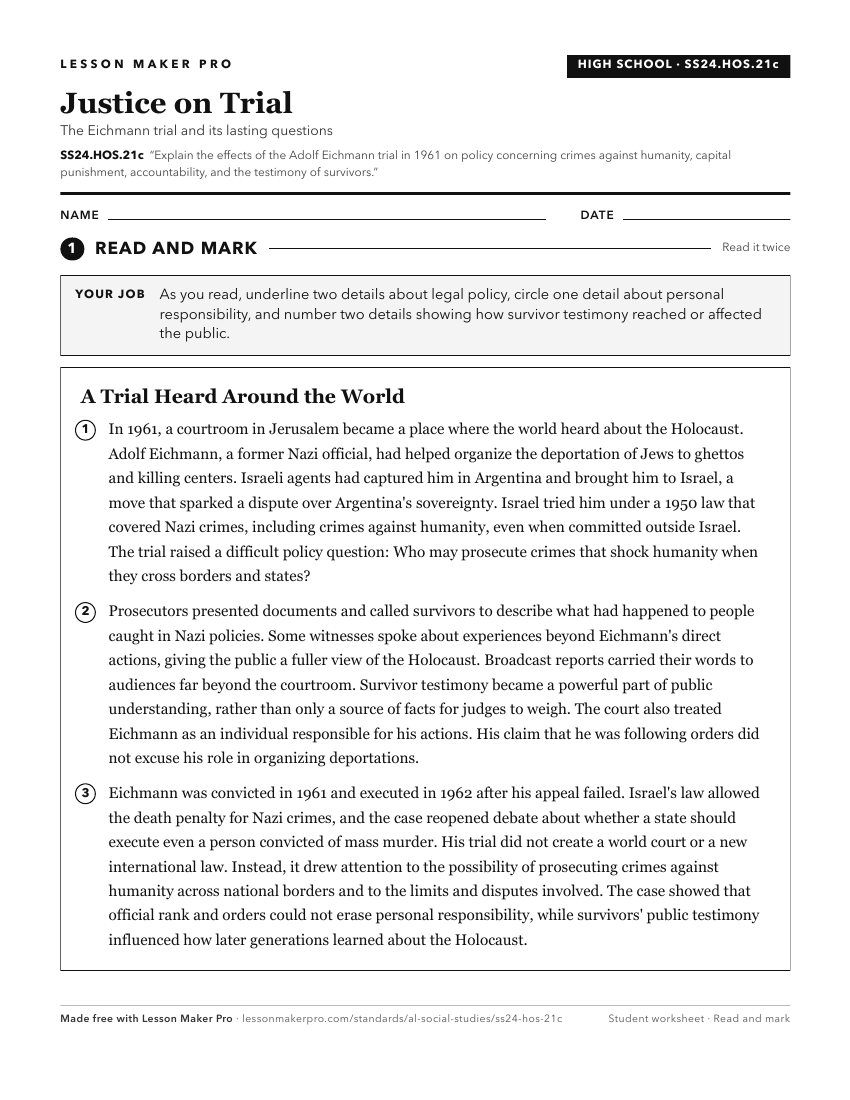
A ready-to-print activity worksheet aligned to SS24.HOS.21c, with an answer key for the teacher on its own page. No account needed.
PDF, US Letter, prints cleanly in black and white.
Download the worksheetKeep exploring
Related Standards
- SS24.HOS.7b
Evaluate the effects of the Nuremberg Laws on Jewish life in Germany.*
- SS24.HOS.18a
Evaluate American and Allied officials’ knowledge of and response to the Final Solution.
- SS24.WH.12a
Explain the origins, conduct, and outcomes of the Nuremberg Trials and Tokyo War Crimes Tribunal.
- SS24.HOS.21
Evaluate the extent to which the legal responses, including the Nuremberg Trials, held Nazi officials to account for war crimes and crimes against humanity.*
Turn this exact standard into a lesson
Grade, subject, topic, and the complete standard are prefilled. Create one free, no account needed.
Also for this standard:Make a WorksheetMake a QuizMake a Sub Lesson