Alabama Social Studies SS24.HOS.21
Standard Cluster
Evaluate the extent to which the legal responses, including the Nuremberg Trials, held Nazi officials to account for war crimes and crimes against humanity.* 21a Assess the contributions of Supreme Court Justice Robert Jackson and the arguments he made as Chief Prosecutor for the United States at the Nuremberg Trials. 21b Analyze the influence of the Holocaust on the drafting and substance of the 1948 United Nations Declaration of Human Rights. 21c Explain the effects of the Adolf Eichmann trial in 1961 on policy concerning crimes against humanity, capital punishment, accountability, and the testimony of survivors. 21d Develop an argument regarding the need for education about the Holocaust and how museums, memorials, and organizations can be used to preserve memory and combat Holocaust denial.*
2024 Alabama Course of Study: Social Studies
Cluster contents
Standards in This Cluster
SS24.HOS.21 is a cluster heading. These are the individual standards under it.
- SS24.HOS.21a
Assess the contributions of Supreme Court Justice Robert Jackson and the arguments he made as Chief Prosecutor for the United States at the Nuremberg Trials.
- SS24.HOS.21b
Analyze the influence of the Holocaust on the drafting and substance of the 1948 United Nations Declaration of Human Rights.
- SS24.HOS.21c
Explain the effects of the Adolf Eichmann trial in 1961 on policy concerning crimes against humanity, capital punishment, accountability, and the testimony of s...
- SS24.HOS.21d
Develop an argument regarding the need for education about the Holocaust and how museums, memorials, and organizations can be used to preserve memory and combat...
Teacher's field guide
What This Cluster Means
What Students Need to Do
- Students weigh what the trials achieved and whom they did not prosecute. They trace Jackson's arguments, the Holocaust's influence on the 1948 rights declaration, and the Eichmann trial's effects on survivor testimony and legal debates. They use museum evidence to argue why Holocaust education matters.
What Mastery Looks Like
- A student uses Jackson's arguments and trial outcomes to explain both accountability and its limits. They connect specific rights in the 1948 declaration to Holocaust atrocities without calling the declaration a criminal law. They explain how the Eichmann trial amplified survivor voices and raised questions about jurisdiction and execution.
Common Misconceptions
- Some students assume all Nazi officials were tried at Nuremberg or that Jackson was a judge. Others treat the 1948 rights declaration as a binding criminal law. Students may think the Eichmann trial invented crimes against humanity or that survivor testimony began there.
How to Assess It
- Exit ticket: Did postwar trials hold Nazi officials accountable? Support your answer with one Jackson argument, one Eichmann trial outcome, and one limit on prosecution.
Lesson moves
Ways to Teach It
Give pairs printed excerpts of Jackson's opening statement, a Nuremberg verdict, and Articles 3 and 5 of the rights declaration; label accusation, ruling, and rights.
Write four sentences: Did Jackson's use of documents and fair trial procedures strengthen Nuremberg's credibility, despite officials who escaped prosecution?
Give students a short Eichmann trial timeline and claim cards on survivor testimony, jurisdiction, execution, and accountability; sort each as supported or unsupported.
Open a United States Holocaust Memorial Museum artifact page; write a 40-word display label explaining how its evidence helps answer Holocaust denial.
Free download
Printable SS24.HOS.21 Worksheet
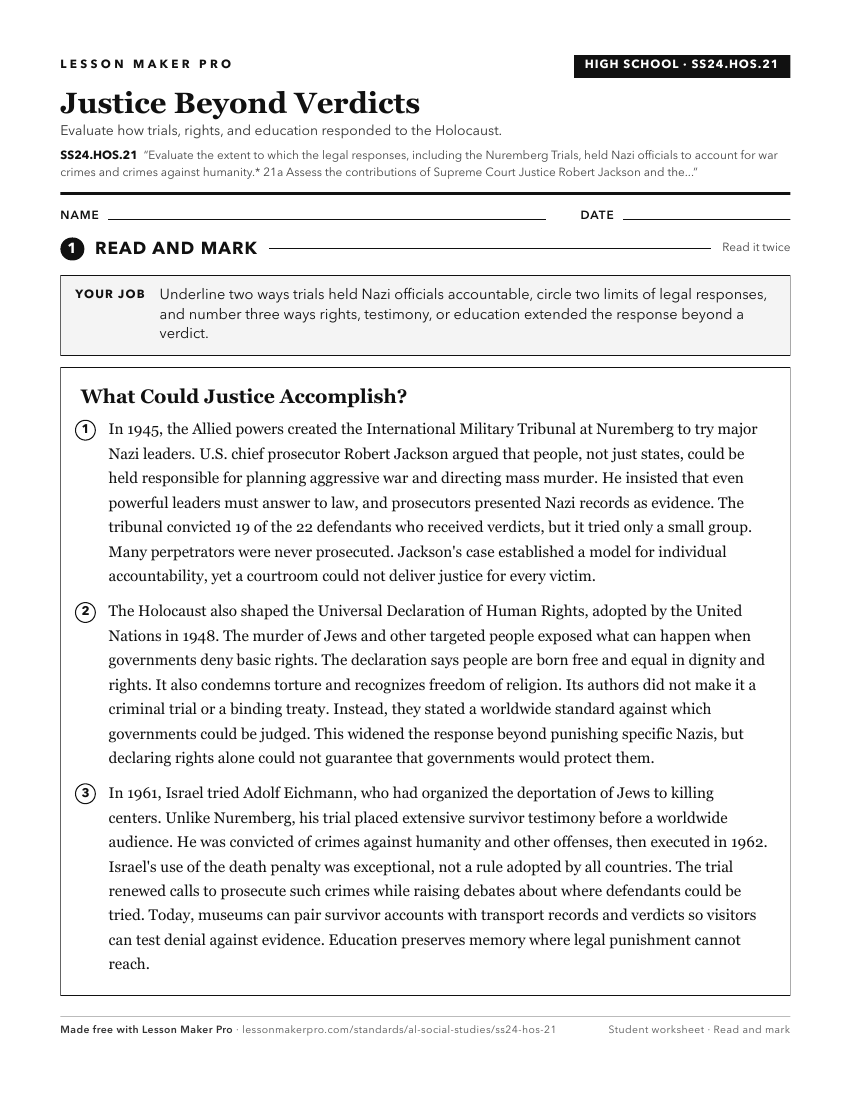
A ready-to-print activity worksheet aligned to SS24.HOS.21, with an answer key for the teacher on its own page. No account needed.
PDF, US Letter, prints cleanly in black and white.
Download the worksheetKeep exploring
Related Standards
Turn this cluster into a lesson
Grade, subject, topic, and the complete cluster are prefilled. Create one free, no account needed.
Also for this cluster:Make a WorksheetMake a QuizMake a Sub Lesson