Alabama Social Studies SS24.E.10
Standard Cluster
Analyze the factors that determine and shape a country’s standard of living. 10a Explain how the relationship between inputs and outputs is used to calculate productivity at various levels of the economy. 10b Explain how investments in education, equipment, factories, healthcare, new technology, and training promote economic growth and enhance living standards. 10c Research and share information on how Alabama and the United States relate to the global economy in terms of current technological innovations and technology-based industries.
2024 Alabama Course of Study: Social Studies
Cluster contents
Standards in This Cluster
SS24.E.10 is a cluster heading. These are the individual standards under it.
- SS24.E.10a
Explain how the relationship between inputs and outputs is used to calculate productivity at various levels of the economy.
- SS24.E.10b
Explain how investments in education, equipment, factories, healthcare, new technology, and training promote economic growth and enhance living standards.
- SS24.E.10c
Research and share information on how Alabama and the United States relate to the global economy in terms of current technological innovations and technology-ba...
Teacher's field guide
What This Cluster Means
What Students Need to Do
- Students compare living standards using income, health, and education data. They calculate output per labor hour for workers, businesses, and countries, then explain how investments can change those rates. They research and present how Alabama and U.S. technology industries connect to other countries.
What Mastery Looks Like
- Students calculate units per worker-hour for a factory and GDP per labor hour for a country. They explain how training, equipment, or healthcare could raise output and improve lives, without assuming everyone benefits equally. They use a dated source to trace an Alabama industry and a U.S. technology industry to overseas buyers or suppliers.
Common Misconceptions
- Students may call total output productivity without dividing by labor hours. They may assume higher GDP means everyone has better healthcare or higher wages. They may overlook imported parts in goods made in Alabama.
How to Assess It
- Exit ticket: A factory makes 120 parts in 6 worker-hours, then 180 parts in 6 worker-hours. Calculate both rates and name one investment that could explain the change and one way it might improve living standards.
Lesson moves
Ways to Teach It
Have pairs fold paper boats for two timed rounds; offer a folding guide before round two and calculate boats per worker-minute.
Have students defend whether a new factory, nurse training, or school funding would improve a rural county's living standards fastest.
Play a card sort matching output to hours for workers and factories, plus GDP to labor hours for countries; calculate each rate.
Have pairs use current Alabama aerospace export data and a U.S. chipmaker's annual report to present one overseas market for each.
Free download
Printable SS24.E.10 Worksheet
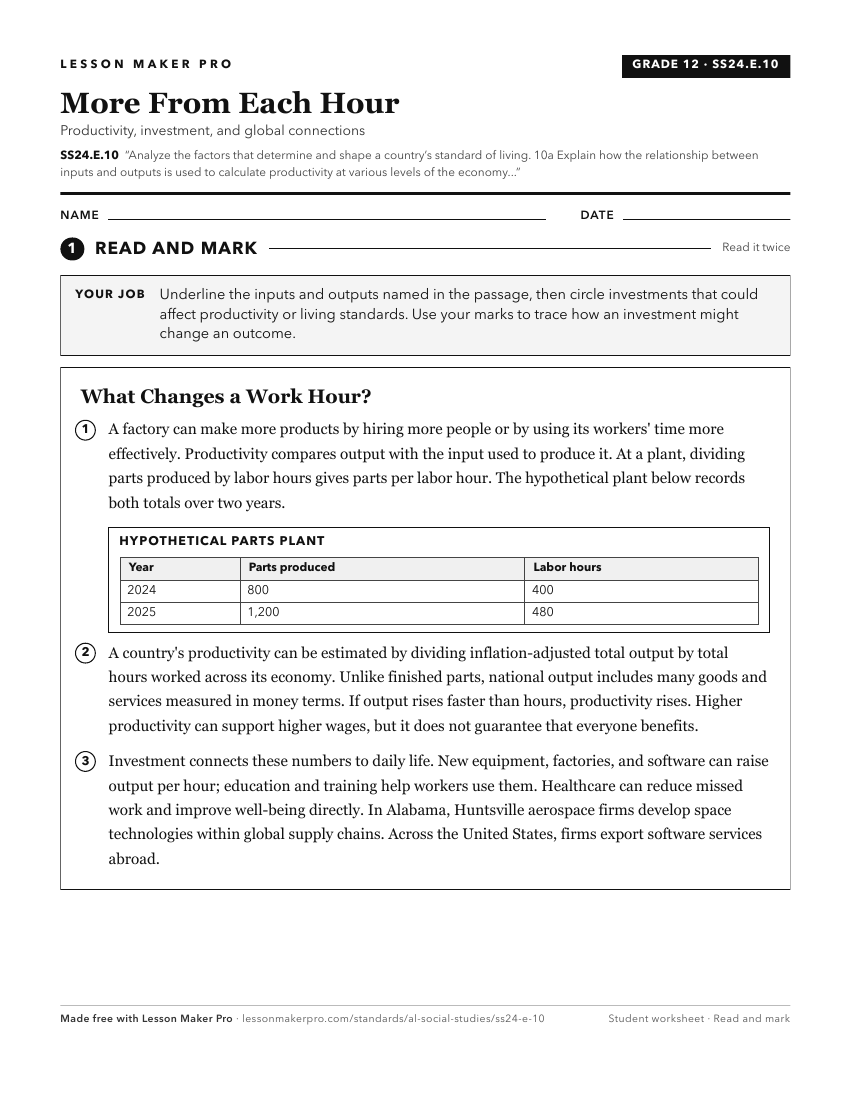
A ready-to-print activity worksheet aligned to SS24.E.10, with an answer key for the teacher on its own page. No account needed.
PDF, US Letter, prints cleanly in black and white.
Download the worksheetKeep exploring
Related Standards
- SS24.CWI.9
Evaluate the impact of economic globalization on worldwide trends and on individual nations and regions.
- SS24.WH.17
Analyze the effects of economic interdependence and globalization on places and their populations.
- SS24.CWI.9c
Compare ways in which different countries address individual needs, national economic problems, and social issues.
- SS24.E.8a
Analyze how spending and production decisions made by households, businesses, and government determine overall levels of income, employment, and prices.
Turn this cluster into a lesson
Grade, subject, topic, and the complete cluster are prefilled. Create one free, no account needed.
Also for this cluster:Make a WorksheetMake a QuizMake a Sub Lesson