Alabama Social Studies SS24.CWI.9
Standard Cluster
Evaluate the impact of economic globalization on worldwide trends and on individual nations and regions. 9a Identify recurring historical patterns in economic development around the world. 9b Describe the costs and benefits of trade among nations in an interdependent world. 9c Compare ways in which different countries address individual needs, national economic problems, and social issues.
2024 Alabama Course of Study: Social Studies
Cluster contents
Standards in This Cluster
SS24.CWI.9 is a cluster heading. These are the individual standards under it.
- SS24.CWI.9a
Identify recurring historical patterns in economic development around the world.
- SS24.CWI.9b
Describe the costs and benefits of trade among nations in an interdependent world.
- SS24.CWI.9c
Compare ways in which different countries address individual needs, national economic problems, and social issues.
Teacher's field guide
What This Cluster Means
What Students Need to Do
- Students trace how goods, jobs, and money move between countries. They compare past and present patterns of industrial growth, weigh the gains and costs of trade, and examine how governments respond.
What Mastery Looks Like
- A student can explain how clothing exports create jobs in Bangladesh and lower prices abroad, while also raising concerns about wages and pollution. They can connect factory growth today to an earlier period of industrial growth and compare how two countries respond to workers' needs.
Common Misconceptions
- Students may assume cheaper imports help everyone equally or that factory jobs always improve workers' lives. They may confuse a tariff, which taxes imports, with a wage law, which sets a pay floor.
How to Assess It
- Exit ticket: British mills in 1850 and Bangladeshi clothing factories today both hired rural workers and polluted rivers. Name one repeating pattern, one benefit and cost of trade, and one action Bangladesh could take to address the cost.
Lesson moves
Ways to Teach It
Give groups cotton-shirt supply-chain cards for U.S. farms, Bangladeshi factories, and German stores; have them trace jobs, prices, and pollution.
Ask: How did British textile mills in the 1800s and Bangladeshi clothing factories today change life for rural workers?
Give teams tariff, wage law, and job-training cards; have them match each policy to a country facing a stated problem and defend their choice.
Have students check two shirt labels, map where each was made, and explain how a shipping delay could affect buyers and workers.
Free download
Printable SS24.CWI.9 Worksheet
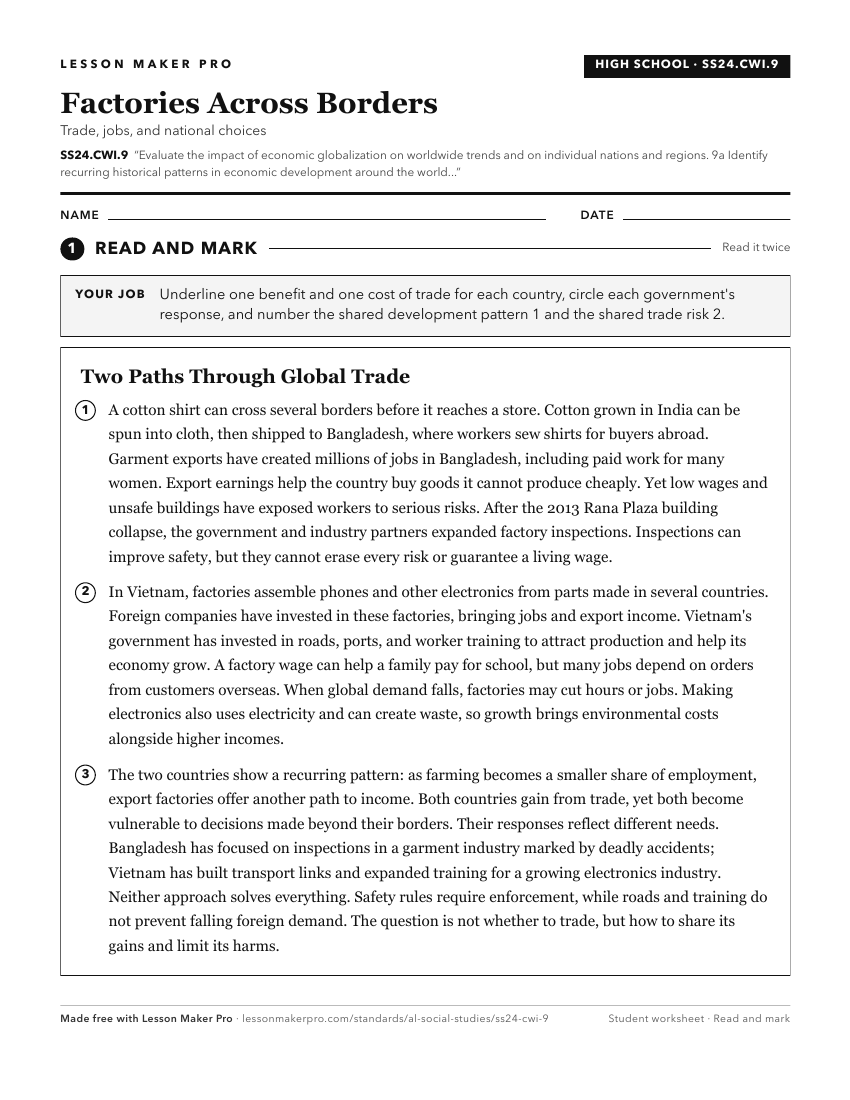
A ready-to-print activity worksheet aligned to SS24.CWI.9, with an answer key for the teacher on its own page. No account needed.
PDF, US Letter, prints cleanly in black and white.
Download the worksheetKeep exploring
Related Standards
- SS24.WH.10
Evaluate the economic, global, political, and social consequences of World War II.
- SS24.HG.14
Explain how economic interdependence and globalization impact countries and their populations.
- SS24.WH.17
Analyze the effects of economic interdependence and globalization on places and their populations.
- SS24.CWI.10
Explain how scientific and technological changes impact the worldwide economy and the process of globalization.
Turn this cluster into a lesson
Grade, subject, topic, and the complete cluster are prefilled. Create one free, no account needed.
Also for this cluster:Make a WorksheetMake a QuizMake a Sub Lesson