Alabama Social Studies SS24.E.10a
The Standard
- SS24.E.10
- Analyze the factors that determine and shape a country’s standard of living.
Explain how the relationship between inputs and outputs is used to calculate productivity at various levels of the economy.
2024 Alabama Course of Study: Social Studies
Teacher's field guide
What This Standard Means
What Students Need to Do
- Students calculate productivity by dividing output by an input, such as items made per labor hour. They use those rates to compare a firm, an industry, or a country over time.
What Mastery Looks Like
- Given 240 shirts made in 60 labor hours, a student calculates 4 shirts per labor hour and labels the units. They can explain why output rising at a factory, across an industry, or in a country does not always mean productivity rose.
Common Misconceptions
- Students may assume more total output means higher productivity, even when the input rose just as much. They may divide input by output or compare rates that use different units.
How to Assess It
- Ask: A bakery made 120 loaves in 8 labor hours on Monday and 150 loaves in 10 labor hours on Tuesday. Calculate productivity for each day and explain whether it changed.
Lesson moves
Ways to Teach It
Have pairs fold paper boxes for two three-minute rounds, count boxes, and calculate boxes per worker-minute for each round.
Ask: A factory doubled its output and doubled its labor hours. Did productivity change? Have students defend their answer with a calculation.
Give teams output and labor-hour cards for three factories; they rank each factory, then calculate the combined industry's productivity.
Use a mock delivery company's package totals and driver-hour log from two weeks; students calculate packages per hour and compare the weeks.
Free download
Printable SS24.E.10a Worksheet
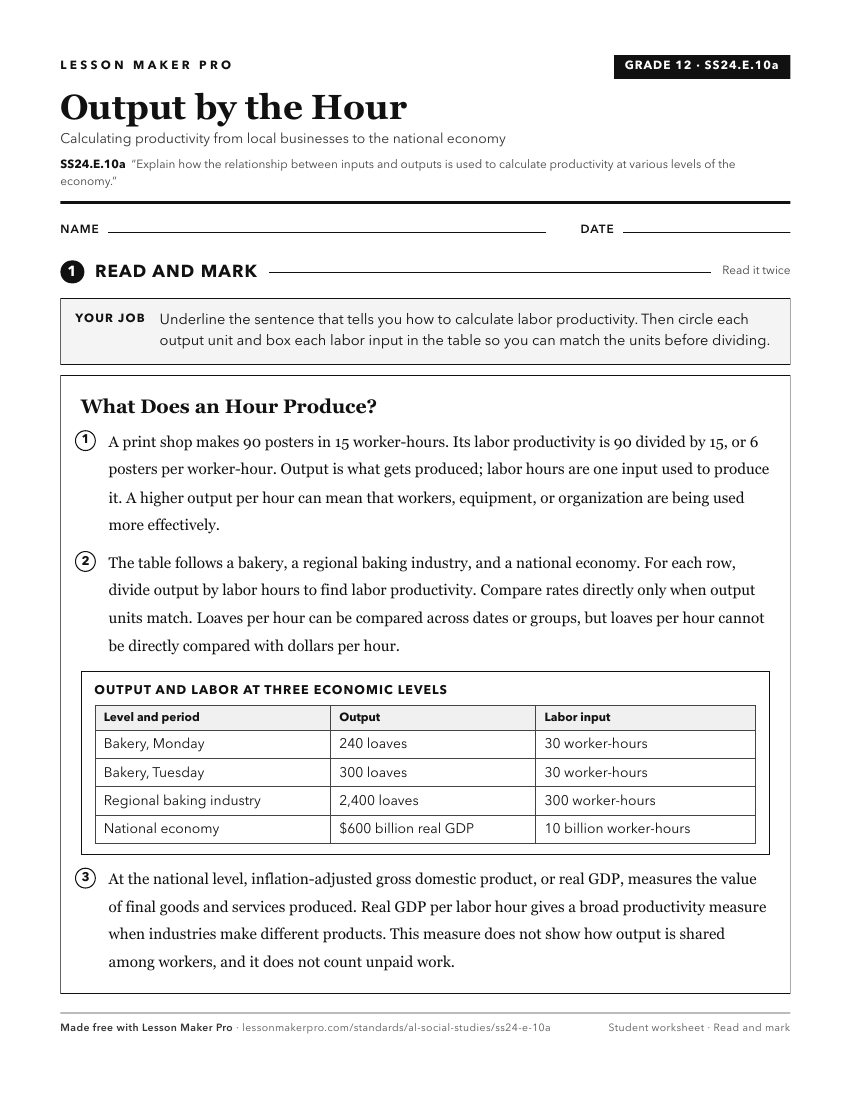
A ready-to-print activity worksheet aligned to SS24.E.10a, with an answer key for the teacher on its own page. No account needed.
PDF, US Letter, prints cleanly in black and white.
Download the worksheetKeep exploring
Related Standards
- SS24.E.1b
Explain how land (natural resource), labor (human resource), capital (physical or human resource), and entrepreneurship function as factors of production.
- SS24.E.8
Explain how economic measurements, including the Consumer Price Index (CPI), the Gross Domestic Product (GDP), inflation rates, labor force participation rate, ...
- SS24.2.4
Explain the economic processes of production and distribution, including the roles of producers, consumers, goods, and services.
- SS24.E.8a
Analyze how spending and production decisions made by households, businesses, and government determine overall levels of income, employment, and prices.
Turn this exact standard into a lesson
Grade, subject, topic, and the complete standard are prefilled. Create one free, no account needed.
Also for this standard:Make a WorksheetMake a QuizMake a Sub Lesson