Alabama Social Studies SS24.8.16
Standard Cluster
Describe the governing policies in East Asia during the sixteenth, seventeenth, and eighteenth centuries, including those of China and Japan. 16a Trace the rise of militarism in Japan and explain how it led to the invasion of Korea. 16b Explain the effects of religion on Japanese society and politics. 16c Compare the policies of absolutism and social structures of the Tokugawa Shogunate in Japan to European monarchies. 16d Describe how political changes in China led to the decline of imperial power from the Ming Dynasty to the end of the Qing Dynasty.
2024 Alabama Course of Study: Social Studies
Cluster contents
Standards in This Cluster
SS24.8.16 is a cluster heading. These are the individual standards under it.
- SS24.8.16a
Trace the rise of militarism in Japan and explain how it led to the invasion of Korea.
- SS24.8.16b
Explain the effects of religion on Japanese society and politics.
- SS24.8.16c
Compare the policies of absolutism and social structures of the Tokugawa Shogunate in Japan to European monarchies.
- SS24.8.16d
Describe how political changes in China led to the decline of imperial power from the Ming Dynasty to the end of the Qing Dynasty.
Teacher's field guide
What This Cluster Means
What Students Need to Do
- Students explain how military leaders ruled Japan, why Hideyoshi attacked Korea, and how religious policies shaped daily life. They compare the shogun's power and the samurai class with European kings and nobles. They follow changes in China's imperial rule from the late Ming through the Qing's fall.
What Mastery Looks Like
- Students connect Hideyoshi's military campaigns to the 1592 invasion of Korea. They explain how Tokugawa leaders used Buddhist temple registration and a ban on Christianity to govern. They compare Japanese and European rulers, then trace Ming collapse, Qing rule, and the later weakening of Qing power.
Common Misconceptions
- Students may credit Tokugawa shoguns with Hideyoshi's invasion, though it happened before their rule. They may mistake the ban on Christianity for a ban on all religion, or assume the emperor held the shogun's governing power. They may think the Qing collapsed as soon as it replaced the Ming.
How to Assess It
- Give students a four-box exit ticket: Why did Hideyoshi invade Korea? How did Tokugawa leaders use religion to govern? How did a shogun compare with a European king? What weakened Qing rule?
Lesson moves
Ways to Teach It
Give pairs five paper cards to order: 1592 Korea invasion, 1603 Tokugawa rule, 1644 Ming fall, 1757 Canton trade limits, 1912 Qing fall.
Ask: Why would Tokugawa leaders require Buddhist temple registration while banning Christianity? Write two sentences about control and loyalty.
Play a matching game with shogun, samurai, king, and noble cards; pair each with a power or social rank description.
Read a product label marked "Made in Japan," then compare today's trade with Tokugawa limits on Dutch and Chinese merchants at Nagasaki.
Free download
Printable SS24.8.16 Worksheet
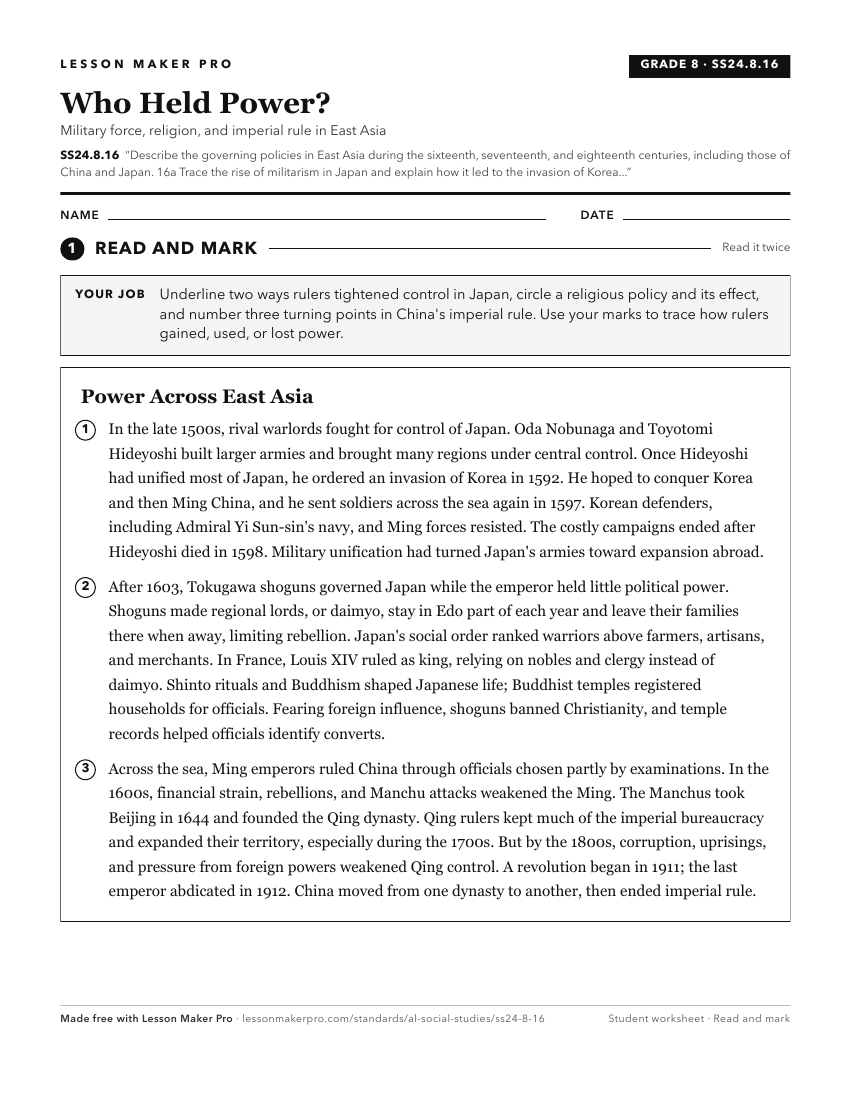
A ready-to-print activity worksheet aligned to SS24.8.16, with an answer key for the teacher on its own page. No account needed.
PDF, US Letter, prints cleanly in black and white.
Download the worksheetKeep exploring
Related Standards
- SS24.WH.5c
Analyze the rise of Japan’s power in East Asia beginning with the Meiji Restoration.
- SS24.7.13a
Compare and contrast the philosophies of Confucianism, Daoism, and Legalism and explain how they influenced dynastic cycles, politics, and society in China.
- SS24.8.4
Compare and contrast the cultural, economic, geographic, and political structures of the civilizations of medieval Asia, including China, India, Japan, and Kore...
Turn this cluster into a lesson
Grade, subject, topic, and the complete cluster are prefilled. Create one free, no account needed.
Also for this cluster:Make a WorksheetMake a QuizMake a Sub Lesson