Alabama Social Studies SS24.8.4
Standard Cluster
Compare and contrast the cultural, economic, geographic, and political structures of the civilizations of medieval Asia, including China, India, Japan, and Korea. 4a Explain China’s influence on other civilizations in Asia. 4b Describe how the Mongols influenced the cultural, economic, and social landscape of Asia. 4c Analyze the evolution of religion in Asia, including the growth of Buddhism, Hinduism, Jainism, and Sikhism. 4d Trace the development of the feudal structure of medieval Japan, including the establishment of the Shogunate by Minamoto no Yoritomo.
2024 Alabama Course of Study: Social Studies
Cluster contents
Standards in This Cluster
SS24.8.4 is a cluster heading. These are the individual standards under it.
- SS24.8.4a
Explain China’s influence on other civilizations in Asia.
- SS24.8.4b
Describe how the Mongols influenced the cultural, economic, and social landscape of Asia.
- SS24.8.4c
Analyze the evolution of religion in Asia, including the growth of Buddhism, Hinduism, Jainism, and Sikhism.
- SS24.8.4d
Trace the development of the feudal structure of medieval Japan, including the establishment of the Shogunate by Minamoto no Yoritomo.
Teacher's field guide
What This Cluster Means
What Students Need to Do
- Students compare geography, trade, government, and culture in medieval China, India, Japan, and Korea. They explain how Chinese ideas and Mongol rule changed societies across Asia. They trace four religions and explain how Yoritomo's shogunate changed Japan's government.
What Mastery Looks Like
- Students use a map to explain how mountains, seas, and land routes affected contact among the four regions. They give examples of Chinese writing in Korea and Japan, Mongol rule affecting trade, and military leaders gaining power in Japan. They distinguish older Hindu and Jain traditions from Buddhism's spread and Sikhism's later beginnings.
Common Misconceptions
- Students may treat the four regions as one culture or assume mountains and seas stopped all contact. Some think Mongol conquests only disrupted trade or that Japan's emperor controlled the shogunate. Others assume all four religions began in medieval times.
How to Assess It
- Exit ticket: On a map of Asia, mark one feature that helped or limited contact between two regions. Explain one Chinese or Mongol influence that crossed between them.
Lesson moves
Ways to Teach It
Give pairs a blank Asia map; have them label the Himalayas, Yellow River, Korean Peninsula, and Japanese islands, then draw possible trade routes.
Ask students to correct the claim, 'All four religions began in medieval times,' using one older tradition and Sikhism's late-1400s beginnings.
Give teams five event cards: Jainism in India, Buddhism in China, Yoritomo's shogunate, Mongol rule in China, Sikhism in Punjab; sort chronologically.
Print Japanese and Chinese dictionary entries for 山, meaning mountain; students compare the character and explain how writing crossed from China to Japan.
Free download
Printable SS24.8.4 Worksheet
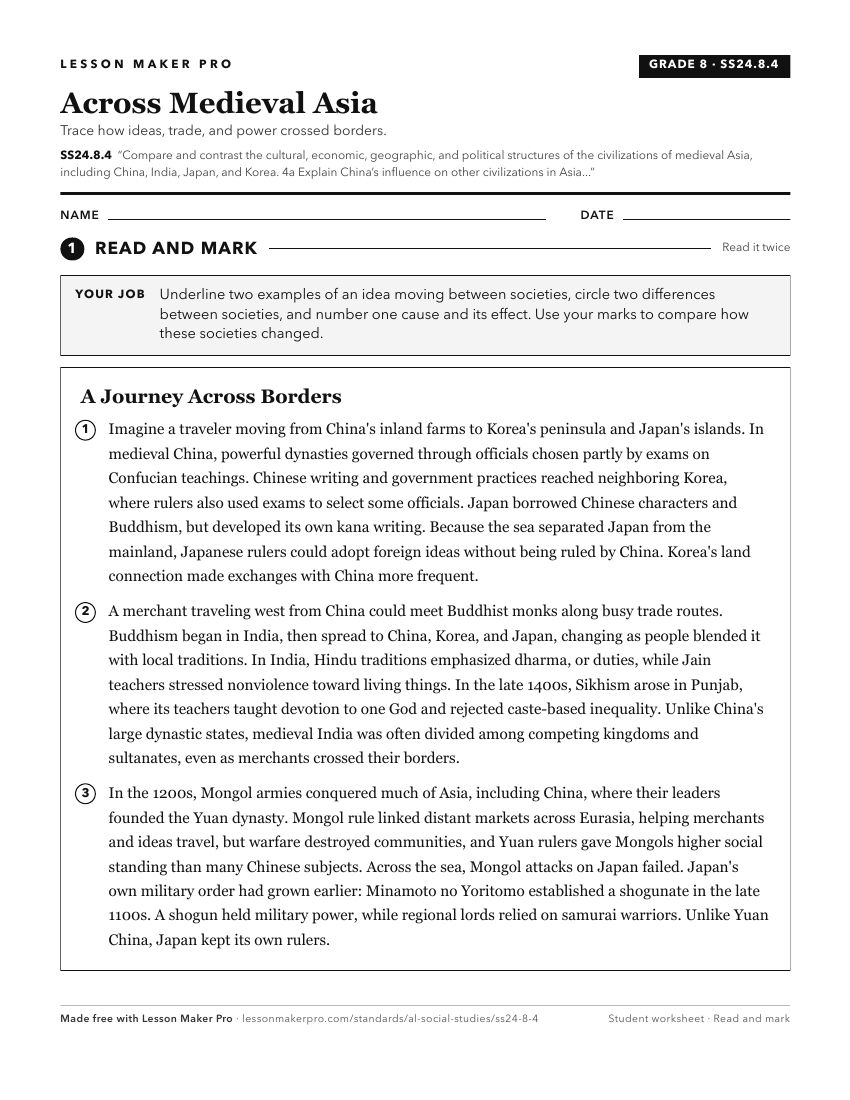
A ready-to-print activity worksheet aligned to SS24.8.4, with an answer key for the teacher on its own page. No account needed.
PDF, US Letter, prints cleanly in black and white.
Download the worksheetKeep exploring
Related Standards
Turn this cluster into a lesson
Grade, subject, topic, and the complete cluster are prefilled. Create one free, no account needed.
Also for this cluster:Make a WorksheetMake a QuizMake a Sub Lesson