Alabama Social Studies SS24.7.9
Standard Cluster
Compare and contrast the economic and cultural structures of early African societies. 9a Explain how physical geography, including natural resources, contributed to the economic and cultural practices of early African societies. 9b Describe common tenets of indigenous religion practiced in Africa, including the beliefs of the Ashanti, Dogon, and Igbo religious traditions. 9c Describe how trade, including silent barter, facilitated exchange of economic practices, language, and culture across Africa from prehistory through the Iron Age.
2024 Alabama Course of Study: Social Studies
Cluster contents
Standards in This Cluster
SS24.7.9 is a cluster heading. These are the individual standards under it.
- SS24.7.9a
Explain how physical geography, including natural resources, contributed to the economic and cultural practices of early African societies.
- SS24.7.9b
Describe common tenets of indigenous religion practiced in Africa, including the beliefs of the Ashanti, Dogon, and Igbo religious traditions.
- SS24.7.9c
Describe how trade, including silent barter, facilitated exchange of economic practices, language, and culture across Africa from prehistory through the Iron Ag...
Teacher's field guide
What This Cluster Means
What Students Need to Do
- Students compare how land, water, and resources shaped work and daily life in different African regions. They describe Ashanti, Dogon, and Igbo beliefs and explain how trade moved goods and cultural practices, even when traders used silent barter.
What Mastery Looks Like
- A student can use a map to explain why people traded salt from the Sahara and gold from farther south. They can identify Nyame, Amma, and Chukwu as creator figures in three distinct traditions and explain how trade networks carried ideas as well as goods.
Common Misconceptions
- Students may picture Africa as one landscape and assume people everywhere did the same work. They may treat the three religious traditions as identical or think silent barter meant trade networks could not spread words and customs.
How to Assess It
- On an exit ticket, ask: Name one way geography shaped work, one belief shared by the three traditions, and one way silent barter connected communities.
Lesson moves
Ways to Teach It
Give pairs a map and salt, gold, and cattle cards; have them place each resource and explain a likely job or trade route.
Read short source cards on Ashanti, Dogon, and Igbo beliefs, then ask: What do these traditions share, and how do they differ?
Run a silent barter game: groups leave salt or gold tokens at a trade station and adjust their offers without meeting.
Use a local farmers market flyer; students circle foods grown nearby and compare how climate affects markets here and in the Sahel.
Free download
Printable SS24.7.9 Worksheet
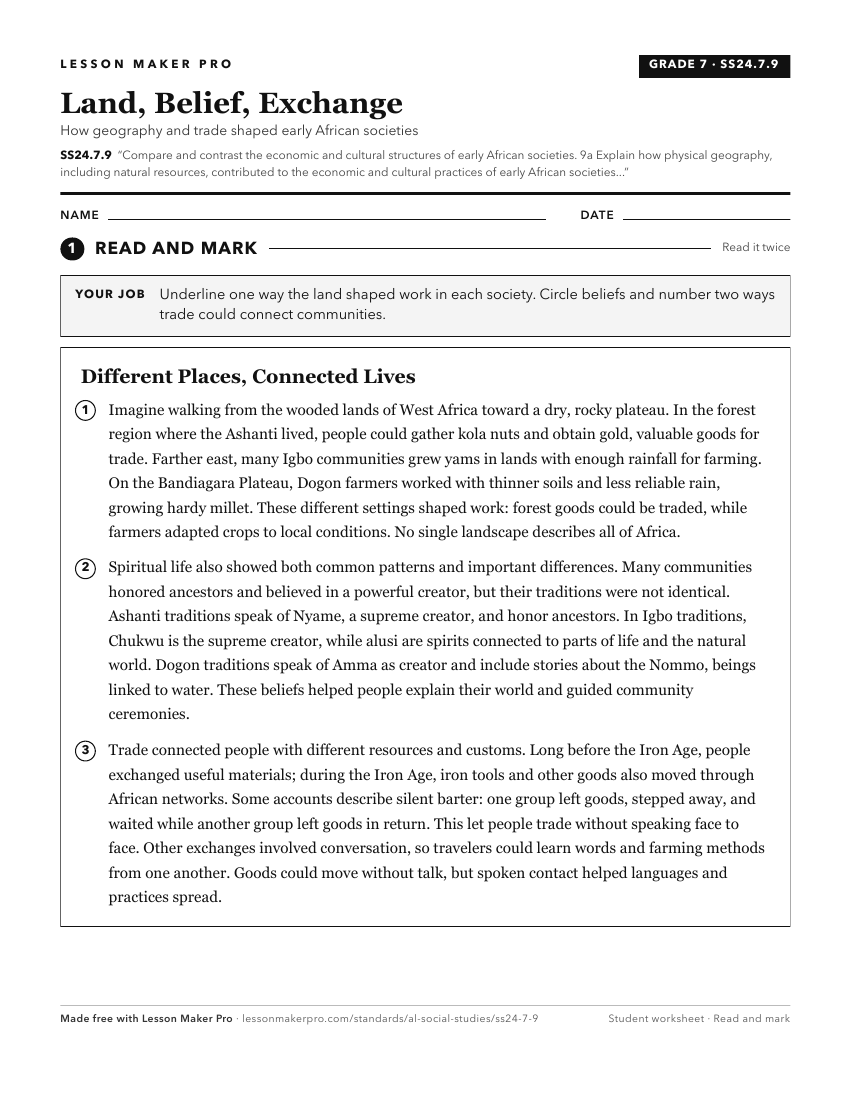
A ready-to-print activity worksheet aligned to SS24.7.9, with an answer key for the teacher on its own page. No account needed.
PDF, US Letter, prints cleanly in black and white.
Download the worksheetKeep exploring
Related Standards
- SS24.8.3c
Analyze the influence of Islamic cultural, economic, and political systems in Africa, Arabia, and Europe.
- SS24.7.7
Analyze the economic, political, and social structures of ancient Egypt.
- SS24.8.5
Compare the African kingdoms of Ghana, Mali, and Songhai, including cultures, economic systems, geography, religions, and slave trade.
Turn this cluster into a lesson
Grade, subject, topic, and the complete cluster are prefilled. Create one free, no account needed.
Also for this cluster:Make a WorksheetMake a QuizMake a Sub Lesson