Alabama Social Studies SS24.7.7
Standard Cluster
Analyze the economic, political, and social structures of ancient Egypt. 7a Describe the role of the Nile River and Mediterranean Sea in supporting the economic and cultural growth of ancient Egypt. 7b Identify major technological and artistic achievements of ancient Egypt. 7c Summarize the social structure and religious beliefs of ancient Egypt. 7d Describe the achievement of key leaders of ancient Egypt and how these achievements helped grow the kingdom.
2024 Alabama Course of Study: Social Studies
Cluster contents
Standards in This Cluster
SS24.7.7 is a cluster heading. These are the individual standards under it.
- SS24.7.7a
Describe the role of the Nile River and Mediterranean Sea in supporting the economic and cultural growth of ancient Egypt.
- SS24.7.7b
Identify major technological and artistic achievements of ancient Egypt.
- SS24.7.7c
Summarize the social structure and religious beliefs of ancient Egypt.
- SS24.7.7d
Describe the achievement of key leaders of ancient Egypt and how these achievements helped grow the kingdom.
Teacher's field guide
What This Cluster Means
What Students Need to Do
- Students explain how Nile floods supported farming and how Mediterranean routes carried goods and ideas. They describe pharaohs, social ranks, religious beliefs, inventions, and art. They connect leaders' actions to Egypt's growth.
What Mastery Looks Like
- A student can explain Nile farming, Mediterranean trade, and how scribes used papyrus to track goods. They can place pharaohs, scribes, and farmers in a hierarchy and link tomb paintings to afterlife beliefs. They can explain how Hatshepsut's trade missions and Ramses II's peace treaty helped Egypt.
Common Misconceptions
- Students may think Nile floods only damaged farmland, rather than also leaving fertile soil. They may think everyone was buried in a pyramid or that pharaohs had only religious power. Some mistake Hatshepsut's trade missions for military conquest.
How to Assess It
- Exit ticket: Name one way the Nile helped farming, one good traded by sea, one social rank, one afterlife belief, and one invention or artwork. Then explain how one leader's action helped Egypt grow.
Lesson moves
Ways to Teach It
On a blank Egypt map, draw the Nile floodplain, shade farmland, and trace a Mediterranean route for cedar shipments.
Ask: How did the pharaoh's power and afterlife beliefs shape pyramid building? Write two claims using a pyramid diagram.
Play a card sort matching papyrus, canals, and tomb paintings to uses, then Hatshepsut and Ramses II to their achievements.
Compare a photo of a modern grain barge with a Nile trade map; list two ways waterways move goods.
Free download
Printable SS24.7.7 Worksheet
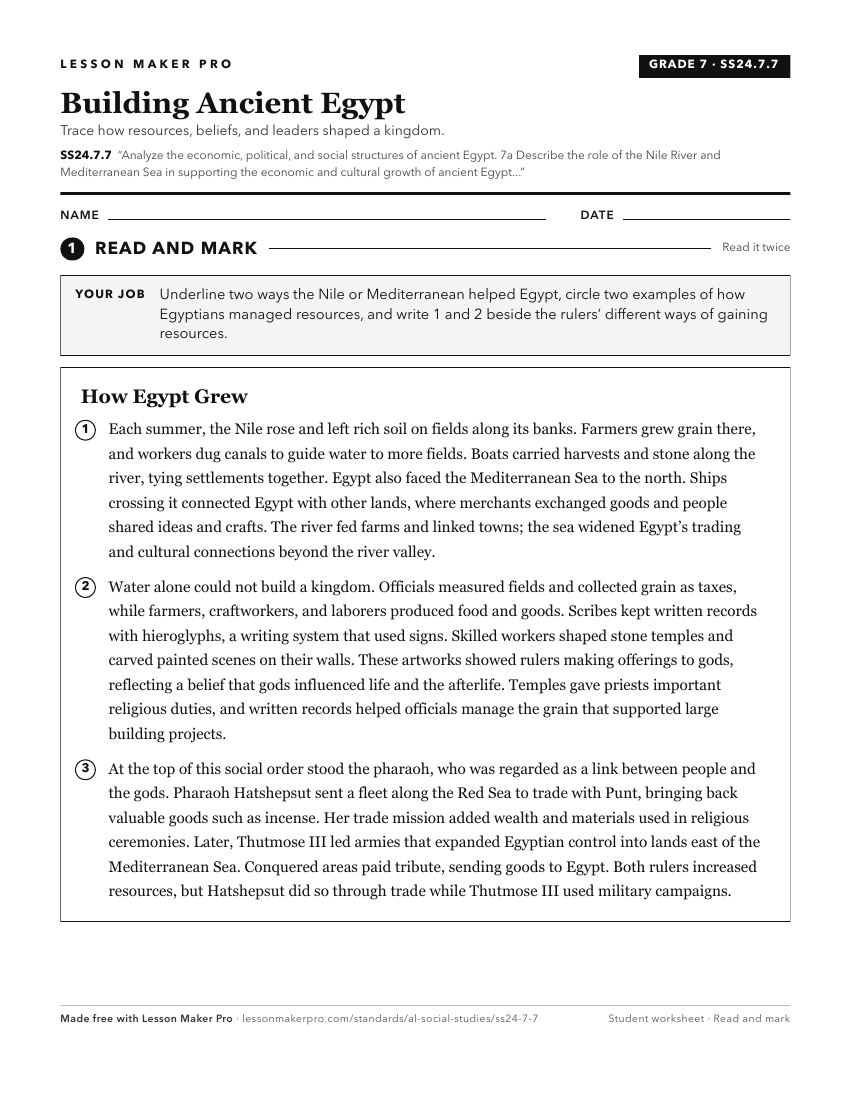
A ready-to-print activity worksheet aligned to SS24.7.7, with an answer key for the teacher on its own page. No account needed.
PDF, US Letter, prints cleanly in black and white.
Download the worksheetKeep exploring
Related Standards
- SS24.8.7b
Analyze the relationship of the Catholic Church to economic, political, and social systems and rulers in medieval Europe.
- SS24.8.3c
Analyze the influence of Islamic cultural, economic, and political systems in Africa, Arabia, and Europe.
- SS24.7.9
Compare and contrast the economic and cultural structures of early African societies.
Turn this cluster into a lesson
Grade, subject, topic, and the complete cluster are prefilled. Create one free, no account needed.
Also for this cluster:Make a WorksheetMake a QuizMake a Sub Lesson