Alabama Social Studies SS24.7.9b
The Standard
- SS24.7.9
- Compare and contrast the economic and cultural structures of early African societies.
Describe common tenets of indigenous religion practiced in Africa, including the beliefs of the Ashanti, Dogon, and Igbo religious traditions.
2024 Alabama Course of Study: Social Studies
Teacher's field guide
What This Standard Means
What Students Need to Do
- Students connect Nyame, Amma, and Chukwu to creator beliefs in three different traditions. They compare beliefs about ancestors, spirits, and the land without treating the traditions as identical.
What Mastery Looks Like
- A student matches Nyame with Ashanti, Amma with Dogon, and Chukwu with Igbo. They can name ancestor respect as a shared belief and explain that Ala is an earth deity in Igbo tradition.
Common Misconceptions
- Students may mix up the names of the creators or assume all three groups honor the same spirits in the same ways. Some think these traditions existed only in the past.
How to Assess It
- On an exit ticket, ask students to match Nyame, Amma, and Chukwu to the three groups. Then have them name one shared belief and explain who Ala is.
Lesson moves
Ways to Teach It
Give pairs a name key and cards for Nyame, Amma, Chukwu, Ala, and ancestors; have them place the cards on a three-column chart.
Ask students to write two sentences: How do Ashanti and Dogon beliefs about ancestors compare? What is one Igbo belief about the land?
Read 'Amma is Igbo,' 'Ala is Igbo,' and 'Nyame is Ashanti'; students mark each claim true or false on mini whiteboards.
Show a photo of a present-day Akwasidae festival in Ghana; ask how the event shows that honoring ancestors remains part of Ashanti life.
Free download
Printable SS24.7.9b Worksheet
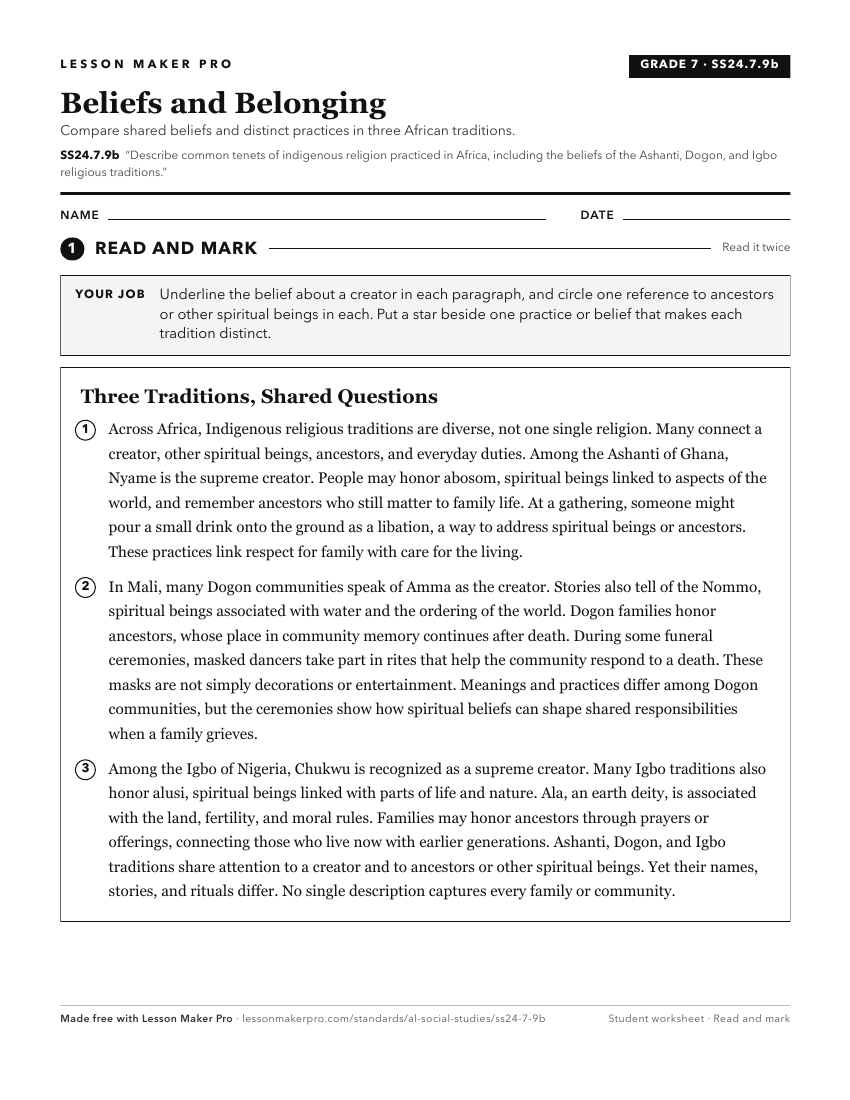
A ready-to-print activity worksheet aligned to SS24.7.9b, with an answer key for the teacher on its own page. No account needed.
PDF, US Letter, prints cleanly in black and white.
Download the worksheetKeep exploring
Related Standards
- SS24.8.5
Compare the African kingdoms of Ghana, Mali, and Songhai, including cultures, economic systems, geography, religions, and slave trade.
- SS24.US1.8b
Describe how enslaved people maintained African traditions and created their own unique culture, including foodways, spiritual beliefs, and ceremonies.
- SS24.8.6c
Explain how religious beliefs and practices shaped culture in Indigenous societies.
- SS24.HG.7
Describe ways religion influences cultures, citing examples from around the globe.
Turn this exact standard into a lesson
Grade, subject, topic, and the complete standard are prefilled. Create one free, no account needed.
Also for this standard:Make a WorksheetMake a QuizMake a Sub Lesson