Alabama Social Studies SS24.8.16d
The Standard
- SS24.8.16
- Describe the governing policies in East Asia during the sixteenth, seventeenth, and eighteenth centuries, including those of China and Japan.
Describe how political changes in China led to the decline of imperial power from the Ming Dynasty to the end of the Qing Dynasty.
2024 Alabama Course of Study: Social Studies
Teacher's field guide
What This Standard Means
What Students Need to Do
- Students trace how Ming rule ended, how Qing emperors took power, and why their authority later broke down. They explain how rebellions, stronger provincial leaders, and the 1911 Revolution changed who held power.
What Mastery Looks Like
- A student can put the Qing takeover, the rise of provincial armies, the 1911 Revolution, and the last emperor’s abdication in order. They can explain that Qing emperors first gained control, then lost it to other leaders.
Common Misconceptions
- Students may think the Qing takeover ended imperial rule, when it replaced one dynasty with another. They may blame the Qing collapse only on foreign powers and overlook rebellions, provincial armies, and revolutionaries.
How to Assess It
- Exit ticket: Put these events in order: Qing takeover, the 1911 Revolution, provincial armies fighting the Taiping Rebellion, and the last emperor’s abdication. Then explain one change in who held power.
Lesson moves
Ways to Teach It
Give pairs four event cards: Ming court struggles, Qing takeover, Taiping-era provincial armies, and the 1912 abdication; have them order the cards.
Ask, 'Why did armies raised by provincial leaders against the Taiping rebels leave the Qing emperor with less control?'
Read Qing takeover, Taiping Rebellion, and 1911 Revolution cards; students hold up emperor, governor, or revolutionary and explain each choice.
Use the school handbook to map who sets one school rule; compare that chain of authority with a Qing emperor and provincial governors.
Free download
Printable SS24.8.16d Worksheet
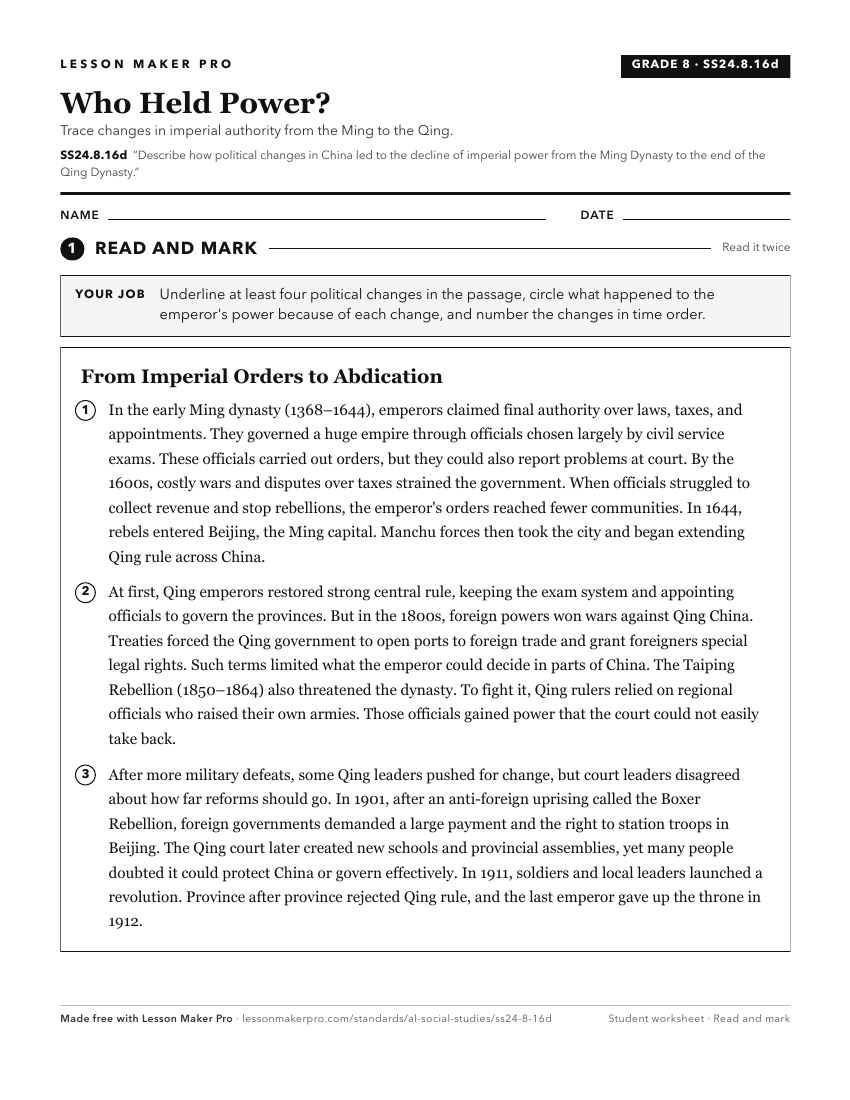
A ready-to-print activity worksheet aligned to SS24.8.16d, with an answer key for the teacher on its own page. No account needed.
PDF, US Letter, prints cleanly in black and white.
Download the worksheetKeep exploring
Related Standards
- SS24.7.13
Explain the emergence and consolidation of China from the Xia Dynasty along the Huang He River Valley through the fall of the Han Dynasty.
- SS24.7.13b
Trace the reunification of China from the Warring States period and the Qin Dynasty which led to China’s Golden Age under the Han Dynasty.
- SS24.WH.5c
Analyze the rise of Japan’s power in East Asia beginning with the Meiji Restoration.
- SS24.7.13a
Compare and contrast the philosophies of Confucianism, Daoism, and Legalism and explain how they influenced dynastic cycles, politics, and society in China.
Turn this exact standard into a lesson
Grade, subject, topic, and the complete standard are prefilled. Create one free, no account needed.
Also for this standard:Make a WorksheetMake a QuizMake a Sub Lesson