Alabama Social Studies SS24.7.13
Standard Cluster
Explain the emergence and consolidation of China from the Xia Dynasty along the Huang He River Valley through the fall of the Han Dynasty. 13a Compare and contrast the philosophies of Confucianism, Daoism, and Legalism and explain how they influenced dynastic cycles, politics, and society in China. 13b Trace the reunification of China from the Warring States period and the Qin Dynasty which led to China’s Golden Age under the Han Dynasty. 13c Describe the significance of Chinese technological advancements, including paper, gunpowder, the compass, and the seismograph. 13d Analyze how the establishment of the Silk Road fostered economic and cultural development across multiple continents.
2024 Alabama Course of Study: Social Studies
Cluster contents
Standards in This Cluster
SS24.7.13 is a cluster heading. These are the individual standards under it.
- SS24.7.13a
Compare and contrast the philosophies of Confucianism, Daoism, and Legalism and explain how they influenced dynastic cycles, politics, and society in China.
- SS24.7.13b
Trace the reunification of China from the Warring States period and the Qin Dynasty which led to China’s Golden Age under the Han Dynasty.
- SS24.7.13c
Describe the significance of Chinese technological advancements, including paper, gunpowder, the compass, and the seismograph.
- SS24.7.13d
Analyze how the establishment of the Silk Road fostered economic and cultural development across multiple continents.
Teacher's field guide
What This Cluster Means
What Students Need to Do
- Students trace China's history from the Xia along the Huang He through the Warring States, Qin reunification, and Han rule. They compare Confucianism, Daoism, and Legalism as ideas that shaped government and daily life. They explain how Chinese inventions and Silk Road trade changed life in China and beyond.
What Mastery Looks Like
- A student can explain how Qin ended the Warring States period, why the Han prospered, and why Han rule ended. They can contrast the three philosophies through choices about laws and social roles. They can name uses for paper, gunpowder, the compass, and the seismograph, then trace one Silk Road good or idea across continents.
Common Misconceptions
- Students may place gunpowder and the compass in the Han period, though both came later. They may confuse Qin reunification with Han prosperity. They may also think the Silk Road was one road traveled by a single merchant.
How to Assess It
- Exit ticket: Explain one way Qin rule changed China after the Warring States period. Then name one governing idea a ruler might use and one effect of Han-era Silk Road trade.
Lesson moves
Ways to Teach It
Place dated Xia, Warring States, Qin, Han, paper, compass, gunpowder, and seismograph cards on a timeline beside a Huang He map.
Ask: Would a Qin ruler use Confucianism, Daoism, or Legalism to stop fighting, and what might that choice cost ordinary people?
Read three clues aloud: strict laws, lead by example, and follow nature; students hold up Legalism, Confucianism, or Daoism cards.
Use a silk garment label, then map a historic route from China to Europe and compare it with the label's modern supply chain.
Free download
Printable SS24.7.13 Worksheet
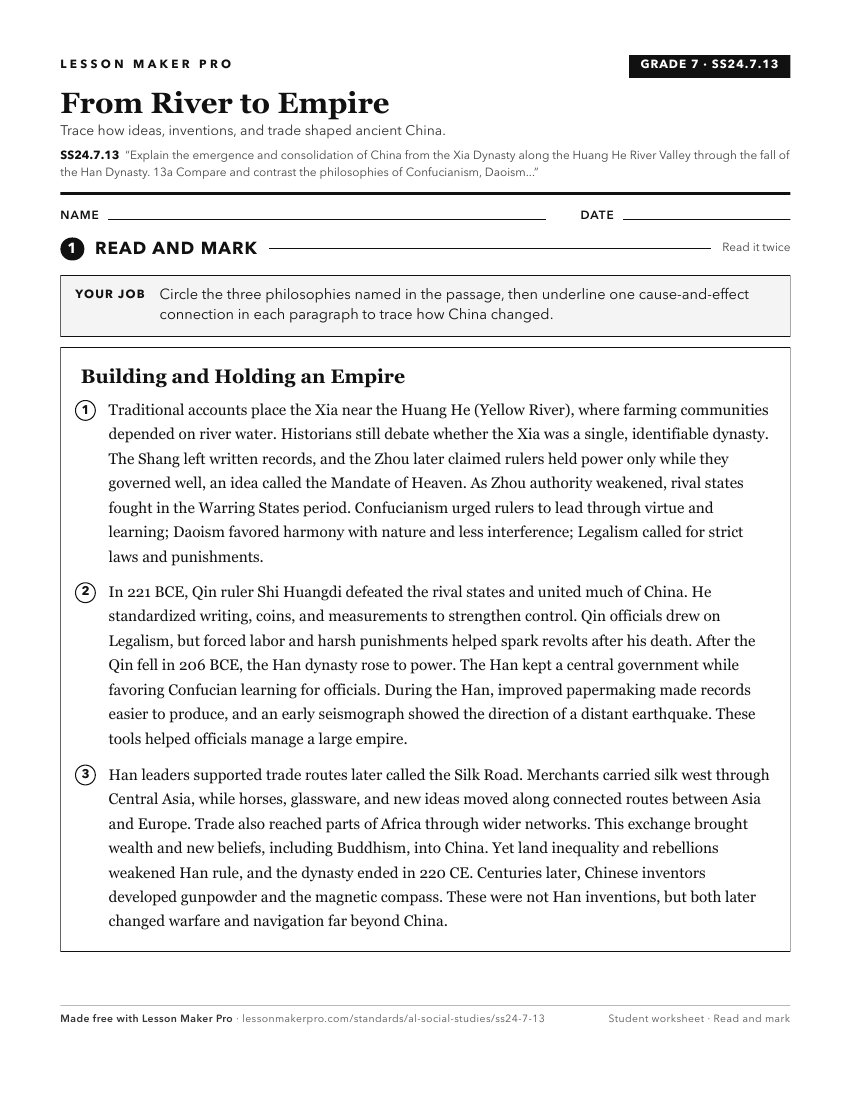
A ready-to-print activity worksheet aligned to SS24.7.13, with an answer key for the teacher on its own page. No account needed.
PDF, US Letter, prints cleanly in black and white.
Download the worksheetKeep exploring
Related Standards
Turn this cluster into a lesson
Grade, subject, topic, and the complete cluster are prefilled. Create one free, no account needed.
Also for this cluster:Make a WorksheetMake a QuizMake a Sub Lesson