Alabama Social Studies SS24.6.4
Standard Cluster
Compare and contrast the key characteristics, including political structures, of the New England, Middle, Chesapeake, and Southern colonies. 4a Explain how climate and geography shaped the economic identities of the colonial regions. 4b Differentiate among the various forms of colonial governments and identify examples of self-government in the colonies, including the Mayflower Compact, New England town meetings, and the Virginia House of Burgesses. 4c Identify individuals in colonial America who sought change for their communities, and describe how their efforts led to shifts in society.
2024 Alabama Course of Study: Social Studies
Cluster contents
Standards in This Cluster
SS24.6.4 is a cluster heading. These are the individual standards under it.
- SS24.6.4a
Explain how climate and geography shaped the economic identities of the colonial regions.
- SS24.6.4b
Differentiate among the various forms of colonial governments and identify examples of self-government in the colonies, including the Mayflower Compact, New Eng...
- SS24.6.4c
Identify individuals in colonial America who sought change for their communities, and describe how their efforts led to shifts in society.
Teacher's field guide
What This Cluster Means
What Students Need to Do
- Students compare the four colonial regions by land, climate, work, and government. They tell royal, proprietary, and charter governments apart and explain how colonists governed themselves. They describe how people such as Roger Williams pushed for change.
What Mastery Looks Like
- Students explain why rocky New England soil favored trade, Middle farmland grew grain, Chesapeake rivers helped ship tobacco, and Southern wetlands supported rice. They distinguish royal, proprietary, and charter governments and identify the Mayflower Compact, town meetings, and House of Burgesses as examples of self-government. They explain how Roger Williams helped establish religious freedom in Rhode Island.
Common Misconceptions
- Students may lump the Chesapeake and Southern colonies together, missing the difference between tobacco farms and Lowcountry rice fields. Some think the Mayflower Compact came from the king or that everyone could vote in town meetings. Others mistake the House of Burgesses for a town meeting rather than an elected assembly.
How to Assess It
- Exit ticket: Match each region to one land or climate feature and one crop or trade. Then name one example of colonial self-government and explain Roger Williams's impact on Rhode Island.
Lesson moves
Ways to Teach It
Give pairs four region maps and climate, crop, and trade cards; have them place each card on a map and defend one choice.
Ask students to write: Why was Roger Williams banished from Massachusetts, and what changed when he founded Providence?
Run a card match using definition cards for royal Virginia, proprietary Pennsylvania, charter Connecticut, the Mayflower Compact, town meetings, and the House of Burgesses.
Bring a local council agenda; have students compare who can speak and vote today with who could participate in a colonial town meeting.
Free download
Printable SS24.6.4 Worksheet
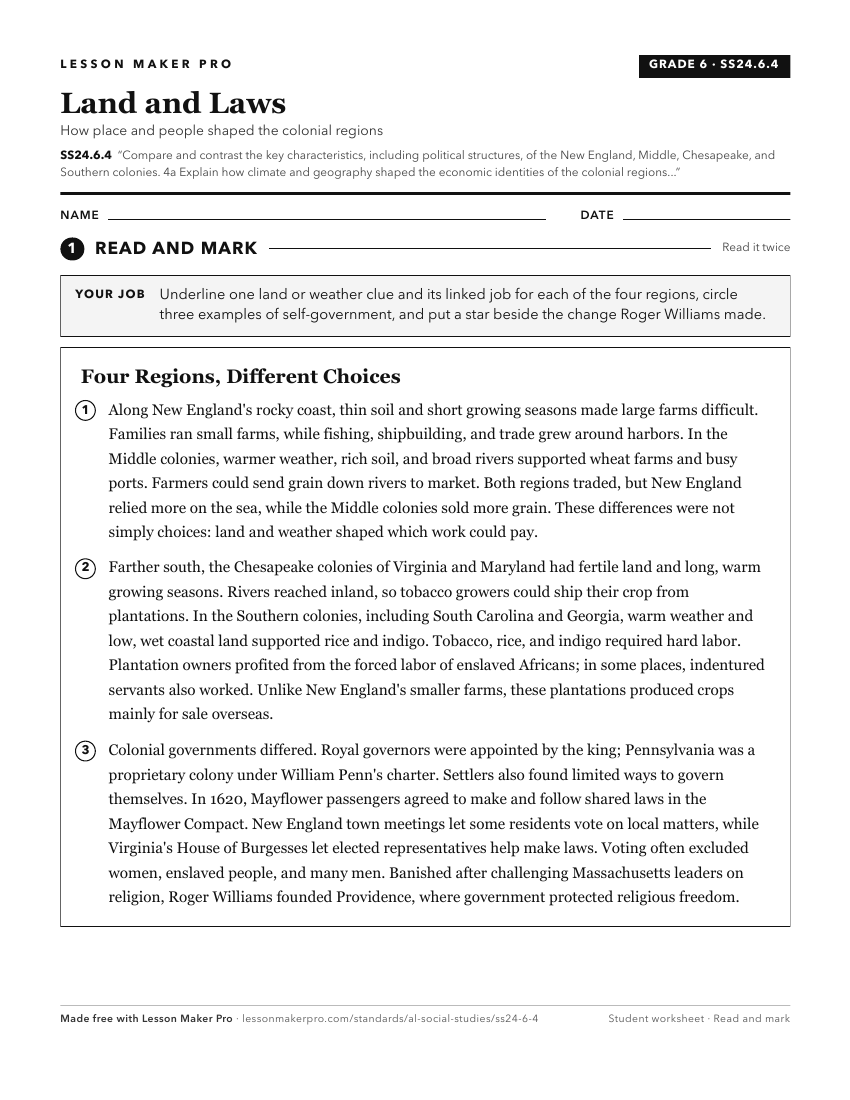
A ready-to-print activity worksheet aligned to SS24.6.4, with an answer key for the teacher on its own page. No account needed.
PDF, US Letter, prints cleanly in black and white.
Download the worksheetKeep exploring
Related Standards
- SS24.6.6a
Compare and contrast the institution of slavery in different colonial regions.
- SS24.6.2
Compare and contrast the reasons for British, French, and Spanish colonization in North America as well as why individuals migrated to the colonies, including m...
- SS24.4.2
Compare and contrast the physical geography of the Northern, Middle, and Southern colonies, including geographic features and differences in climate, and explai...
Turn this cluster into a lesson
Grade, subject, topic, and the complete cluster are prefilled. Create one free, no account needed.
Also for this cluster:Make a WorksheetMake a QuizMake a Sub Lesson