Alabama Social Studies SS24.6.2
Standard Cluster
Compare and contrast the reasons for British, French, and Spanish colonization in North America as well as why individuals migrated to the colonies, including mercantilism, religious persecution, poverty, oppression, and new opportunities. 2a Summarize how the Crusades, Reformation, and Renaissance influenced European exploration and describe how individuals contributed to these movements. 2b Trace the routes of key European expeditions in North America and describe their effects on colonization in the New World. 2c Locate on a map of North America the areas of European colonization, including colonies of England, France, Russia, and Spain.
2024 Alabama Course of Study: Social Studies
Cluster contents
Standards in This Cluster
SS24.6.2 is a cluster heading. These are the individual standards under it.
- SS24.6.2a
Summarize how the Crusades, Reformation, and Renaissance influenced European exploration and describe how individuals contributed to these movements.
- SS24.6.2b
Trace the routes of key European expeditions in North America and describe their effects on colonization in the New World.
- SS24.6.2c
Locate on a map of North America the areas of European colonization, including colonies of England, France, Russia, and Spain.
Teacher's field guide
What This Cluster Means
What Students Need to Do
- Students compare why Britain, France, and Spain built colonies and why people moved there. They explain how the Crusades, Reformation, and Renaissance shaped exploration, using people from each movement as examples. They trace expedition routes and map British, French, Spanish, and Russian claims.
What Mastery Looks Like
- A student can explain why France sought fur trade, Spain sought wealth, and Britain sought land, while all three wanted trade profits. They can distinguish those goals from a person's reasons for leaving, such as poverty or religious persecution. They can place Russian claims in Alaska and show how Cartier's St. Lawrence route supported French colonization.
Common Misconceptions
- Students may think every empire had the same goal or that everyone migrated for religious freedom. They may confuse an explorer's route with the full area an empire claimed. Some place Russian colonies on the Atlantic coast instead of in Alaska.
How to Assess It
- Give students a blank North America map. Ask them to label four colonial regions, trace Cartier's route, compare two empires' goals, and name one reason a person migrated.
Lesson moves
Ways to Teach It
Mark British, French, Spanish, and Russian claims on a blank map; trace Cartier's St. Lawrence route and label its fur trade link.
Hand out short profiles of Pope Urban II, Martin Luther, and mapmaker Martin Waldseemüller; ask how each movement affected exploration.
Sort cards labeled fur trade, silver, farmland, trade profits, poverty, oppression, and faith into empire goals or personal reasons to migrate.
Find New Orleans and San Antonio on a current map, then connect their names to French and Spanish colonial claims.
Free download
Printable SS24.6.2 Worksheet
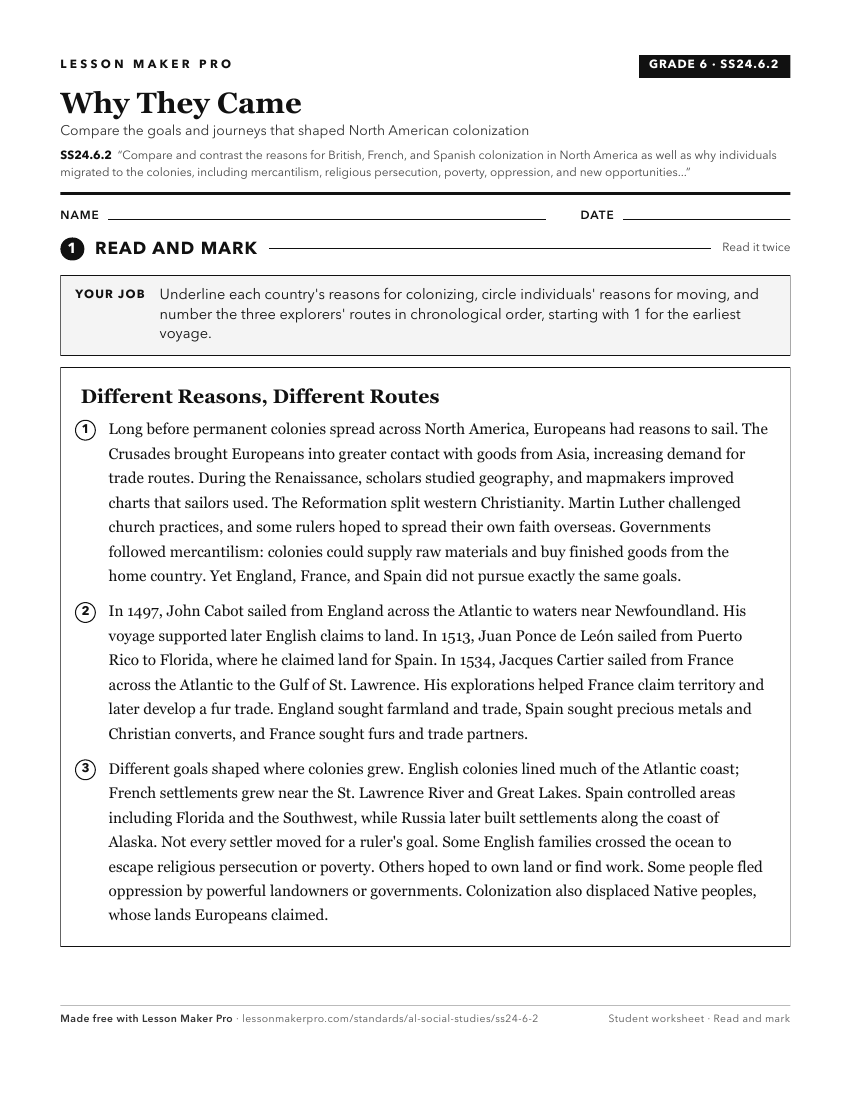
A ready-to-print activity worksheet aligned to SS24.6.2, with an answer key for the teacher on its own page. No account needed.
PDF, US Letter, prints cleanly in black and white.
Download the worksheetKeep exploring
Related Standards
- SS24.6.3
Describe the effects of European expeditions and colonization on the economic, geographic, and social conditions of Indigenous peoples during the fifteenth thro...
- SS24.3.9
Explain reasons for European expeditions and the establishment of early settlements and colonies in North America during the sixteenth and seventeenth centuries...
Turn this cluster into a lesson
Grade, subject, topic, and the complete cluster are prefilled. Create one free, no account needed.
Also for this cluster:Make a WorksheetMake a QuizMake a Sub Lesson