Alabama Social Studies SS24.5.12
Standard Cluster
Outline key events and campaigns of the Civil Rights Movement and identify significant organizations and their contributions within the Movement. 12a Describe ways in which the Civil Rights Movement sought to create change. 12b Trace the chronology of civil rights events in Alabama and across the nation, and summarize how they impacted one another. 12c Describe the contributions of Alabama leaders and foot soldiers of the Civil Rights Movement as well as other Alabamian supporters who aided their efforts. 12d Summarize how opponents of the Civil Rights Movement in Alabama sought to limit its success. 12e Identify Alabamians who contributed to concurrent civil rights movements in the United States during the decades following World War II.
2024 Alabama Course of Study: Social Studies
Cluster contents
Standards in This Cluster
SS24.5.12 is a cluster heading. These are the individual standards under it.
- SS24.5.12a
Describe ways in which the Civil Rights Movement sought to create change.
- SS24.5.12b
Trace the chronology of civil rights events in Alabama and across the nation, and summarize how they impacted one another.
- SS24.5.12c
Describe the contributions of Alabama leaders and foot soldiers of the Civil Rights Movement as well as other Alabamian supporters who aided their efforts.
- SS24.5.12d
Summarize how opponents of the Civil Rights Movement in Alabama sought to limit its success.
- SS24.5.12e
Identify Alabamians who contributed to concurrent civil rights movements in the United States during the decades following World War II.
Teacher's field guide
What This Cluster Means
What Students Need to Do
- Students put the Montgomery bus boycott, Birmingham campaign, and Selma marches in order. They explain how groups, leaders, and everyday protesters worked for change in Alabama and across the country. They describe opposition in Alabama and Coretta Scott King’s later work for women’s rights.
What Mastery Looks Like
- A student places the Montgomery boycott before the Birmingham campaign and the Selma marches. They link police attacks on Selma marchers to growing support for the Voting Rights Act. They explain Jo Ann Robinson’s boycott flyers and George Wallace’s attempt to block Black students at the University of Alabama.
Common Misconceptions
- Students may think Martin Luther King Jr. acted alone, overlooking people who printed flyers, walked to work, and registered voters. They may confuse the Civil Rights Act with the Voting Rights Act. They may blame peaceful marchers for attacks by police.
How to Assess It
- Exit ticket: Put Montgomery, Birmingham, and Selma in order. For Selma, name one organizer, one obstacle marchers faced, and one national result.
Lesson moves
Ways to Teach It
Give pairs five cards for Montgomery, Birmingham, Selma, and the two federal laws; have them arrange dates and draw cause-and-effect arrows.
Ask students to write: Why did Jo Ann Robinson print boycott flyers, and why did bus riders keep walking despite threats?
Play a match-up: students pair the NAACP with court cases, SCLC with Birmingham marches, and the Women’s Political Council with boycott flyers.
Bring a local school board agenda and have students draft a two-sentence public comment asking for a fair change to a school rule.
Free download
Printable SS24.5.12 Worksheet
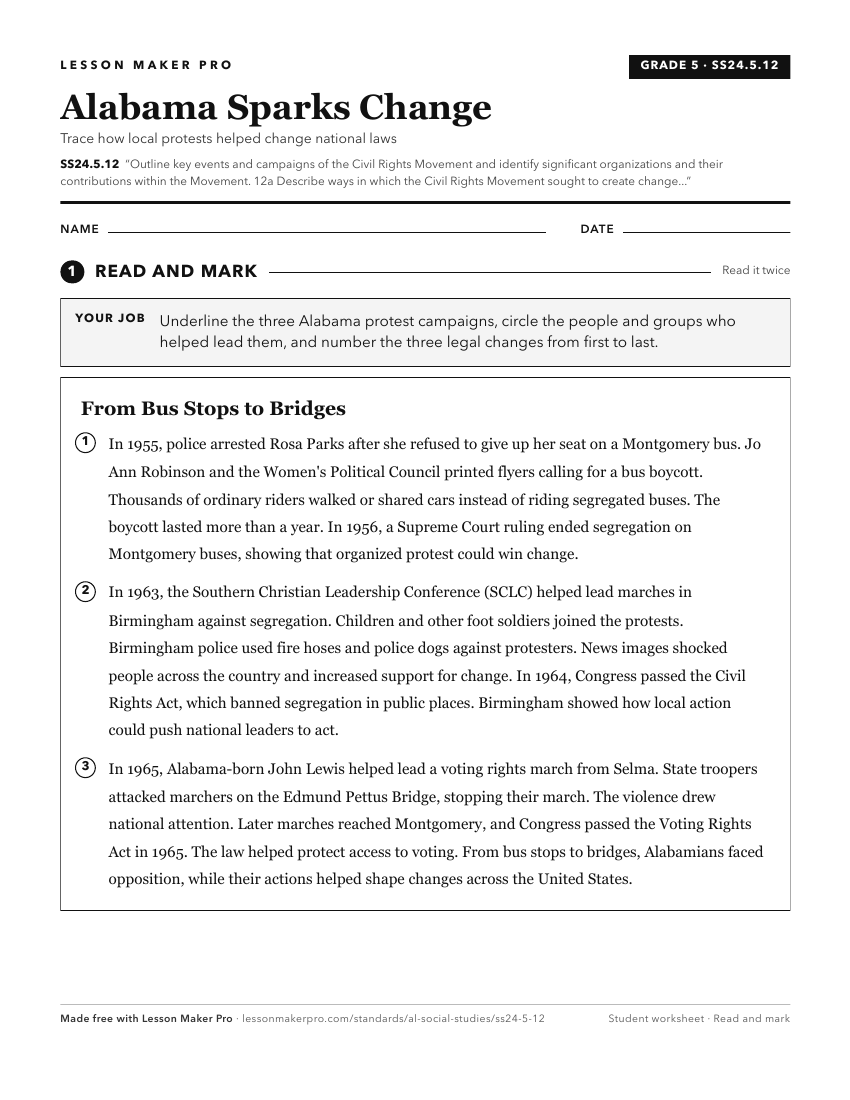
A ready-to-print activity worksheet aligned to SS24.5.12, with an answer key for the teacher on its own page. No account needed.
PDF, US Letter, prints cleanly in black and white.
Download the worksheetKeep exploring
Related Standards
- SS24.US2.10
Evaluate the influence of events, organizations, and individual actions on the expansion of the Civil Rights Movement nationally.
- SS24.US2.10b
Analyze the extent to which the actions and campaigns of civil rights activists and organizations from 1954 to 1965 prompted federal measures to advance civil a...
- SS24.US2.10a
Identify and explain key events from 1945 to 1955 that brought about the emergence of a large-scale movement for civil rights.
- SS24.US2.14a
Explain how the Civil Rights Movement inspired other movements for civil and human rights, and describe the contributions of groups and individuals to these mov...
Turn this cluster into a lesson
Grade, subject, topic, and the complete cluster are prefilled. Create one free, no account needed.
Also for this cluster:Make a WorksheetMake a QuizMake a Sub Lesson