Alabama Science PS.3.f
The Standard
- PS.3
- Construct an explanation of the ways in which modern science uses both magnetic and electric concepts to create usable products.
Analyze and interpret data concerning the advantages and disadvantages of the energy sources used to produce electricity.
2023 Alabama Course of Study: Science · Waves and Their Applications in Technologies for Information Transfer
Teacher's field guide
What This Standard Means
What Students Need to Do
- Read tables and graphs that compare sources of electricity. Use data on cost, emissions, and availability to explain the benefits and drawbacks of each source.
What Mastery Looks Like
- A student compares two sources using numbers and units from a table. They recommend a source for a stated need and explain a trade-off the numbers show.
Common Misconceptions
- Students may treat capacity factor as the percentage of time a source is running. They may choose the source with the lowest emissions without checking its cost or when it can supply power.
How to Assess It
- Exit ticket: Compare coal (10¢/kWh, 900 g CO₂e/kWh, available on demand) with wind (7¢/kWh, 12 g CO₂e/kWh, weather-dependent). Name one advantage and one drawback of each, using the data.
Lesson moves
Ways to Teach It
Give pairs printed coal, wind, and solar data cards showing cost, emissions, and availability; have them sort the cards by each measure.
Ask: Which source would you choose for a town trying to cut emissions without raising costs? Cite two figures and one trade-off.
Give teams source data cards, a cost limit, and an emissions cap; have them build a mix that meets both limits.
Show a local utility fuel-mix chart alongside an emissions chart; ask students what the utility gains and gives up with its current mix.
Free download
Printable PS.3.f Worksheet
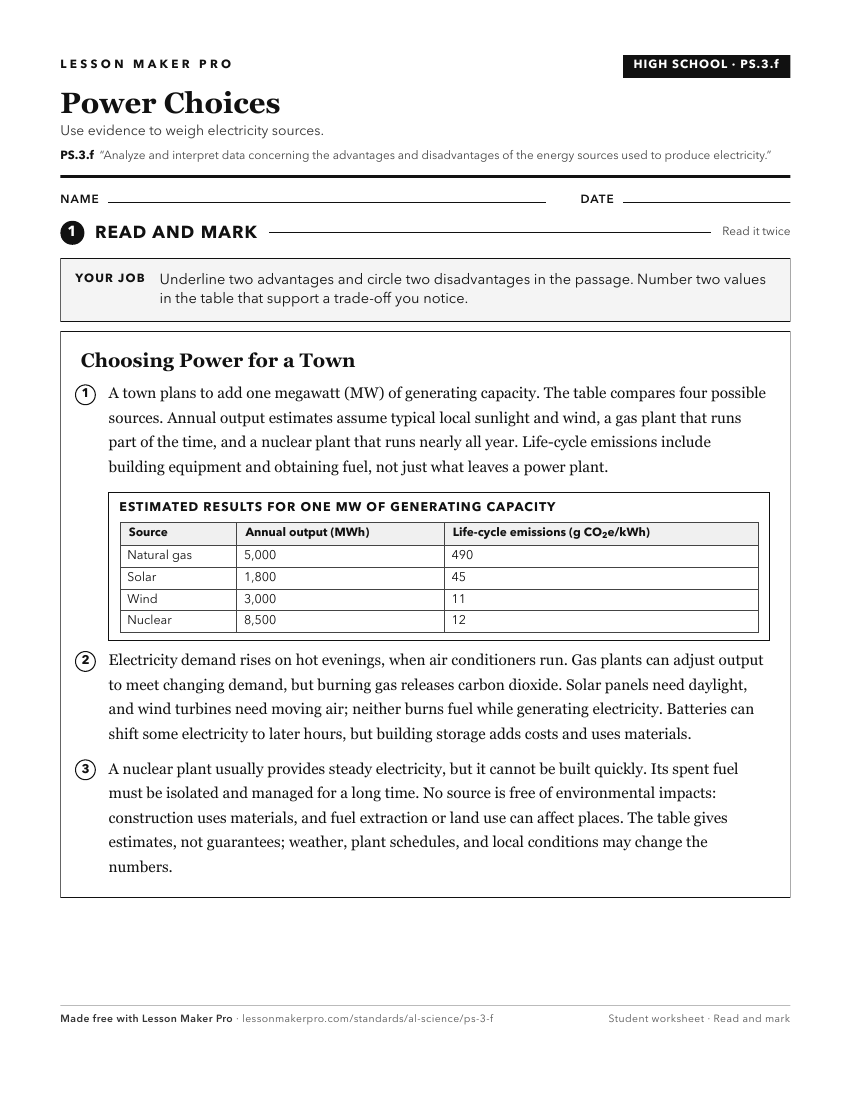
A ready-to-print activity worksheet aligned to PS.3.f, with an answer key for the teacher on its own page. No account needed.
PDF, US Letter, prints cleanly in black and white.
Download the worksheetKeep exploring
Related Standards
- ES.6.a
Analyze and interpret data on the origins and availability of renewable and nonrenewable forms of energy to predict consumption trends.
- ES.6
Obtain, evaluate, and communicate information to describe the use of renewable and nonrenewable energy sources.
- ES.6.b
Construct an argument based on data about the risks and benefits of using renewable and nonrenewable energy sources in Alabama.
- 4.14
Gather information to describe how the use of energy derived from renewable and nonrenewable resources affects the environment.
Turn this exact standard into a lesson
Grade, subject, topic, and the complete standard are prefilled. Create one free, no account needed.
Also for this standard:Make a WorksheetMake a QuizMake a Sub Lesson