Alabama Science ES.6
Standard Cluster
Obtain, evaluate, and communicate information to describe the use of renewable and nonrenewable energy sources. a. Analyze and interpret data on the origins and availability of renewable and nonrenewable forms of energy to predict consumption trends. b. Construct an argument based on data about the risks and benefits of using renewable and nonrenewable energy sources in Alabama.
2023 Alabama Course of Study: Science · Earth and Human Activity
Cluster contents
Standards in This Cluster
ES.6 is a cluster heading. These are the individual standards under it.
Teacher's field guide
What This Cluster Means
What Students Need to Do
- Students find reliable data about where energy sources come from and how available they are. They use Alabama consumption figures to predict changes in energy use. They make a case for an energy choice using data, benefits, and risks.
What Mastery Looks Like
- Students can explain why sunlight renews daily but coal and natural gas take millions of years to form. They use dated Alabama figures to predict which sources people may use more or less. They support a choice with numbers, one benefit, and one risk.
Common Misconceptions
- Students may call natural gas renewable because it forms naturally, or nuclear energy renewable because it produces little carbon dioxide. They may assume solar panels produce steady power at night. Some confuse electricity generated in Alabama with energy consumed there.
How to Assess It
- Show students EIA Alabama energy consumption data for 2015 and 2023. Ask: “Predict one change by 2030 using two figures. Where does that source come from, what limits its availability, and what are one benefit and one risk for Alabama?”
Lesson moves
Ways to Teach It
Use a small solar panel and multimeter under a lamp and in shade; record voltage and compare availability with a coal fact card.
Give pairs an EIA Alabama consumption chart; ask whether the state should use more solar or gas, citing a trend, a benefit, and a risk.
Deal coal, gas, solar, hydro, and nuclear cards; teams sort by energy origin and renewal rate, then defend one disputed card.
Give students a sample 100 kWh power bill and Alabama's electricity generation mix; calculate the approximate kWh represented by each source.
Free download
Printable ES.6 Worksheet
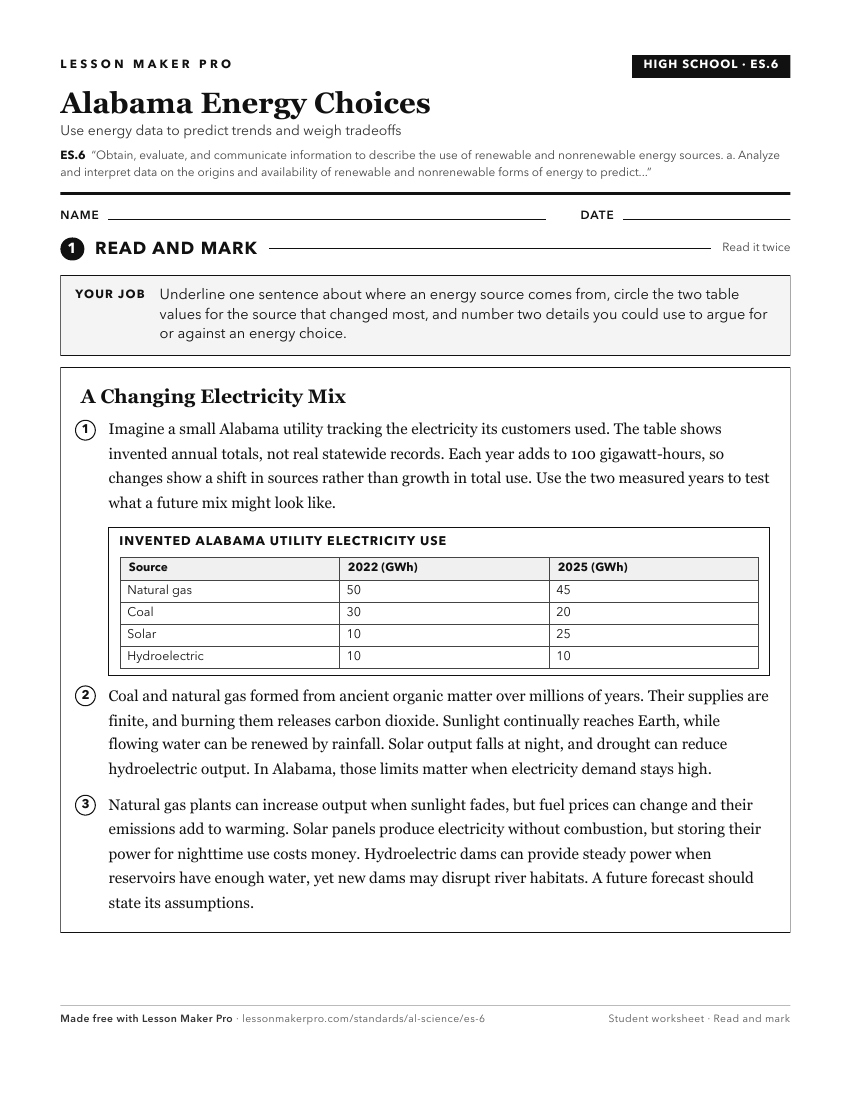
A ready-to-print activity worksheet aligned to ES.6, with an answer key for the teacher on its own page. No account needed.
PDF, US Letter, prints cleanly in black and white.
Download the worksheetKeep exploring
Related Standards
- 4.14
Gather information to describe how the use of energy derived from renewable and nonrenewable resources affects the environment.
- ES.7
Obtain, evaluate, and communicate information to describe the development, management, and recycling of mineral resources.
- PS.3.f
Analyze and interpret data concerning the advantages and disadvantages of the energy sources used to produce electricity.
Turn this cluster into a lesson
Grade, subject, topic, and the complete cluster are prefilled. Create one free, no account needed.
Also for this cluster:Make a WorksheetMake a QuizMake a Sub Lesson