Alabama Science 4.14
The Standard
Gather information to describe how the use of energy derived from renewable and nonrenewable resources affects the environment.
2023 Alabama Course of Study: Science · Earth and Human Activity
Teacher's field guide
What This Standard Means
What Students Need to Do
- Students use short texts or charts to find out where energy comes from. They describe how using each source can affect air, land, water, or living things.
What Mastery Looks Like
- A student can identify coal as nonrenewable and sunlight as renewable. They can use a fact from a source to explain an effect of each, such as air pollution from burning coal or land used for solar panels.
Common Misconceptions
- Students may think renewable energy has no environmental effects. They may also think all electricity is made the same way, regardless of its source.
How to Assess It
- Give students two fact cards: “Burning coal releases gases into the air” and “Solar panels make electricity without burning fuel but take up land.” Ask them to name one environmental effect of each and point to the fact they used.
Lesson moves
Ways to Teach It
Cover and uncover a solar calculator's panel; then read fact cards about solar panels and coal plants and label one environmental effect of each.
Ask, “A wind turbine needs no fuel, so can it affect wildlife?” Have students cite one fact from a short wind farm article.
Play a matching game: students pair coal, oil, wind, and solar cards with environmental effects, then check matches against a fact sheet.
Show your state's electricity generation chart; students choose one listed source and describe an environmental effect of using it.
Free download
Printable 4.14 Worksheet
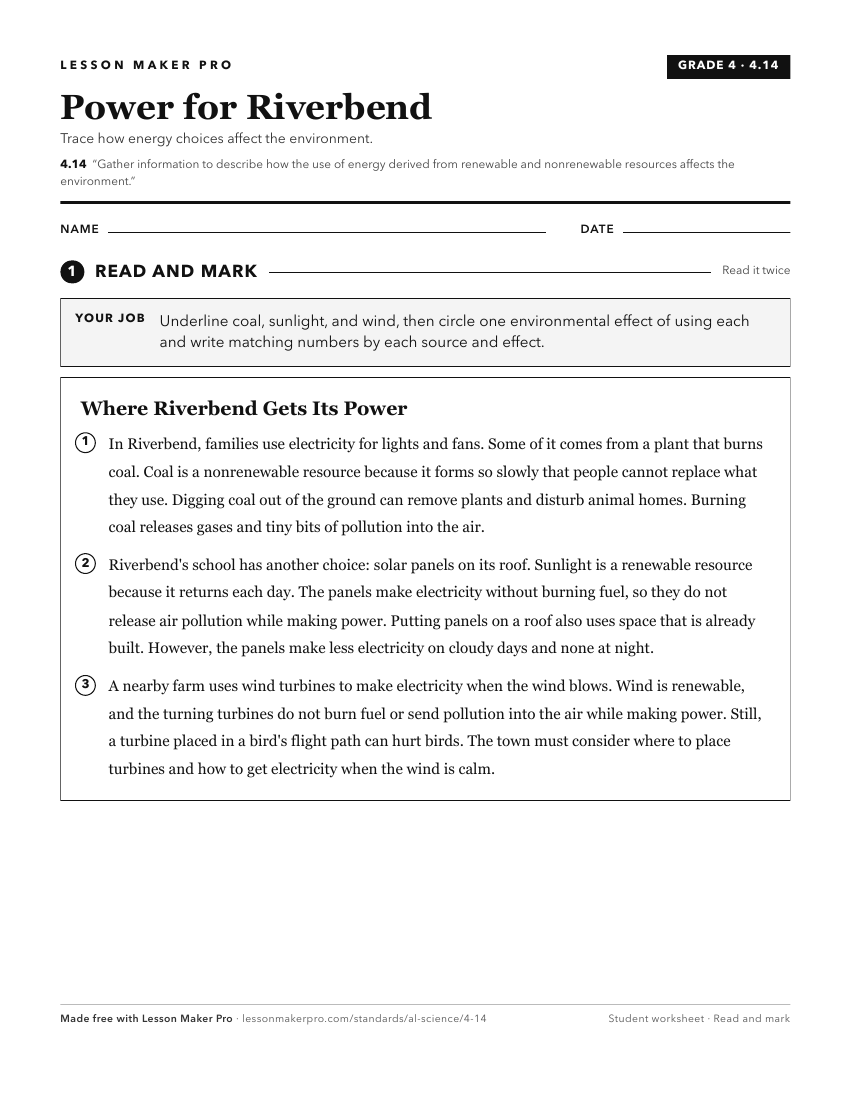
A ready-to-print activity worksheet aligned to 4.14, with an answer key for the teacher on its own page. No account needed.
PDF, US Letter, prints cleanly in black and white.
Download the worksheetKeep exploring
Related Standards
- ES.6
Obtain, evaluate, and communicate information to describe the use of renewable and nonrenewable energy sources.
- ES.6.a
Analyze and interpret data on the origins and availability of renewable and nonrenewable forms of energy to predict consumption trends.
- 5.14
Obtain and evaluate information to communicate how science-based solutions are being used to protect Earth’s natural resources and its environment.
- PS.3.f
Analyze and interpret data concerning the advantages and disadvantages of the energy sources used to produce electricity.
Turn this exact standard into a lesson
Grade, subject, topic, and the complete standard are prefilled. Create one free, no account needed.
Also for this standard:Make a WorksheetMake a QuizMake a Sub Lesson