Alabama Science PS.1
Standard Cluster
Evaluate sources of information concerning the law of conservation of energy to illustrate energy transformations in practical applications and natural systems. a. Plan and carry out investigations to explore how mechanical energy is transformed within a system, including kinetic energy, gravitational potential energy, elastic potential energy, and work. b. Collect, analyze, and use data to explain how thermal energy is transferred by conduction, convection, and radiation. c. Construct explanations to justify the selection of materials for specific applications based on the materials’ specific heat values. d. Investigate collisions and other real-world situations to evaluate the effects of impulse on changes in momentum.
2023 Alabama Course of Study: Science · Energy
Cluster contents
Standards in This Cluster
PS.1 is a cluster heading. These are the individual standards under it.
- PS.1.a
Plan and carry out investigations to explore how mechanical energy is transformed within a system, including kinetic energy, gravitational potential energy, ela...
- PS.1.b
Collect, analyze, and use data to explain how thermal energy is transferred by conduction, convection, and radiation.
- PS.1.c
Construct explanations to justify the selection of materials for specific applications based on the materials’ specific heat values.
- PS.1.d
Investigate collisions and other real-world situations to evaluate the effects of impulse on changes in momentum.
Teacher's field guide
What This Cluster Means
What Students Need to Do
- Students check whether sources back energy claims with measurements. They test how motion, height, springs, and work transfer energy. They use temperature and specific heat data to explain heating and choose materials, then use collision data to link force and contact time to momentum change.
What Mastery Looks Like
- Students use ramp and spring measurements to track energy as it changes form, including energy transferred to heat. They identify conduction, convection, and radiation from temperature data and defend a material choice using specific heat values. They explain how force and contact time affect momentum change and check whether evidence supports an energy claim.
Common Misconceptions
- Students may say a stopped ball has lost its energy instead of tracing energy to heat and sound. They may call moving warm air conduction or think a higher specific heat means faster warming. They may think a longer collision always means a greater change in momentum.
How to Assess It
- Exit ticket: A ball hits two pads at the same speed. Pad A stops it in 0.01 seconds, and pad B stops it in 0.05 seconds. Ask which pad exerts less average force and where the ball's kinetic energy goes.
Lesson moves
Ways to Teach It
Drop a tennis ball onto tile and a folded towel, film both impacts, and compare contact time and rebound height.
Show a perpetual motion video and ask students where friction sends energy and what measurements would make the claim trustworthy.
Sort cards showing a spoon in hot soup, circulating soup, and sunlight warming pavement into conduction, convection, and radiation.
Compare water and sand specific heat values, then choose a material for a reusable heat pack and defend the choice with numbers.
Free download
Printable PS.1 Worksheet
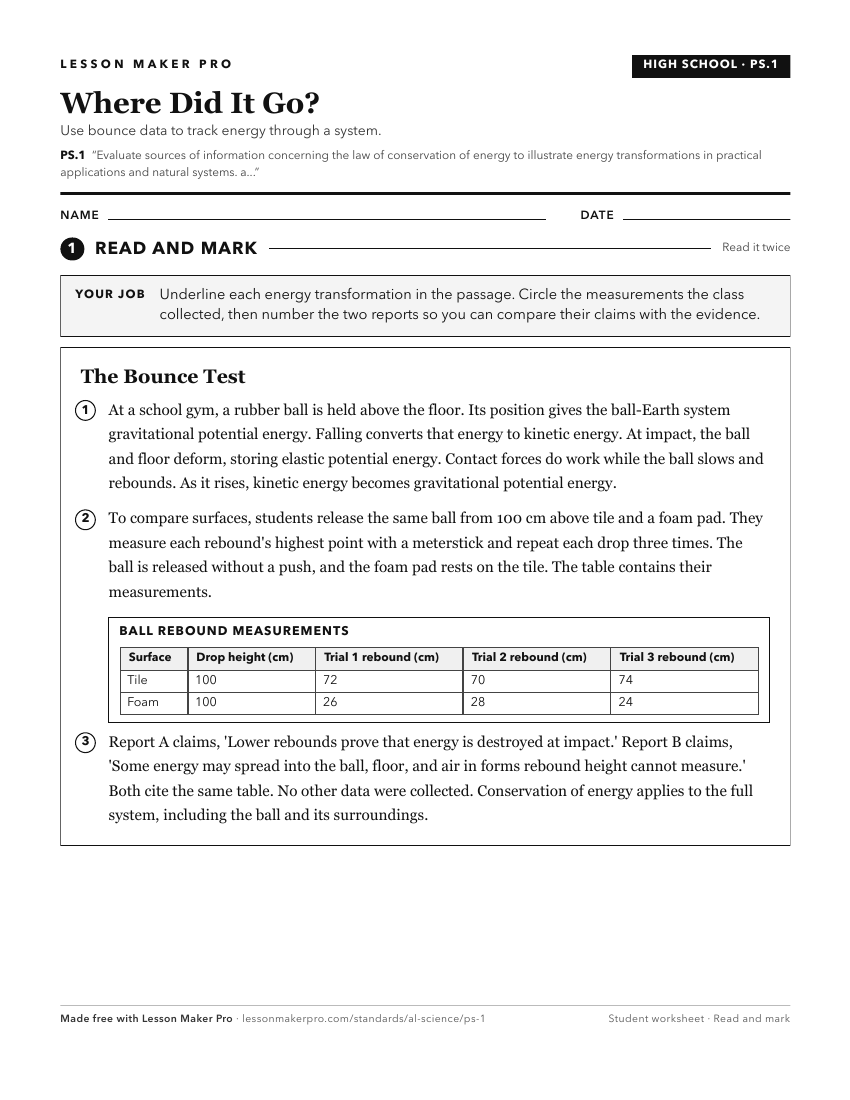
A ready-to-print activity worksheet aligned to PS.1, with an answer key for the teacher on its own page. No account needed.
PDF, US Letter, prints cleanly in black and white.
Download the worksheetKeep exploring
Related Standards
- 8.15
Use models to construct an explanation of how energy is transformed but still conserved.
- ES.1
Use mathematical representations to illustrate how the first two laws of thermodynamics demonstrate energy transfers throughout ecosystems, including food chain...
- P.3.b
Create mathematical and graphical representations to depict the transformation of energy from one form to another, including kinetic energy, gravitational poten...
- ES.6
Obtain, evaluate, and communicate information to describe the use of renewable and nonrenewable energy sources.
Turn this cluster into a lesson
Grade, subject, topic, and the complete cluster are prefilled. Create one free, no account needed.
Also for this cluster:Make a WorksheetMake a QuizMake a Sub Lesson