Alabama Science ES.1
The Standard
Use mathematical representations to illustrate how the first two laws of thermodynamics demonstrate energy transfers throughout ecosystems, including food chains, food webs, and trophic levels, at various levels of biological organization.
2023 Alabama Course of Study: Science · Ecosystems: Interactions, Energy, and Dynamics
Teacher's field guide
What This Standard Means
What Students Need to Do
- Students use numbers on a food chain or web to calculate energy transfers between trophic levels. They track energy through organisms and populations, including energy that becomes heat, waste, or uneaten biomass. They show that energy is conserved, even though less usable energy reaches each level.
What Mastery Looks Like
- Given 10,000 J stored in a producer population and a 10% transfer rate, students calculate 1,000 J for herbivores and 100 J for predators. They split energy across food web branches without counting it twice. They account for energy left in biomass, waste, and dispersed heat.
Common Misconceptions
- Students may say energy disappears when it leaves a food chain. They may assume every transfer is exactly 10%, even when given different data. In a food web, they may count the same producer energy twice.
How to Assess It
- Exit ticket: A producer population stores 2,000 J, herbivores get 200 J, and predators get 20 J. Draw the chain, calculate the energy not passed on at each step, and explain where it goes.
Lesson moves
Ways to Teach It
Give pairs 100 beans for producer energy. Move 10 to herbivores and one to predators, then sort the rest into heat, waste, or biomass.
Ask, 'If energy is conserved, why does a hawk get less usable energy than the mice it eats?' Require a numbered example.
Hand out a food web with 500 J available to herbivores. Students divide it between rabbits and grasshoppers without counting it twice.
Trace chicken feed to chicken to student. Sketch energy arrows and mark heat released at each step.
Free download
Printable ES.1 Worksheet
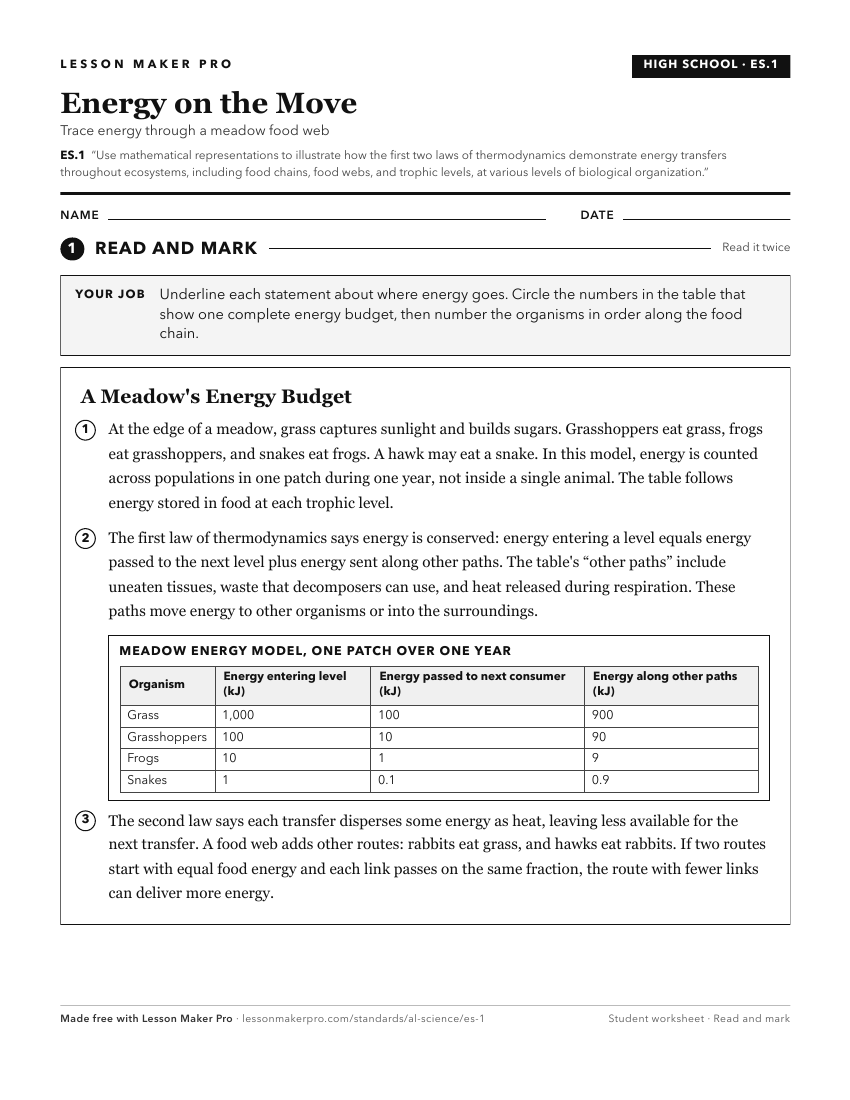
A ready-to-print activity worksheet aligned to ES.1, with an answer key for the teacher on its own page. No account needed.
PDF, US Letter, prints cleanly in black and white.
Download the worksheetKeep exploring
Related Standards
- BIO.7
Develop and use models to illustrate the flow of matter and energy between abiotic and biotic factors in ecosystems, including loss of heat, 10% rule, and the c...
- PS.1
Evaluate sources of information concerning the law of conservation of energy to illustrate energy transformations in practical applications and natural systems.
- P.3.b
Create mathematical and graphical representations to depict the transformation of energy from one form to another, including kinetic energy, gravitational poten...
- 5.9
Create and use a model to explain the transfer of matter and energy between the environment and organisms within it.
Turn this exact standard into a lesson
Grade, subject, topic, and the complete standard are prefilled. Create one free, no account needed.
Also for this standard:Make a WorksheetMake a QuizMake a Sub Lesson