Alabama Science PS.1.d
The Standard
- PS.1
- Evaluate sources of information concerning the law of conservation of energy to illustrate energy transformations in practical applications and natural systems.
Investigate collisions and other real-world situations to evaluate the effects of impulse on changes in momentum.
2023 Alabama Course of Study: Science · Energy
Teacher's field guide
What This Standard Means
What Students Need to Do
- Students measure mass, speed before and after a collision, and contact time. They calculate the change in momentum and impulse. They use contact time to compare average forces.
What Mastery Looks Like
- A student calculates impulse from the change in momentum and gets the direction right. They can explain why padding lowers average force when it brings the same moving object to a stop over more time.
Common Misconceptions
- Students may think padding reduces the impulse needed to stop an object, rather than spreading that impulse over more time. They may also treat a ball that bounces back as if it simply stopped.
How to Assess It
- Exit ticket: A 0.20 kg ball moving at 10 m/s stops in 0.02 s or 0.10 s. Find the impulse and average force for each stop. Which stop has less average force?
Lesson moves
Ways to Teach It
Roll a toy car into a foam block and then a book; film both collisions in slow motion and compare contact times and rebounds.
Ask students to write: Why does an airbag reduce injury if a passenger still comes to a stop?
Give pairs cards with mass, starting velocity, ending velocity, and contact time; have them calculate impulse and average force.
Show a helmet liner and hard shell; have students sketch how the liner changes stopping time and average force in a crash.
Free download
Printable PS.1.d Worksheet
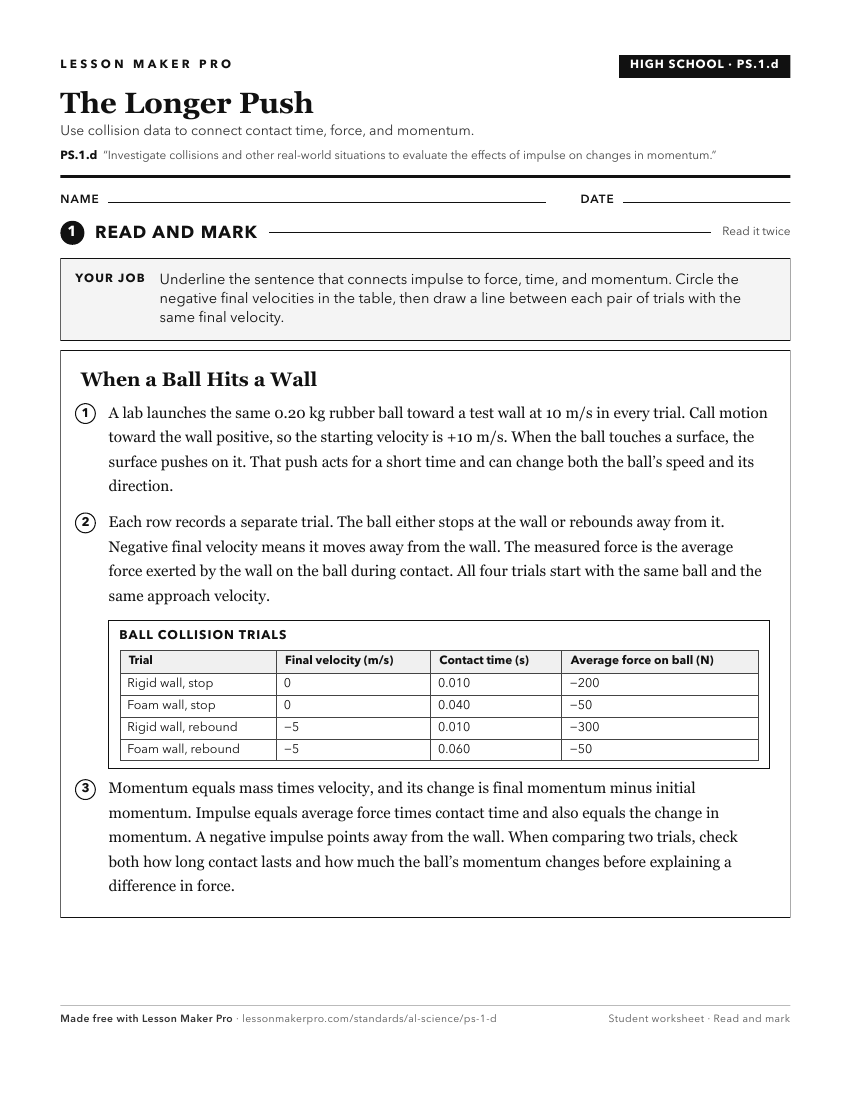
A ready-to-print activity worksheet aligned to PS.1.d, with an answer key for the teacher on its own page. No account needed.
PDF, US Letter, prints cleanly in black and white.
Download the worksheetKeep exploring
Related Standards
- P.3.e
Obtain, evaluate, and interpret data related to collisions (both elastic and inelastic) and their effects on both linear momentum and energy conservation.
- P.3.d
Qualitatively and quantitatively evaluate the relationship among the force acting on an object, the time of interaction, and the change in linear momentum (impu...
- 4.2
Plan and carry out investigations to answer questions regarding changes in energy when objects collide, and predict reasonable outcomes based on observed patter...
- K.1
Plan and carry out investigations to determine the effects of forces of different strengths and directions on the motion of an object, including speed, directio...
Turn this exact standard into a lesson
Grade, subject, topic, and the complete standard are prefilled. Create one free, no account needed.
Also for this standard:Make a WorksheetMake a QuizMake a Sub Lesson